. 2011 Jun 21;40(23):6168-95.
doi: 10.1039/c0dt01595d. Epub 2011 Mar 25.

A practical guide to the construction of radiometallated bioconjugates for positron emission tomography

Affiliations

A practical guide to the construction of radiometallated bioconjugates for positron emission tomography

Brian M Zeglis et al. Dalton Trans. .

Abstract

Positron emission tomography (PET) has become a vital imaging modality in the diagnosis and treatment of disease, most notably cancer. A wide array of small molecule PET radiotracers have been developed that employ the short half-life radionuclides (11)C, (13)N, (15)O, and (18)F. However, PET radiopharmaceuticals based on biomolecular targeting vectors have been the subject of dramatically increased research in both the laboratory and the clinic. Typically based on antibodies, oligopeptides, or oligonucleotides, these tracers have longer biological half-lives than their small molecule counterparts and thus require labeling with radionuclides with longer, complementary radioactive half-lives, such as the metallic isotopes (64)Cu, (68)Ga, (86)Y, and (89)Zr. Each bioconjugate radiopharmaceutical has four component parts: biomolecular vector, radiometal, chelator, and covalent link between chelator and biomolecule. With the exception of the radiometal, a tremendous variety of choices exists for each of these pieces, and a plethora of different chelation, conjugation, and radiometallation strategies have been utilized to create agents ranging from (68)Ga-labeled pentapeptides to (89)Zr-labeled monoclonal antibodies. Herein, the authors present a practical guide to the construction of radiometal-based PET bioconjugates, in which the design choices and synthetic details of a wide range of biomolecular tracers from the literature are collected in a single reference. In assembling this information, the authors hope both to illuminate the diverse methods employed in the synthesis of these agents and also to create a useful reference for molecular imaging researchers both experienced and new to the field.


Figures

Fig. 1
Fig. 1
The anatomy of a PET bioconjugate.
Fig. 2
Fig. 2
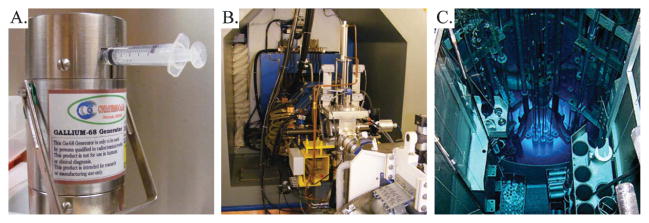
Three methods for the production of radionuclides: (A) 68Ga generator, (B) cyclotron, and (C) nuclear reactor. The authors acknowledge David Nickolaus of the Missouri University Research Reactor for the photo of the nuclear reactor.
Fig. 3
Fig. 3
Selected chelators and bifunctional chelators for 64Cu, 68Ga, 86Y, and 89Zr.
Fig. 4
Fig. 4
Selected chelators and bifunctional chelators for 64Cu, 68Ga, 86Y, and 89Zr.
Fig. 5
Fig. 5
The three principal types of bioconjugation reactions: (A) peptide bond formation via reaction of a primary amine with a carboxylic acid activated with a succinimidyl ester (NHS), a sulfosuccinimidyl ester (SNHS), tetrafluorophenol (TFP), or a peptide coupling reagent (e.g. HATU, HOBT, etc.); (B) thioether bond formation via reaction of a thiol and a maleimide; and (C) thiourea bond formation via reaction of an isothiocyanate and a primary amine.
Fig. 6
Fig. 6
A 78-year-old woman with neuroendocrine tumor of unknown primary origin: (A) 68Ga-DOTATOC PET depicts diffuse bone metastases, (B) CT shows only part of widespread bone involvement, and (C) the structure of 68Ga-DOTATOC. Reprinted by permission of the Society of Nuclear Medicine from: D. Putzer, M. Gabriel, B. Henninger, D. Kendler, C. Uprimny, G. Dobrozemsky, C. Decristoforo, R. J. Bale, W. Jaschke and I. J. Virgolini, Journal of Nuclear Medicine, 2009, 50, 1214–1221. Fig. 2.
Fig. 7
Fig. 7
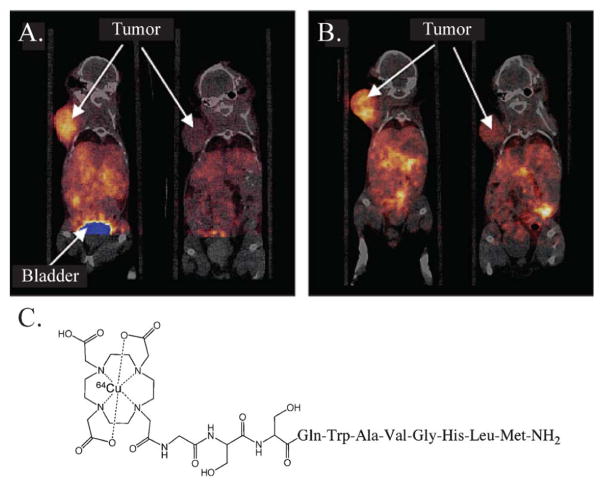
Coronal microPET images with co-registered CT of mice bearing PC-3 xenografts in the axillary thorax at (A) 1 h and (B) 24 h. The mice were injected i.v. with a GRPR-targeting 64Cu-bombesin analogue, 64Cu-DOTA-GSS-BN(7–14). The mice on the left (A) were not injected with blocking agent, while the mice on the right (B) received 100 μg of Tyr4-BN as an inhibitor. Adapted with permission from J. J. Parry, T. S. Kelly, R. Andrews and B. E. Rogers, Bioconjugate Chemistry, 2007, 18, 1110–1117. Copyright 2007 American Chemical Society.
Fig. 8
Fig. 8
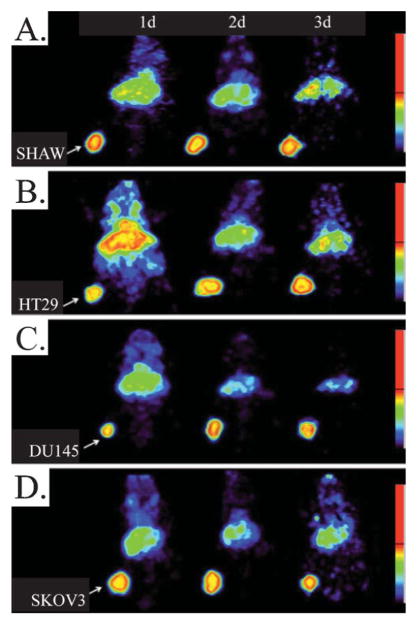
Representative reconstructed and processed maximum intensity projections of female athymic (NCr) nu/nu mice bearing (A) SHAW, (B) HT29, (C) DU145, and (D) SKOV3 tumor xenografts injected i.v. with 3.8–4.0 MBq of 86Y-CHX-A″-DTPA-cetuximab. Arrows indicate tumors. The scaling is based on % maximum and minimum threshold intensity without normalization to absolute value. With kind permission from Springer Science + Business Media: T. K. Nayak, C. A. S. Regino, K. J. Wong, D. E. Milenic, K. Garmestani, K. E. Baidoo, L. P. Szajek and M. W. Brechbiel, European Journal of Nuclear Medicine and Molecular Imaging, 37, 1368–1376. Fig. 3.
Fig. 9
Fig. 9
Temporal immunoPET images of 89Zr-DFO-J591 recorded in (A) LNCaP tumor–bearing (PSMA-positive) and (B) PC-3 tumor–bearing (PSMA-negative) mice between 3 and 144 h after injection. Transverse and coronal planar images intersect the center of the tumors and the mean tumor-to-muscle ratios derived from volume-of-interest analysis of immunoPET images are given. Upper thresholds of immunoPET have been adjusted for visual clarity, as indicated by scale bars. Reprinted by permission of the Society of Nuclear Medicine from: J. P. Holland, V. Divilov, N. H. Bander, P. M. Smith-Jones, S. M. Larson and J. S. Lewis, Journal of Nuclear Medicine, 2010, 51, 1293–1300. Fig. 4.

References

    1. Rudin M, Weissleder R. Nat Rev Drug Discovery. 2003;2:123–131. - PubMed
    1. Gillies RJ. J Cell Biochem. 2002;87(S39):231–238. - PubMed
    1. Smith SV. J Inorg Biochem. 2004;98:1874–1901. - PubMed
    1. Blower P. Dalton Trans. 2006:1705–1711. - PubMed
    1. Mettler JFA, Guiberteau MJ. Essentials of Nuclear Medicine Image. 5. 2007.

Publication types