Aerobic fitness and response variability in preadolescent children performing a cognitive control task
- PMID: 21443340
- PMCID: PMC3086950
- DOI: 10.1037/a0022167
Aerobic fitness and response variability in preadolescent children performing a cognitive control task
Abstract
Objective: To investigate the relationship between aerobic fitness and cognitive variability in preadolescent children.
Method: Forty-eight preadolescent children (25 males, 23 females, mean age = 10.1 years) were grouped into higher- and lower-fit groups according to their performance on a test of aerobic capacity (VO2max). Cognitive function was measured via behavioral responses to a modified flanker task. The distribution in reaction time was calculated within each participant to assess intraindividual variability of performance. Specifically, the standard deviation and coefficient variation of reaction time were used to represent cognitive variability.
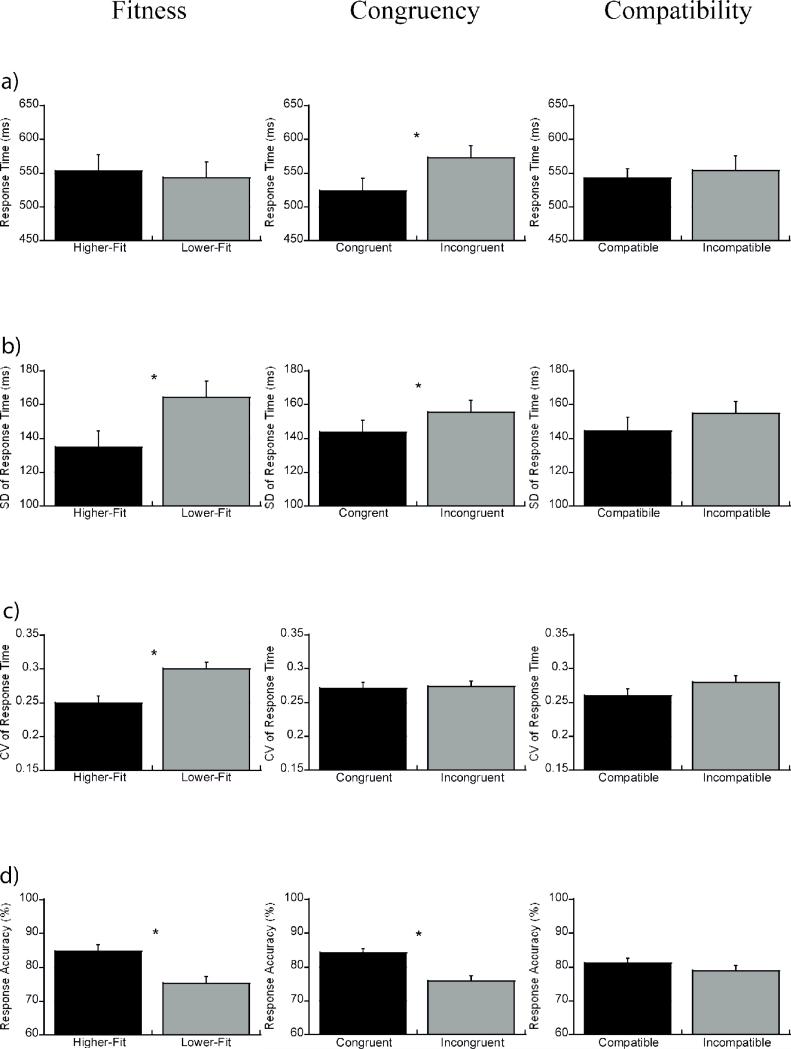
Results: Preadolescent children, regardless of fitness, exhibited longer reaction time, increased response variability, and decreased response accuracy to incongruent compared to congruent trials. Further, higher-fit children were less variable in their response time and more accurate in their responses across conditions of the flanker task, while no group differences were observed for response speed.
Conclusion: These findings suggest that fitness is associated with better cognitive performance during a task that varies cognitive control demands, and extends this area of research to suggest that intraindividual variability may be a useful measure to examine the relationship between fitness and cognition during preadolescence.
Figures
References
-
- Adleman NE, Menon V, Blasey CM, White CD, Warsofsky IS, Glover GH, et al. A Developmental fMRI Study of the Stroop Color-Word Task. NeuroImage. 2002;16:61–75. - PubMed
-
- Aguiar AS, Speck AE, Prediger RD, Kapczinski F, Pinho RA. Downhill training upregulates mice hippocampal and striatal brain-derived neurotrophic factor levels. Journal of Neural Transmission. 2008;115:1251–1255. - PubMed
-
- American College of Sports Medicine . ACSM's guidelines for exercise testing and prescription. 7th ed. Lippincott Williams & Wilkins; New York: 2006.
-
- Andersen LB, Harro M, Sardinha LB, Froberg K, Ekelund U, Brage S, Anderssen SA. Physical activity and clustered cardiovascular risk in children: a cross-sectional study (The European Youth Heart Study). Lancet. 2006;368:299–304. - PubMed
-
- Bar-Or O. Pediatric sports medicine for the practitioner: From physiologic principles to clinical applications. Springer-Verlag; New York: 1983.