


Intakes of vitamins and minerals in relation to urinary incontinence, voiding, and storage symptoms in women: a cross-sectional analysis from the Boston Area Community Health survey
- PMID: 21444148
- PMCID: PMC3085565
- DOI: 10.1016/j.eururo.2011.03.008
Intakes of vitamins and minerals in relation to urinary incontinence, voiding, and storage symptoms in women: a cross-sectional analysis from the Boston Area Community Health survey
Abstract
Background: Whether lower urinary tract symptoms (LUTS), including voiding, storage, and urinary incontinence, are affected by dietary micronutrients is uncertain.
Objective: To test the hypothesis that carotenoid, vitamin C, zinc, and calcium intakes are associated with LUTS and urinary incontinence in women.
Design, setting, and participants: During an observational, cross-sectional, population-based epidemiologic study of 2060 women (30-79 yr of age) in the Boston Area Community Health (BACH) survey (2002-2005), data were collected by validated food frequency questionnaire and in-person interviews and analyzed using multivariate regression.
Measurements: LUTS, storage, and voiding symptoms were assessed using the American Urological Association Symptom Index (AUASI) and a validated severity index for urinary incontinence.
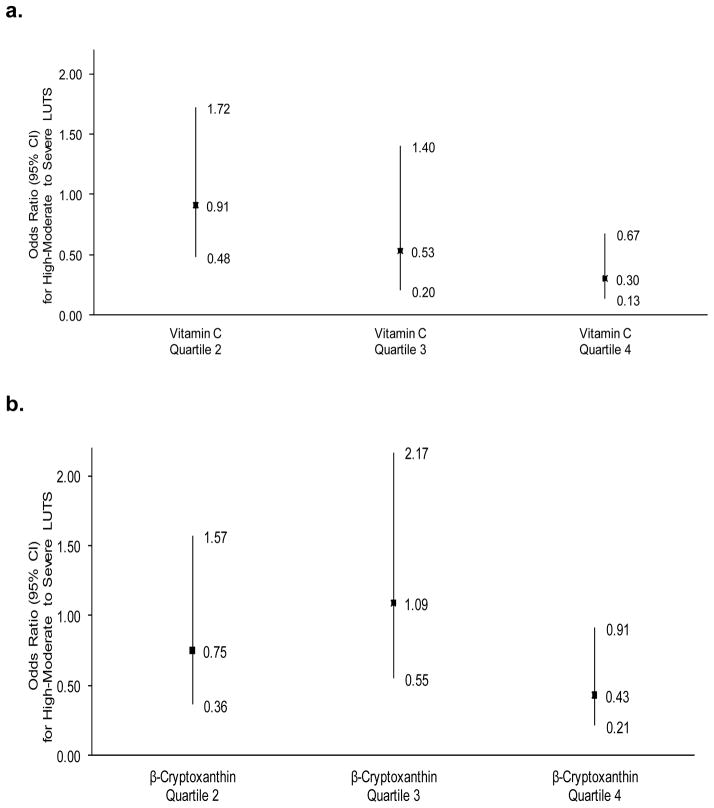
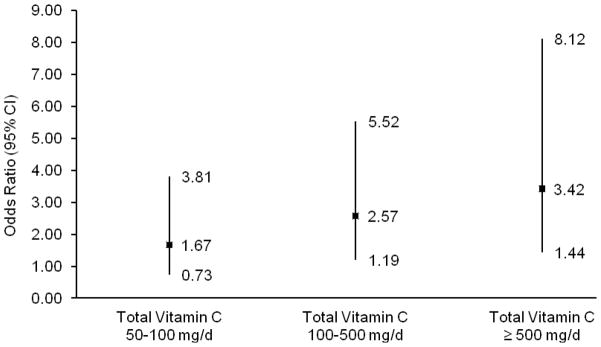
Results and limitations: Women who consumed high-dose vitamin C from diet and supplements were more likely to report storage symptoms, especially combined frequency and urgency (≥ 500 vs < 50mg/d; odds ratio [OR]: 3.42; 95% confidence interval [CI], 1.44-8.12). However, greater consumption of dietary vitamin C or β-cryptoxanthin was inversely associated with voiding symptoms (p(trend) ≤ 0.01). Both dietary and supplemental calcium were positively associated with storage symptoms (eg, supplement ≥ 1000 mg/d vs none; OR: 2.04; 95% CI, 1.35-3.09; p(trend)=0.0002). No consistent associations were observed for β-carotene, lycopene, or other carotenoids, although smokers using β-carotene supplements were more likely to report storage problems. Whether the observed associations represent direct causes of diet on LUTS is uncertain.
Conclusions: High-dose intakes of vitamin C and calcium were positively associated with urinary storage or incontinence, whereas vitamin C and β-cryptoxanthin from foods and beverages were inversely associated with voiding symptoms. Results indicate that micronutrient intakes may contribute to LUTS in dose-dependent and symptom-specific ways. Further study is needed to confirm these findings and their relevance to clinical treatment decisions.
Copyright © 2011 European Association of Urology. Published by Elsevier B.V. All rights reserved.
Figures
References
-
- Kupelian V, Wei JT, O’Leary MP, et al. Prevalence of lower urinary tract symptoms and effect on quality of life in a racially and ethnically diverse random sample: the Boston Area Community Health (BACH) survey. Arch Intern Med. 2006;166:2381–7. - PubMed
-
- Tennstedt SL, Link CL, Steers WD, McKinlay JB. Prevalence of and risk factors for urine leakage in a racially and ethnically diverse population of adults: the Boston Area Community Health (BACH) survey. Am J Epidemiol. 2008;167:390–9. - PubMed
-
- Wennberg AL, Molander U, Fall M, Edlund C, Peeker R, Milsom I. Lower urinary tract symptoms: lack of change in prevalence and help-seeking behaviour in two population-based surveys of women in 1991 and 2007. BJU Int. 2009;104:954–9. - PubMed
-
- Hubeaux K, Deffieux X, Ismael SS, Raibaut P, Amarenco G. Autonomic nervous system activity during bladder filling assessed by heart rate variability analysis in women with idiopathic overactive bladder syndrome or stress urinary incontinence. J Urol. 2007;178:2483–7. - PubMed
Publication types
MeSH terms
Substances
Grants and funding
LinkOut - more resources
Full Text Sources
Other Literature Sources
Medical
Miscellaneous
