


Pathophysiology of medication overuse headache: insights and hypotheses from preclinical studies
- PMID: 21444643
- PMCID: PMC5697138
- DOI: 10.1177/0333102411402367
Pathophysiology of medication overuse headache: insights and hypotheses from preclinical studies
Abstract
Introduction: Medication overuse headache (MOH) is a clinical concern in the management of migraine headache. MOH arises from the frequent use of medications used for the treatment of a primary headache. Medications that can cause MOH include opioid analgesics as well as formulations designed for the treatment of migraine, such as triptans, ergot alkaloids, or drug combinations that include caffeine and barbiturates.
Literature review: Gathering evidence indicates that migraine patients are more susceptible to development of MOH, and that prolonged use of these medications increases the prognosis for development of chronic migraine, leading to the suggestion that similar underlying mechanisms may drive both migraine headache and MOH. In this review, we examine the link between several mechanisms that have been linked to migraine headache and a potential role in MOH. For example, cortical spreading depression (CSD), associated with migraine development, is increased in frequency with prolonged use of topiramate or paracetamol.
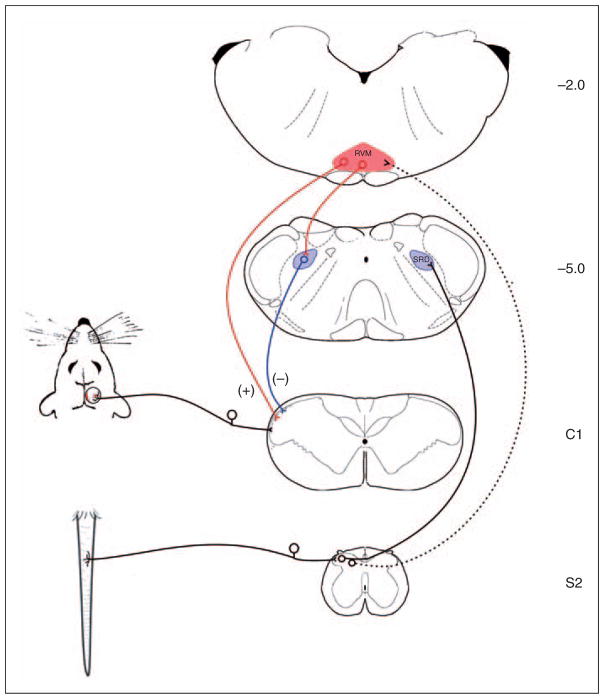
Conclusions: Increased CGRP levels in the blood have been linked to migraine and elevated CGRP can be casued by prolonged sumatriptan exposure. Possible mechanisms that may be common to both migraine and MOH include increased endogenous facilitation of pain and/or diminished diminished endogenous pain inhibition. Neuroanatomical pathways mediating these effects are examined.
Figures
References
-
- Headache Classification Subcommittee of the International Headache Society. The International Classification of Headache Disorders. 2nd ed. Cephalalgia. 2004;24(Suppl 1):1–160. - PubMed
-
- Colas R, Munoz P, Temprano R, et al. Chronic daily headache with analgesic overuse: epidemiology and impact on quality of life. Neurology. 2004;62:1338–1342. - PubMed
-
- Dyb G, Holmen TL, Zwart JA. Analgesic overuse among adolescents with headache: the Head-HUNT-Youth Study. Neurology. 2006;66:198–201. - PubMed
-
- Zwart JA, Dyb G, Hagen K, et al. Analgesic overuse among subjects with headache, neck, and low-back pain. Neurology. 2004;62:1540–1544. - PubMed
-
- Castillo J, Munoz P, Guitera V, et al. Kaplan Award 1998. Epidemiology of chronic daily headache in the general population. Headache. 1999;39:190–196. - PubMed
Publication types
MeSH terms
Substances
Grants and funding
LinkOut - more resources
Full Text Sources
Medical
Research Materials
