. 2011 Mar 21;6(3):e17989.
doi: 10.1371/journal.pone.0017989.

Complete sequencing of pNDM-HK encoding NDM-1 carbapenemase from a multidrug-resistant Escherichia coli strain isolated in Hong Kong

Affiliations

Complete sequencing of pNDM-HK encoding NDM-1 carbapenemase from a multidrug-resistant Escherichia coli strain isolated in Hong Kong

Pak Leung Ho et al. PLoS One. .

Abstract

Background: The emergence of plasmid-mediated carbapenemases, such as NDM-1 in Enterobacteriaceae is a major public health issue. Since they mediate resistance to virtually all β-lactam antibiotics and there is often co-resistance to other antibiotic classes, the therapeutic options for infections caused by these organisms are very limited.

Methodology: We characterized the first NDM-1 producing E. coli isolate recovered in Hong Kong. The plasmid encoding the metallo-β-lactamase gene was sequenced.

Principal findings: The plasmid, pNDM-HK readily transferred to E. coli J53 at high frequencies. It belongs to the broad host range IncL/M incompatibility group and is 88803 bp in size. Sequence alignment showed that pNDM-HK has a 55 kb backbone which shared 97% homology with pEL60 originating from the plant pathogen, Erwina amylovora in Lebanon and a 28.9 kb variable region. The plasmid backbone includes the mucAB genes mediating ultraviolet light resistance. The 28.9 kb region has a composite transposon-like structure which includes intact or truncated genes associated with resistance to β-lactams (bla(TEM-1), bla(NDM-1), Δbla(DHA-1)), aminoglycosides (aacC2, armA), sulphonamides (sul1) and macrolides (mel, mph2). It also harbors the following mobile elements: IS26, ISCR1, tnpU, tnpAcp2, tnpD, ΔtnpATn1 and insL. Certain blocks within the 28.9 kb variable region had homology with the corresponding sequences in the widely disseminated plasmids, pCTX-M3, pMUR050 and pKP048 originating from bacteria in Poland in 1996, in Spain in 2002 and in China in 2006, respectively.

Significance: The genetic support of NDM-1 gene suggests that it has evolved through complex pathways. The association with broad host range plasmid and multiple mobile genetic elements explain its observed horizontal mobility in multiple bacterial taxa.


Conflict of interest statement

Competing Interests: The authors have declared that no competing interests exist.

Figures

Figure 1
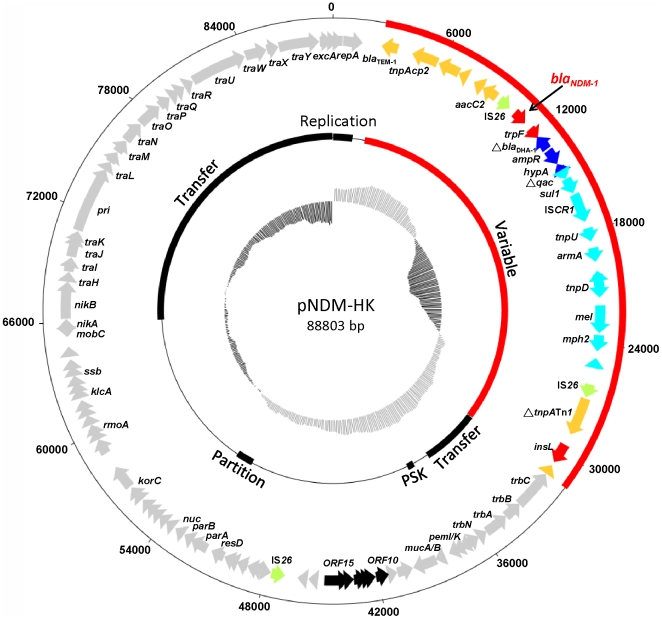
Figure 1. An overview of the bla NDM-1 encoding plasmid, pNDM-HK.
Starting from the outside, the first circle indicates the coordinate of the complete plasmid circle and the 28.9 kb variable region is showed in red. The open reading frames (ORFs) were annotated in the second circle with arrows representing the direction of transcription. Coding sequences with and without pEL60 homologs are indicated in grey and black, respectively. All IS26 elements are indicated in green. The variable resistant region is coded by the same color scheme as in figure 2. The third circle indicates the functional sequence blocks. The G+C plot is indicated in the inner circle (mean 51.5%), ranging from high (grey) to low (black).
Figure 2
Figure 2. Schematic representation of the DNA sequences surrounding the bla NDM-1 genes in E. coli 271 NDM-1 encoding plasmid, pNDM-HK, pkpANDM-1 and comparison with the sequences in pCTX-M-3 and pKP048.
(A) Comparison of the regions surrounding bla NDM-1 in the E. coli 271 plasmid encoding this gene, pNDM-HK, and pkpANDM-1. The 2.1 kb DNA sequence between the left inverted repeat (IRL) or right inverted repeat (IRR) and the end of phosphoribosyl anthranilate isomerase (trpF) in pkpNDM-1 and pNDM-HK were identical except for a 24 bp deletion. The sequence to the left of trpF up to the −35 promoter in pNDM-1HK is 100% identical to the corresponding region in the NDM-1 encoding plasmid in E. coli 271. The putative −35 and −10 promoter regions were indicated above and underlined. In both plasmids, this region is flanked by IS26 and a truncated β-lactamase (bla DHA-1) gene. (B) Comparison of pNDM-HK, pCTX-M-3 and pKP048. The regions franked by IS26 (green color) and the surrounding sequences are represented. The gaps in the alignment are shown in dotted lines. Arrows showed the direction of transcription. The same color and label are used to represent homologous genes. The lengths of the arrows are drawn in proportion to the length of the genes or open reading frames (ORFs). The homologous genes found in all three plasmids are indicated in light blue; those genes found in pNDM-HK and pCTX-M3 are in yellow; and those found in pNDM-HK and pKP048 are in blue. The genes unique to the three plasmids are labeled in red, black, brown or purple. Other abbreviations and symbols were: Δ, genes that are truncated; Tn, transposon; ldh, lactate dehydrogenase; bla NDM-1, New Delhi metallo-β-lactamase gene; bla TEM-1, class A beta-lactamase gene; bla DHA-1, class C beta-lactamase gene; ampR, LysR family bla DHA-1 regulator; aacC2, aminoglycoside acetyltransferase gene; armA, 16S rRNA methylase gene; mel, macrolide efflux protein; mph2, macrolide 2′-phosphotransferase gene; intl1, class 1 integrase; dhfr, dihydrofolate reductase gene; aadA2, aminoglycoside adenyltransferase gene; sapB, peptide transport system permease gene; sapA, peptide transport periplasmic protein, cinA, competence damage-inducible protein A; sdr, short-chain dehydrogenase/reductase gene; qnrB4, quinolone resistance protein; psp operon, transcriptional activator and phage shock proteins; purR, LacI family transcription regulator; and linF, lincosamide nucleotidyltransferase gene. The following were putative transposase: ISCR1, tnpU, tnpAcp2, tnpD, Δ tnpATn1 and insL. The accession numbers were: plasmid encoding NDM-1 in E. coli 271 (HQ162469), pNDM-HK (GenBank accession HQ451074), pkpANDM-1 (FN396877), pCTX-M-3 (AF550415), pKP048 (FJ628167) and pMUR050 (AY522431).

References

    1. Hawkey PM. Prevalence and clonality of extended-spectrum beta-lactamases in Asia. Clin Microbiol Infect. 2008;14(Suppl 1):159–165. - PubMed
    1. Ho PL, Shek RH, Chow KH, Duan RS, Mak GC, et al. Detection and characterization of extended-spectrum beta-lactamases among bloodstream isolates of Enterobacter spp. in Hong Kong, 2000–2002. J Antimicrob Chemother. 2005;55:326–332. - PubMed
    1. Ho PL, Poon WW, Loke SL, Leung MS, Chow KH, et al. Community emergence of CTX-M type extended-spectrum beta-lactamases among urinary Escherichia coli from women. J Antimicrob Chemother. 2007;60:140–144. - PubMed
    1. Lo WU, Ho PL, Chow KH, Lai EL, Yeung F, et al. Fecal carriage of CTXM type extended-spectrum beta-lactamase-producing organisms by children and their household contacts. J Infect. 2010;60:286–292. - PubMed
    1. Chu YW, Tung VW, Cheung TK, Chu MY, Cheng N, et al. Carbapenemases in enterobacteria, Hong Kong, china, 2009. Emerg Infect Dis. 2011;17:130–132. - PMC - PubMed

Publication types

Associated data