


Web-based guide to health: relationship of theoretical variables to change in physical activity, nutrition and weight at 16-months
- PMID: 21447470
- PMCID: PMC3221349
- DOI: 10.2196/jmir.1614
Web-based guide to health: relationship of theoretical variables to change in physical activity, nutrition and weight at 16-months
Abstract
Background: Evaluation of online health interventions should investigate the function of theoretical mechanisms of behavior change in this new milieu.
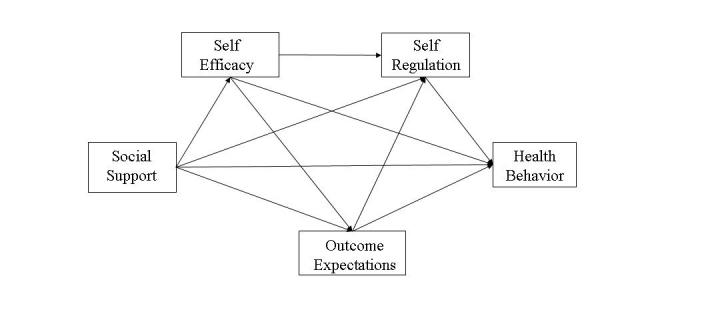
Objectives: To expand our understanding of how Web-based interventions influence behavior, we examined how changes at 6 months in participants' psychosocial characteristics contributed to improvements at 16 months in nutrition, physical activity (PA), and weight management as a result of the online, social cognitive theory (SCT)-based Guide to Health intervention (WB-GTH).
Methods: We conducted recruitment, enrollment, and assessments online with 272 of 655 (41.5%) participants enrolling in WB-GTH who also completed 6- and 16-month follow-up assessments. Participants' mean age was 43.68 years, 86% were female, 92% were white, mean education was 17.45 years, median income was US $85,000, 84% were overweight or obese, and 73% were inactive. Participants received one of two equally effective versions of WB-GTH. Structural equation analysis of theoretical models evaluated whether psychosocial constructs targeted by WB-GTH contributed to observed health behavior changes.
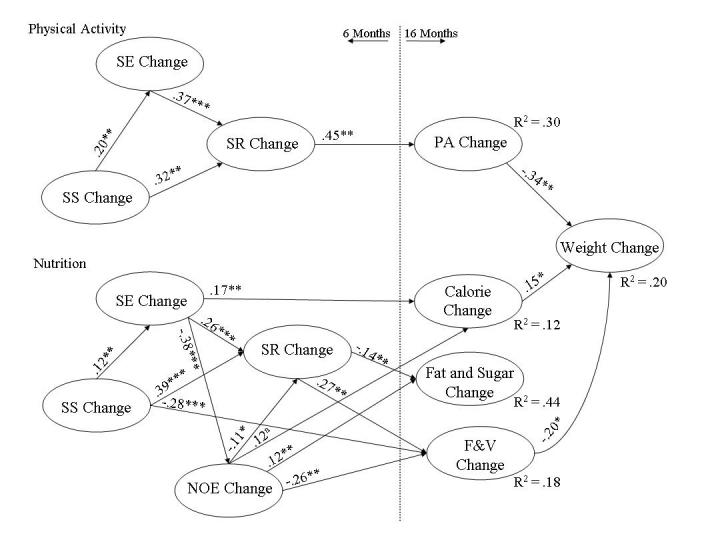
Results: The longitudinal model provided good fit to the data (root mean square error of approximation <.05). Participants' weight loss at 16 months was predicted by improvements in their PA (beta(total) = -.34, P = .01), consumption of fruits and vegetables (F&V) (beta(total) = -.20, P = .03) and calorie intake (beta(total) = .15, P = .04). Improvements at 6 months in PA self-efficacy (beta(total) = -.10, P = .03), PA self-regulation (beta(total) = -.15, P = .01), nutrition social support (beta(total) = -.08, P = .03), and nutrition outcome expectations (beta(total) = .08, P = .03) also contributed to weight loss. WB-GTH users with increased social support (beta(total) = .26, P = .04), self-efficacy (beta(total) = .30, P = .01), and self-regulation (beta(total) = .45, P = .004) also exhibited improved PA levels. Decreased fat and sugar consumption followed improved social support (beta(total) = -.10, P = .02), outcome expectations (beta(total) = .15, P = .007), and self-regulation (beta(total) = -.14, P = .008). Decreased calorie intake followed increased social support (beta(total) = -.30, P < .001). Increased F&V intake followed improved self-efficacy (beta(total) = .20, P = .01), outcome expectations (beta(total) = -.29, P = .002), and self-regulation (beta(total) = .27, P = .009). Theorized indirect effects within SCT variables were also supported.
Conclusions: The WB-GTH influenced behavior and weight loss in a manner largely consistent with SCT. Improving social support, self-efficacy, outcome expectations, and self-regulation, in varying combinations, led to healthier diet and exercise habits and concomitant weight loss. High initial levels of self-efficacy may be characteristic of Web-health users interested in online interventions and may alter the function of SCT in these programs. Researchers may find that, although increased self-efficacy enhances program outcomes, participants whose self-efficacy is tempered by online interventions may still benefit.
Trial registration: Clinicaltrials.gov NCT00128570; http://clinicaltrials.gov/ct2/show/NCT00128570 (Archived by WebCite at http://www.webcitation.org/5vgcygBII).
Conflict of interest statement
None declared
Figures
References
-
- Pew Internet. Washington, DC: Pew Internet & American Life Project; 2009. Dec 04, [2010-07-13]. 5rCG6KhWq Online activities: daily internet activities http://www.pewinternet.org/Trend-Data/Online-Activities-Daily.aspx.
-
- Pew Internet. Washington, DC: Pew Internet & American Life Project; 2010. [2010-07-13]. 5rCGL1Od1 Who’s online: demographics of Internet-users http://www.pewinternet.org/Trend-Data/Whos-Online.aspx.
-
- Fox S, Jones S. Pew Internet. Washington, DC: Pew Internet & American Life Project; 2009. Jun, [2011-01-13]. 5vi26aPUJ The social life of health information: Americans’ pursuit of health takes place within a widening network of both online and offline sources http://www.pewinternet.org/~/media//Files/Reports/2009/PIP_Health_2009.pdf.
Publication types
MeSH terms
Associated data
Grants and funding
LinkOut - more resources
Full Text Sources
Medical
