


Progression and regression: distinct developmental patterns of diabetic retinopathy in patients with type 2 diabetes treated in the diabetes care system west-friesland, the Netherlands
- PMID: 21447662
- PMCID: PMC3064043
- DOI: 10.2337/dc10-1741
Progression and regression: distinct developmental patterns of diabetic retinopathy in patients with type 2 diabetes treated in the diabetes care system west-friesland, the Netherlands
Abstract
Objective: To identify distinct developmental patterns of diabetic retinopathy (DR) and assess the risk factor levels of patients in these clusters.
Research design and methods: A cohort of 3,343 patients with type 2 diabetes mellitus (T2DM) monitored and treated in the Diabetes Care System West-Friesland, the Netherlands, was followed from 2 to 6 years. Risk factors were measured, and two-field fundus photographs were taken annually and graded according to the EURODIAB study group. Latent class growth modeling was used to identify distinct developmental patterns of DR over time.
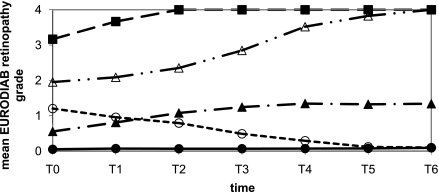
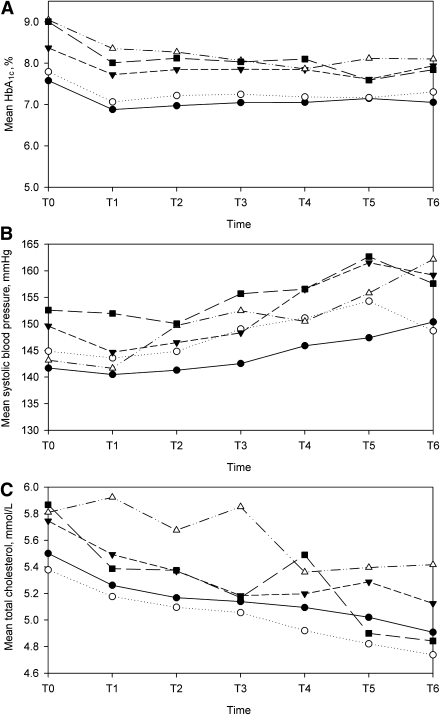
Results: Five clusters of patients with distinct developmental patterns of DR were identified: A, patients without any signs of DR (88.9%); B, patients with a slow regression from minimal background to no DR (4.9%); C, patients with a slow progression from minimal background to moderate nonproliferative DR (4.0%); D, patients with a fast progression from minimal or moderate nonproliferative to (pre)proliferative or treated DR (1.4%); and E, patients with persistent proliferative DR (0.8%). Patients in clusters A and B were characterized by lower risk factor levels, such as diabetes duration, HbA(1c), and systolic blood pressure compared with patients in progressive clusters (C-E).
Conclusions: Clusters of patients with T2DM with markedly different patterns of DR development were identified, including a cluster with regression of DR. These clusters enable a more detailed examination of the influence of various risk factors on DR.
Figures
Comment in
-
Diabetic retinopathy in 2011: further insights from new epidemiological studies and clinical trials.Diabetes Care. 2011 Apr;34(4):1066-7. doi: 10.2337/dc11-0225. Diabetes Care. 2011. PMID: 21447672 Free PMC article. No abstract available.
References
-
- Kempen JH, O’Colmain BJ, Leske MC, et al. Eye Diseases Prevalence Research Group The prevalence of diabetic retinopathy among adults in the United States. Arch Ophthalmol 2004;122:552–563 - PubMed
-
- Stratton IM, Cull CA, Adler AI, Matthews DR, Neil HA, Holman RR. Additive effects of glycaemia and blood pressure exposure on risk of complications in type 2 diabetes: a prospective observational study (UKPDS 75). Diabetologia 2006;49:1761–1769 - PubMed
-
- The Diabetic Retinopathy Study Research Group Photocoagulation treatment of proliferative diabetic retinopathy. Clinical application of Diabetic Retinopathy Study (DRS) findings, DRS Report Number 8. Ophthalmology 1981;88:583–600 - PubMed
-
- Rodbard HW, Blonde L, Braithwaite SS, et al. AACE Diabetes Mellitus Clinical Practice Guidelines Task Force American Association of Clinical Endocrinologists medical guidelines for clinical practice for the management of diabetes mellitus. Endocr Pract 2007;13(Suppl. 1):1–68 - PubMed
MeSH terms
Substances
LinkOut - more resources
Full Text Sources
Medical
Miscellaneous
