


Development and persistence of methamphetamine-conditioned hyperactivity in Swiss-Webster mice
- PMID: 21448061
- PMCID: PMC3082579
- DOI: 10.1097/FBP.0b013e328345f741
Development and persistence of methamphetamine-conditioned hyperactivity in Swiss-Webster mice
Abstract
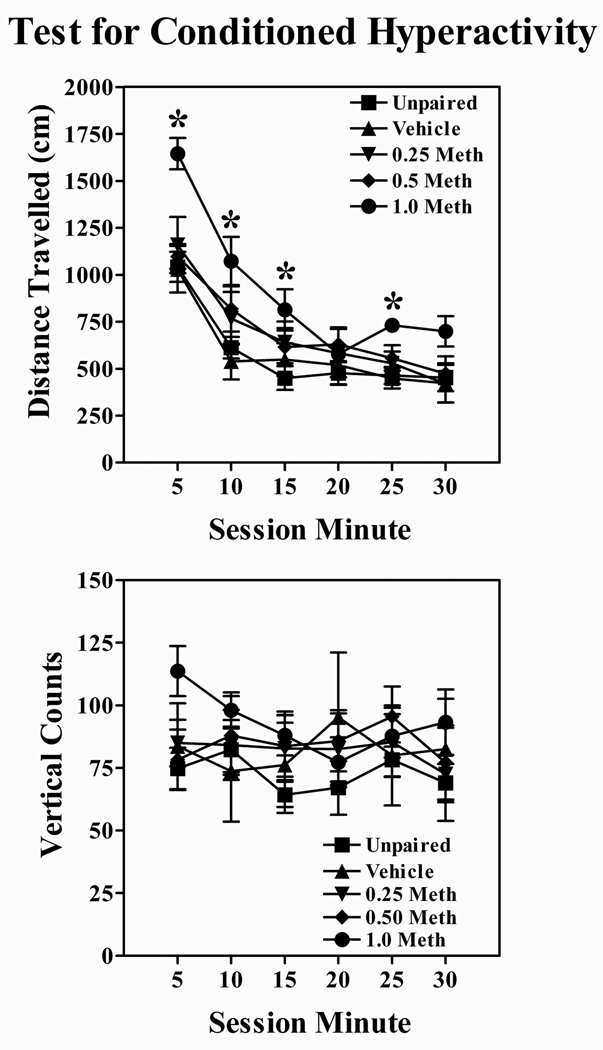
These experiments examined the development and persistence of methamphetamine-conditioned hyperactivity in Swiss-Webster mice. Experiments 1 and 2 examined the development of conditioned hyperactivity, varying the methamphetamine dose (0.25-2.0 mg/kg), the temporal injection parameters (continuous; experiment 1 or intermittent; experiment 2), and the comparison control group (saline; experiment 1 or unpaired; experiment 2). Experiment 3 examined the persistence of methamphetamine-conditioned hyperactivity by comparing mice 1 (immediate) or 28 (delay) days after drug withdrawal. In each experiment, several behavioral measures (vertical counts, distance traveled, and velocity) were recorded and temporal analyses conducted to assess methamphetamine-conditioned hyperactivity. In experiments 1 and 2, it was found that methamphetamine-conditioned hyperactivity was (i) dose-dependent, (ii) detected early in the session, and (iii) detected by a behavioral measure indicative of general activity (i.e. distance traveled), and (iv) varied as a function of the number of conditioning sessions. In experiment 3, it was found that conditioned hyperactivity persisted for 28 days, though was weakened by nonassociative factors, following methamphetamine withdrawal. Collectively, these results suggest that conditioned hyperactivity to methamphetamine is robust and persists after prolonged periods of drug withdrawal in mice. Furthermore, these results are consistent with an excitatory classical conditioning interpretation of conditioned hyperactivity.
Figures



References
-
- Ahmed SH, Cador M, Le Moal M, Stinus L. Amphetamine-induced conditioned activity in rats: Comparison with novelty-induced activity and role of the basolateral amygdale. Behav Neurosci. 1995;109:723–733. - PubMed
-
- Ahmed H, Stinus L, Cador M. Amphetamine-induced conditioned activity is insensitive to perturbations known to affect Pavlovian conditioning responses in rats. Behav Neurosci. 1998;112:1167–1176. - PubMed
-
- Alam MR. Enhancement of Motor- Accelerating Effect Induced by Repeated Administration of Methamphetamine in Mice: Involvement of Environmental Factors. J Pharmacol. 1981;31:897–904. - PubMed
-
- Anagnostaras SG, Robinson TE. Sensitization to the psychomotor stimulant effects of amphetamine: Modulation by associative learning. Behav Neurosci. 1996;110:1397–1414. - PubMed
-
- Bardo MT, Bevins RA. Conditioned place preference: What does it add to our preclinical understanding of drug reward? Psychopharmacology. 2000;153:31–43. - PubMed
Publication types
MeSH terms
Substances
Grants and funding
LinkOut - more resources
Full Text Sources
Medical
