


Treatment of nephrotic syndrome with adrenocorticotropic hormone (ACTH) gel
- PMID: 21448451
- PMCID: PMC3063118
- DOI: 10.2147/DDDT.S17521
Treatment of nephrotic syndrome with adrenocorticotropic hormone (ACTH) gel
Abstract
Purpose: A synthetic adrenocorticotropin (ACTH) analog has shown efficacy in Europe as primary and secondary therapy for nephrotic syndrome, but there is no published experience using the natural, highly purified ACTH gel formulation, available in the United States, for nephrotic syndrome. We therefore investigated the use of ACTH gel for nephrotic syndrome in the United States.
Patients and methods: Twenty-one patients with nephrotic syndrome treated with ACTH gel outside of research settings in the United States, with initiation of therapy by December 31, 2009, allowing a minimum 6 months follow-up. We defined complete remission as stable renal function with proteinuria falling to <500 mg/day, and partial remission as stable renal function with >50% reduction in proteinuria from 500 to 3500 mg/day.
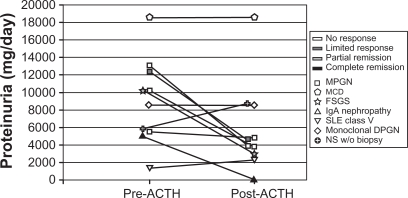
Results: Twenty-one patients with nephrotic syndrome were treated: 11 with idiopathic membranous nephropathy (iMN), 4 with membranoproliferative glomerulonephritis (MPGN), 1 with focal segmental glomerulosclerosis (FSGS), 1 with minimal change disease (MCD), 1 with immunoglobulin A (IgA) nephropathy, 1 with class V systemic lupus erythematosus (SLE) glomerulonephritis, 1 with monoclonal diffuse proliferative glomerulonephritis, and 1 with unbiopsied nephrotic syndrome. ACTH was used as primary therapy for 3 patients; the remaining patients had previously failed a mean 2.3 immunosuppressive regimens. Eleven patients achieved a complete or partial remission, with 4 (19%) in complete remission. Of the 11 patients who achieved remission, 9 had iMN, 1 had FSGS, and 1 had IgA nephropathy. Of the 11 patients with iMN, 3 (27%) achieved complete remission and 6 (55%) achieved partial remission despite having previously failed a mean 2.4 therapies. Five patients reported steroid-like adverse effects, but there were no severe infections. The limitations were retrospective data analysis with short-term follow-up.
Conclusion: ACTH gel may be a viable treatment option for resistant nephrotic syndrome due to membranous nephropathy. Short-term data suggest that remission rates may approach 80%.
Keywords: chronic kidney disease; membranous nephropathy; nephrotic syndrome.
Figures

References
-
- Waldman M, Crew RJ, Valeri A, et al. Adult minimal-change disease: clinical characteristics, treatment, and outcomes. Clin J Am Soc Nephrol. 2007;2:445–453. - PubMed
-
- Ponticelli C, Edefonti A, Ghio L, et al. Cyclosporin versus cyclophosphamide for patients with steroid-dependent and frequently relapsing idiopathic nephrotic syndrome: a multicentre randomized controlled trial. Nephrol Dial Transplant. 1993;8:1326–1332. - PubMed
-
- Cattran DC, Appel GB, Hebert LA, et al. Cyclosporine in patients with steroid-resistant membranous nephropathy: a randomized trial. Kidney Int. 2001;59:1484–1490. - PubMed
-
- Cattran DC, Alexopoulos E, Heering P, et al. Cyclosporin in idiopathic glomerular disease associated with the nephrotic syndrome: workshop recommendations. Kidney Int. 2007;72:1429–1447. - PubMed
Publication types
MeSH terms
Substances
LinkOut - more resources
Full Text Sources
Other Literature Sources
Medical
Miscellaneous
