


Troubleshooting adult ECMO
J Extra Corpor Technol.
2011 Mar.
Abstract
The following scenarios explore some of the common problems encountered during extracorporeal membrane oxygenation (ECMO) in adults. In each scenario, the circuit is comprised of a centrifugal pump and a polymethylpentene oxygenator.
Figures
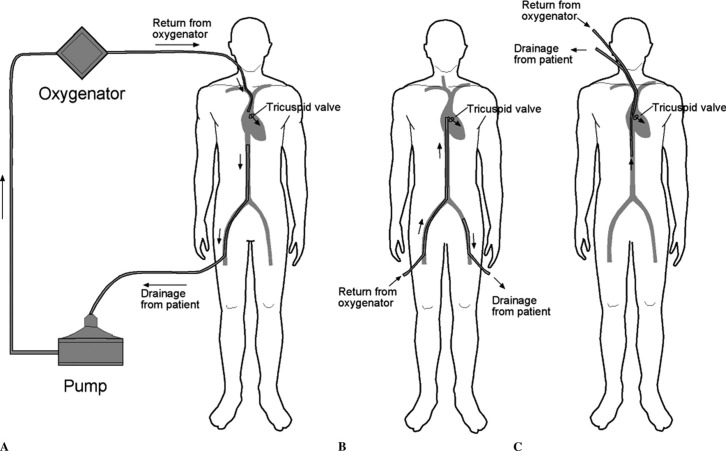
Here are three possible cannula arrangements for VV ECMO. In example A, deoxygenated blood is drained from the patient from a multi-hole cannula positioned in the inferior vena cava (inserted in a femoral vein) and oxygenated blood returns to the patient via a cannula positioned in the right atrium (inserted in the right internal jugular vein). In example B, blood is drained from the patient via a cannula positioned in the distal inferior vena cava or iliac vein (inserted in a femoral vein) and blood returns to the patient via a cannula positioned in the right atrium (inserted into the femoral vein). In example C, a double lumen cannula is inserted into the right internal jugular vein. The return port is positioned in the right atrium and the multi-holed drainage port is positioned in the inferior vena cava. In each configuration, the goal is to return oxygenated blood to the right atrium with the goal of the majority of the return blood passing through the tricuspid valve and through the pulmonary circulation. By having oxygenated return blood pass through the tricuspid valve recirculation (in which oxygenated return blood passes directly to the drainage cannula) is minimized.
References
-
- Sidebotham D, McGeorge A, McGuinness S, Edwards M, Willcox T, Beca J.. Extracorporeal membrane oxygenation for treating severe cardiac and respiratory disease in adults: Part 1–overview of extracorporeal membrane oxygenation. J Cardiothorac Vasc Anesth. 2009;23:886–92. - PubMed
-
- Sidebotham D, McGeorge A, McGuinness S, Edwards M, Willcox T, Beca J.. Extracorporeal membrane oxygenation for treating severe cardiac and respiratory failure in adults: Part 2–technical considerations. J Cardiothorac Vasc Anesth. 2010;24:164–72. - PubMed
MeSH terms
LinkOut - more resources
Full Text Sources