. 2011 Jun;85(12):5757-63.
doi: 10.1128/JVI.02690-10. Epub 2011 Mar 30.

Mother-to-infant transmission of simian immunodeficiency virus is rare in sooty mangabeys and is associated with low viremia

Affiliations

Mother-to-infant transmission of simian immunodeficiency virus is rare in sooty mangabeys and is associated with low viremia

Ann Chahroudi et al. J Virol. 2011 Jun.

Abstract

Mother-to-child transmission of human immunodeficiency virus type 1 (HIV-1) occurs in utero, intrapartum, and through breastfeeding, with a cumulative rate of transmission of 35 to 40%. As a result, ∼ 400,000 children become infected each year. Little is known about mother-to-infant transmission (MTIT) during natural simian immunodeficiency virus (SIV) infection of sooty mangabeys (SMs) that typically is nonpathogenic despite high viral loads. In this study, we retrospectively investigated the rates of MTIT in a large colony of naturally SIV-infected SMs using serological (anti-SIV antibody by enzyme-linked immunosorbent assay [ELISA] and Western blot analysis) and virological (SIV(smm) real-time reverse transcription-PCR) methods. We examined 161 SM infants born to SIV-infected mothers and found that 150 (93.2%) were infected by non-MTIT (n = 120) or remained uninfected (n = 30). The remaining 11 SM infants (6.8%) were defined as acquiring SIV by presumptive MTIT based on (i) the presence of anti-SIV antibodies without seroreversion and (ii) a viral load of >500 copies/ml of serum in the first year of life. SM infants infected with SIV by presumptive MTIT did not show any increased morbidity or mortality, indicating that the infection is nonpathogenic even when acquired early in life. Interestingly, viral loads of SIV-infected SM infants with presumptive MTIT were 2-log lower than those of SIV-infected adult SMs living in the same colony (i.e., ∼ 1,000 and 100,000 copies/ml, respectively). These results indicate that MTIT is substantially less frequent in naturally SIV-infected SMs than in HIV-1-infected humans and results in nonpathogenic infection associated with low SIV viremia. Evolutionary pressure to reduce MTIT may have contributed to the restriction of SIV pathogenesis in natural hosts.


Figures
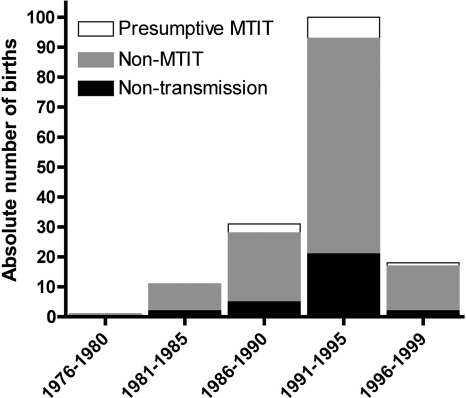
Fig. 1.
Fig. 1.
SM births in the YNPRC colony from 1976 to 1999. The absolute number of SMs born to naturally SIV-infected dams is shown for each time period. Only SMs with ≥1 SIV antibody test are included (n = 249). SMs infected with SIV by presumptive MTIT are depicted by the white bars (n = 11); SMs infected with SIV by non-MTIT are depicted by the gray bars (n = 120); and uninfected SMs (nontransmission) are depicted by the black bars (n = 30). The presumptive MTIT group was SIV seropositive from birth (with a sample tested at ≥6 months and ≤1 year) and had an SIVsmm viral load of greater than 500 copies/ml of serum within the first year of life. The non-MTIT infected group was either seropositive at birth with seroreversion (loss of maternal antibody) and subsequent seroconversion after 1 year of life or seronegative at birth with seroconversion after 1 year of life. Nontransmission was defined as negative testing at all time points or persistent seroreversion at any time after birth. There were a further 88 SMs (not shown) who were classified as indeterminate.
Fig. 2.
Fig. 2.
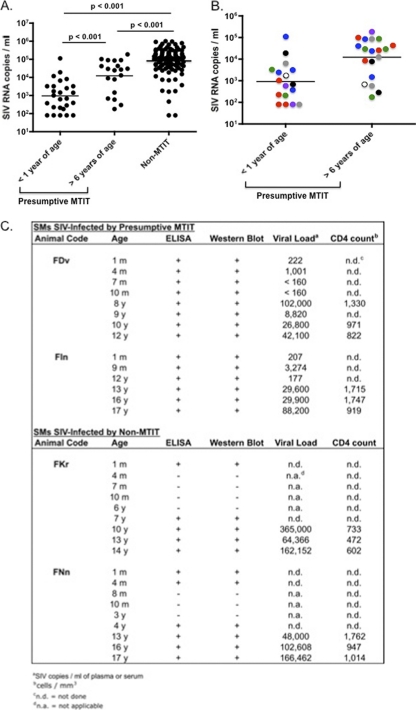
Viral loads of SMs vary by mode of SIV transmission and age. (A) Viral loads in SMs infected with SIV by presumptive MTIT and non-MTIT were measured as SIV RNA copies per ml of serum or plasma. Serial measurements during the first year of life (≤1 year of age; n = 26) and as adults (≥6 years of age; n = 19) were performed for the 11 SIV-infected SMs with presumptive MTIT. For comparison, viral loads of 105 adult SMs infected with SIV by non-MTIT are shown. Measurements below the limit of detection for the assay are plotted at 80 SIV RNA copies/ml. Circles represent individual data points, and horizontal lines indicate geometric means. Mixed-effects models were used to determine statistical significance. (B) Direct comparison of the viral loads measured in seven SMs infected with SIV by presumptive MTIT for which samples were available at both ≤1 year of age and at ≥6 years of age. Individual animals are color coded. Measurements below the limit of detection for the assay are plotted at 80 SIV RNA copies/ml. Circles represent individual data points, and horizontal lines indicate geometric means. (C) Representative examples of SIV serology, viremia, and CD4+ T-cell counts over time in two SMs infected with SIV by presumptive MTIT and two infected with SIV by non-MTIT.
Fig. 3.
Fig. 3.
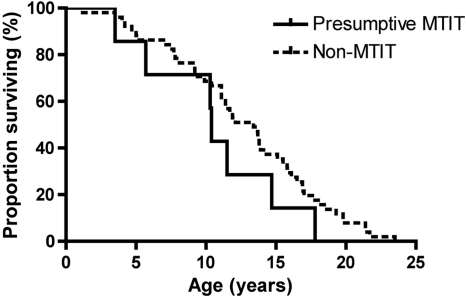
Mortality is not affected by mode of SIV transmission. Kaplan-Meier survival curves are shown for SMs infected with SIV by presumptive MTIT (n = 7; filled line) and SMs infected with SIV by non-MTIT (n = 51; dashed line). The mortality rates of the two groups do not differ significantly (P = 0.22). The proportion of surviving SMs is shown in relation to their age in years.

References

    1. Amedee A. M., Lacour N., Ratterree M. 2003. Mother-to-infant transmission of SIV via breast-feeding in rhesus macaques. J. Med. Primatol. 32:187–193 - PubMed
    1. Amedee A. M., Rychert J., Lacour N., Fresh L., Ratterree M. 2004. Viral and immunological factors associated with breast milk transmission of SIV in rhesus macaques. Retrovirology 1:17. - PMC - PubMed
    1. Beer B., et al. 1998. Simian immunodeficiency virus of African green monkeys is apathogenic in the newborn natural host. J. Acquir. Immune Defic. Syndr. Hum. Retrovirol. 18:210–220 - PubMed
    1. Bosinger S. E., et al. 2009. Global genomic analysis reveals rapid control of a robust innate response in SIV-infected sooty mangabeys. J. Clin. Investig. 119:3556–3572 - PMC - PubMed
    1. Brenchley J. M., Silvestri G., Douek D. C. 2010. Nonprogressive and progressive primate immunodeficiency lentivirus infections. Immunity 32:737–742 - PMC - PubMed

Publication types

MeSH terms