


A spatial explicit strategy reduces error but interferes with sensorimotor adaptation
- PMID: 21451054
- PMCID: PMC3118744
- DOI: 10.1152/jn.00002.2011
A spatial explicit strategy reduces error but interferes with sensorimotor adaptation
Abstract
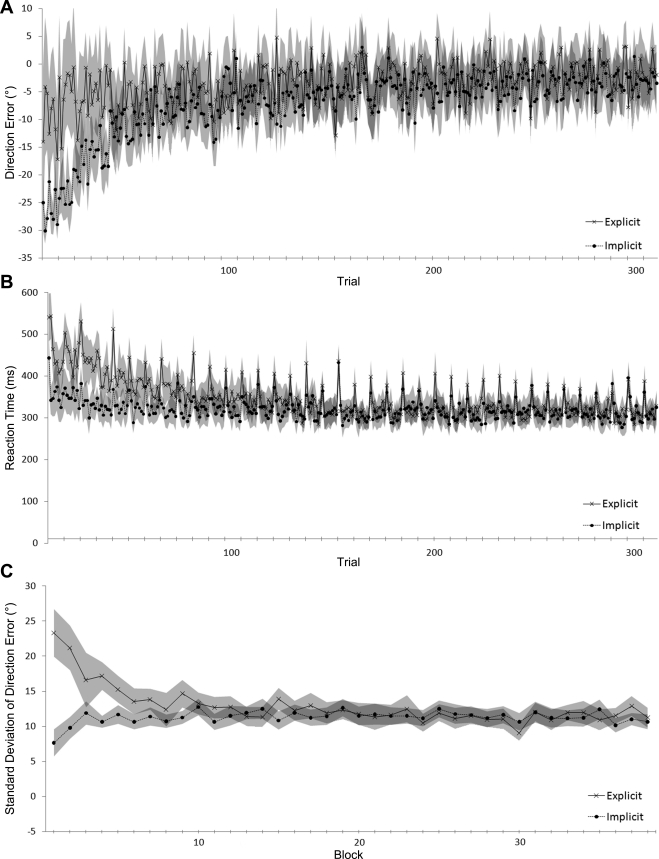
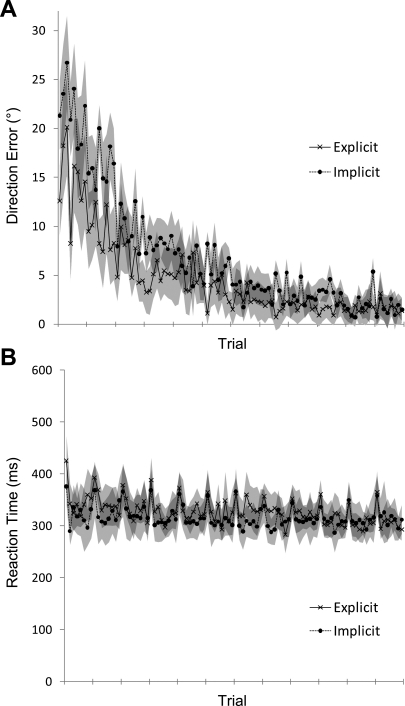
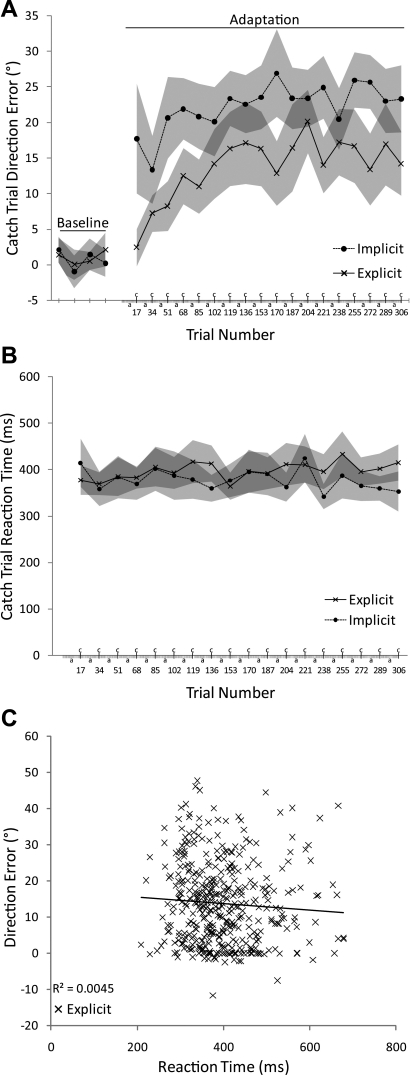
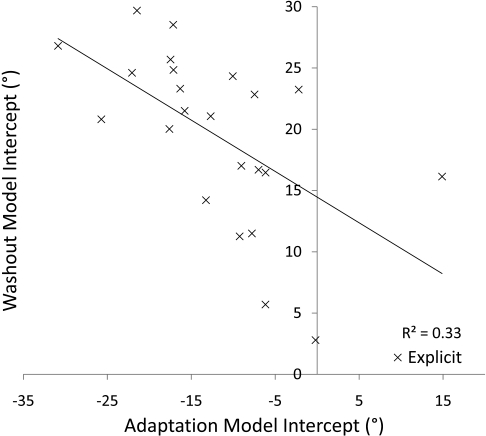
Although sensorimotor adaptation is typically thought of as an implicit form of learning, it has been shown that participants who gain explicit awareness of the nature of the perturbation during adaptation exhibit more learning than those who do not. With rare exceptions, however, explicit awareness is typically polled at the end of the study. Here, we provided participants with either an explicit spatial strategy or no instructions before learning. Early in learning, explicit instructions greatly reduced movement errors but also resulted in increased trial-to-trial variability and longer reaction times. Late in adaptation, performance was indistinguishable between the explicit and implicit groups, but the mechanisms underlying performance improvements remained fundamentally different, as revealed by catch trials. The progression of implicit recalibration in the explicit group was modulated by the use of an explicit strategy: these participants showed a lower level of recalibration as well as decreased aftereffects. This phenomenon may be due to the reduced magnitude of errors made to the target during adaptation or inhibition of implicit learning mechanisms by explicit processing.
Figures
References
-
- Abeele S, Bock O. Mechanisms for sensorimotor adaptation to rotated visual input. Exp Brain Res 139: 248–253, 2001 - PubMed
-
- Anguera JA, Reuter-Lorenz PA, Willingham DT, Seidler RD. Contributions of spatial working memory to visuomotor learning. J Cogn Neurosci 22: 1917–1930, 2010 - PubMed
-
- Beilock SL, Carr TH. On the fragility of skilled performance: what governs choking under pressure? J Exp Psychol Gen 130: 701–725, 2001 - PubMed
-
- Beilock SL, Carr TH, MacMahon C, Starkes JL. When paying attention becomes counterproductive: impact of divided versus skill-focused attention on novice and experienced performance of sensorimotor skills. J Exp Psychol Appl 8: 6–16, 2002 - PubMed
Publication types
MeSH terms
Grants and funding
LinkOut - more resources
Full Text Sources
