. 2011 May;17(5):865-77.
doi: 10.1261/rna.2446311. Epub 2011 Mar 30.

MRB3010 is a core component of the MRB1 complex that facilitates an early step of the kinetoplastid RNA editing process

Affiliations

MRB3010 is a core component of the MRB1 complex that facilitates an early step of the kinetoplastid RNA editing process

Michelle L Ammerman et al. RNA. 2011 May.

Abstract

Gene expression in the mitochondria of the kinetoplastid parasite Trypanosoma brucei is regulated primarily post-transcriptionally at the stages of RNA processing, editing, and turnover. The mitochondrial RNA-binding complex 1 (MRB1) is a recently identified multiprotein complex containing components with distinct functions during different aspects of RNA metabolism, such as guide RNA (gRNA) and mRNA turnover, precursor transcript processing, and RNA editing. In this study we examined the function of the MRB1 protein, Tb927.5.3010, which we term MRB3010. We show that MRB3010 is essential for growth of both procyclic form and bloodstream form life-cycle stages of T. brucei. Down-regulation of MRB3010 by RNAi leads to a dramatic inhibition of RNA editing, yet its depletion does not impact total gRNA levels. Rather, it appears to affect the editing process at an early stage, as indicated by the accumulation of pre-edited and small partially edited RNAs. MRB3010 is present in large (>20S) complexes and exhibits both RNA-dependent and RNA-independent interactions with other MRB1 complex proteins. Comparison of proteins isolated with MRB3010 tagged at its endogenous locus to those reported from other MRB1 complex purifications strongly suggests the presence of an MRB1 "core" complex containing five to six proteins, including MRB3010. Together, these data further our understanding of the function and composition of the imprecisely defined MRB1 complex.


Figures
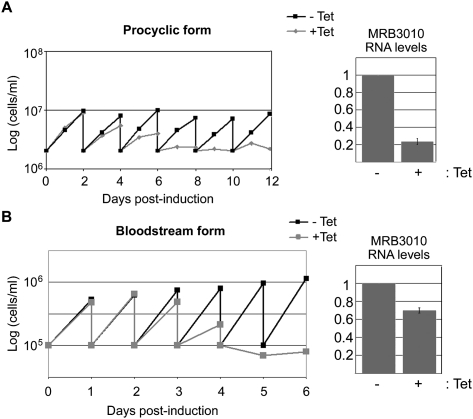
FIGURE 1.
FIGURE 1.
MRB3010 is essential for growth in both PF and BF life-cycle stages. (A) Growth was measured in PF MRB3010 RNAi cells that were uninduced (black) or induced with 1 μg/mL tet (gray). Cell growth, plotted here on a logarithmic scale, was measured every 24 h. Cells were diluted every 2 d to a starting concentration of 2 × 10⁶ cells/mL. The bar graph on the right indicates the relative MRB3010 RNA levels in the tet-induced vs. uninduced cells as determined by quantitative RT–PCR. (B) Growth was measured in BF MRB3010 RNAi cells that were uninduced (black) or induced with 1 μg/mL tet (gray). Cell growth was measured every 24 h, followed by dilution of cells to a starting concentration of 1 × 10⁵ cells/mL. The bar graph on the right indicates the relative MRB3010 RNA levels in the tet-induced vs. uninduced cells as determined by quantitative RT–PCR.
FIGURE 2.
FIGURE 2.
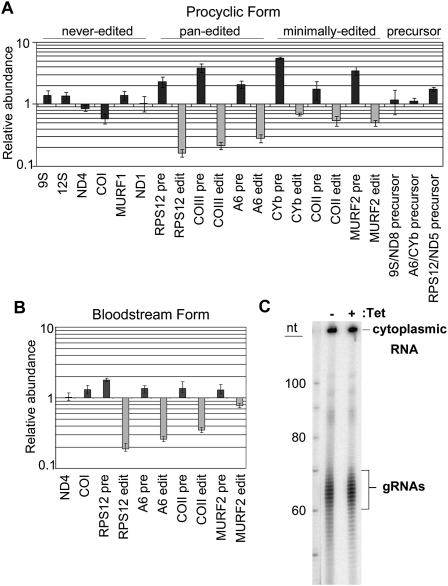
Effect of MRB3010 depletion on the abundance of mitochondrial RNAs. (A) Quantitative RT–PCR analysis of mitochondrial maxicircle transcripts from PF MRB3010 RNAi cells 4 d post-induction. Abundance of a given RNA in induced cells relative to that in the uninduced cells is plotted on a log scale. RNA levels were standardized against 18S rRNA, and the numbers represent the mean and standard deviation of at least six determinations. (B) Quantitative RT–PCR analysis of mitochondrial maxicircle transcripts from BF MRB3010 RNAi cells 4 d post-induction. RNA levels were standardized against 18S rRNA and numbers represent the mean and standard deviation of at least three determinations. (C) Guanylyl transferase labeling of the total gRNA population from the PF MRB3010 RNAi cells 4 d post-induction. Fifteen micrograms of total RNA were labeled with [α-32P]GTP using guanylyl transferase and resolved on a denaturing gel. RNA input was standardized against the quantity of a labeled cytoplasmic RNA (indicated).
FIGURE 3.
FIGURE 3.
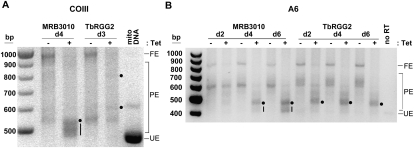
MRB3010 impacts an early step of the editing process. (A) Gel analysis of COIII RT–PCR reactions using RNAs from MRB3010 and TbRGG2 RNAi cells that were grown in the absence (−) or presence (+) of tet for 4 (MRB3010) or 3 (TbRGG2) d. Primers specific to the 5′ and 3′ ends of the COIII gene amplify the entire population of the mRNAs including pre-edited (or unedited) (UE), partially edited (PE), and fully edited (FE) transcripts. Mitochondrial (Mito) DNA was used as a template control for sizing the pre-edited COIII transcript. Dots and dashes represent major editing pause sites in cells depleted for MRB3010 or TbRGG2. (B) Gel analysis of A6 RT–PCR reactions that were performed essentially as described in A, except that primers were specific to the 3′ and 5′ ends of the A6 gene and RNA was collected from MRB3010 and TbRGG2 RNAi cells that were grown in the absence (−) or presence (+) of tet for 2, 4, and 6 d.
FIGURE 4.
FIGURE 4.
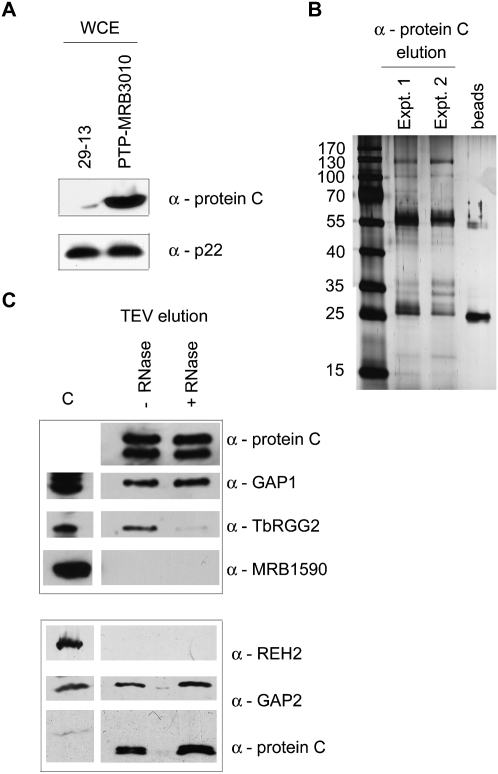
MRB3010 undergoes RNA-dependent and RNA-independent interactions with MRB1 complex components. (A) Western blot analysis of 29-13 or PTP-MRB3010 PF cells with anti-Protein C antibody confirms expression of the tandem affinity tagged MRB3010 protein (top). The p22 protein was used as a loading control (bottom). (B) Ten percent of two PTP-purified MRB3010 samples were separated on a 10% SDS–polyacrylamide gel and visualized by silver staining. Anti-Protein C beads were run as a control for unintended antibody elution. (C) IgG affinity purification of PTP-MRB3010 from cell extracts that were either RNase treated (+ RNase) or left untreated (− RNase). Proteins were eluted from IgG Sepharose 6 Fast Flow columns by TEV protease cleavage and electrophoresed on 10% (top) or 6% (bottom) SDS–polyacrylamide gels, followed by Western blotting with antibodies specific to Protein C (to detect MRB3010-ProtC) and various MRB complex components. (C) Control whole-cell extract, which is from either 29-13 PF cells (top) or PTP-MRB3010 cells (bottom).
FIGURE 5.
FIGURE 5.
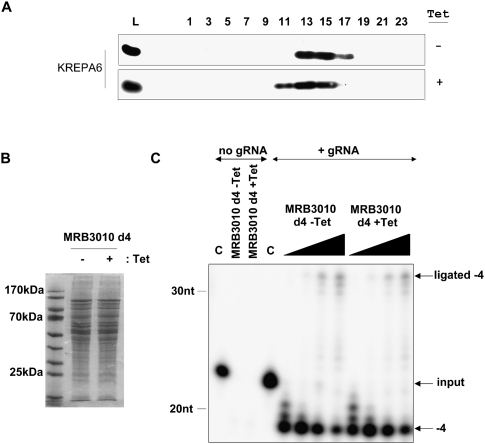
MRB3010 knockdown does not affect RNA editing core complexes. (A) The effect of MRB3010 depletion on the sedimentation of the RNA editing core complex (RECC). Mitochondrial extracts from uninduced (− tet) or tet-induced (+ tet) PF MRB3010 RNAi cells 4 d post-induction were fractionated on 10%–30% glycerol gradients. Alternate gradient fractions were electrophoresed on SDS–polyacrylamide gels and immunoblotted with anti-KREPA6 antibody. The mitochondrial extracts loaded on the gradient are shown on the left (abbreviated as L). (B) Equivalent amounts of mitochondrial extract purified from PF MRB3010 cells uninduced (−) or tet induced (+) for 4 d were separated on a 10% SDS-PAGE, followed by Coomassie staining. (C) Precleaved deletion editing assays were performed with [Γformula image-32P]ATP-radiolabeled 5′ mRNA fragment and 3′ mRNA fragment, but no gRNA (no gRNA); or radiolabeled 5′ mRNA fragment, 3′ mRNA fragment, and gRNA (+ gRNA). In the no gRNA experiments either a control with no protein (C) or 2.5 μL of the indicated extract was added. Nonspecific ribonucleases in the extracts degraded the radiolabeled 5′ mRNA fragment when gRNA was not present. In the experiments where gRNA was added either no protein (C) or 1, 2.5, 5, and 7.5 μL of the indicated extracts were added. The migration position of the input radiolabeled 5′ mRNA fragment is indicated. The −4 nonligated deletion product is labeled −4 and the ligated deletion product is labeled ligated −4.
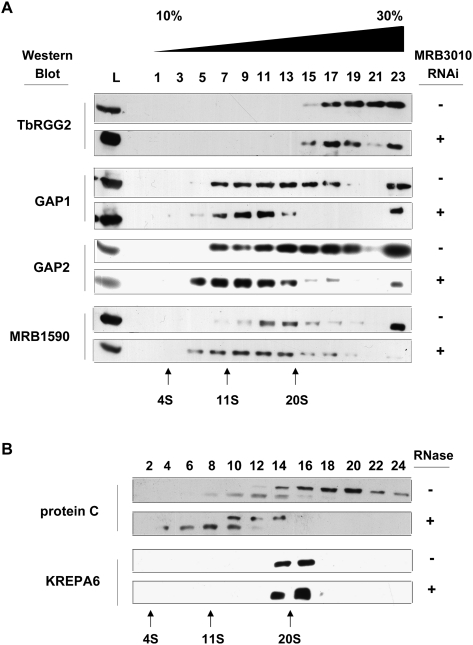
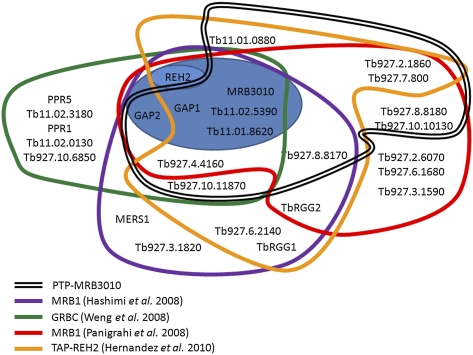
FIGURE 6.
FIGURE 6.
Glycerol gradient sedimentation of MRB complex components. (A) The effect of MRB3010 depletion on the sedimentation of TbRGG2, GAP1, GAP2, and MRB1590-containing complexes. Mitochondrial extracts from uninduced (− tet) or tet-induced (+ tet) PF MRB3010 RNAi cells 4 d post-induction were fractionated on 10%–30% glycerol gradients. Alternate gradient fractions were electrophoresed on SDS–polyacrylamide gels and immunoblotted with the indicated antibodies. The mitochondrial extracts loaded on the gradient are shown on the left (abbreviated as L). (B) MRB3010 is part of a macromolecular complex that sediments at >20S and has RNA-dependent interactions. Mitochondrial extracts from PF PTP-MRB3010 cells that were either treated with an RNase cocktail (+) or left untreated (–) were fractionated and analyzed as described in A. The position of KREPA6-containing complexes is shown here as a 20S size standard.
FIGURE 7.
FIGURE 7.
Overlapping and distinct components of MRB1 complexes isolated by different methods. Gene DB numbers or common names of proteins identified by affinity purification and mass spectrometry from this study and previous studies are outlined in different colors. The blue oval indicates proteins that were identified in the majority of TAP purifications performed with tagged MRB1 components, which may constitute a core subcomplex. GAP2 was identified, but shown to be RNA dependent in the REH2-based purification (Hernandez et al. 2010). REH2 is highlighted because it was not detected with either MRB3010-based purification (Panigrahi et al. 2008; this study); however, the latter may be due to the C-terminal tag, since MRB3010 was detected in the reciprocal REH2-based purification (Hernandez et al. 2010). MRB1 complexes purified by Weng et al. (2008), Hernandez et al. (2010), and in this study were RNase treated, while MRB1 complexes purified by Panigrahi et al. (2008) and Hashimi et al. (2009) were not.

References

    1. Acestor N, Panigrahi AK, Carnes J, Zíková A, Stuart KD 2009. The MRB1 complex functions in kinetoplastid RNA processing. RNA 15: 277–286 - PMC - PubMed
    1. Ammerman ML, Fisk JC, Read LK 2008. gRNA/pre-mRNA annealing and RNA chaperone activities of RBP16. RNA 14: 1069–1080 - PMC - PubMed
    1. Ammerman MA, Presnyak V, Fisk JC, Foda BM, Read LK 2010. TbRGG2 facilitates kinetoplastid RNA editing initiation and progression past intrinsic pause sites. RNA 16: 2239–2251 - PMC - PubMed
    1. Aphasizhev R, Aphasizheva I, Nelson RE, Simpson L 2003. A 100-kD complex of two RNA-binding proteins from mitochondria of Leishmania tarentolae catalyzes RNA annealing and interacts with several RNA editing components. RNA 9: 62–76 - PMC - PubMed
    1. Babbarwal VK, Fleck M, Ernst NL, Schnaufer A, Stuart K 2007. An essential role of KREPB4 in RNA editing and structural integrity of the editosome in Trypanosoma brucei. RNA 13: 737–744 - PMC - PubMed

Publication types

MeSH terms

LinkOut - more resources