Feather bedding and childhood asthma associated with house dust mite sensitisation: a randomised controlled trial
- PMID: 21451166
- PMCID: PMC3093241
- DOI: 10.1136/adc.2010.189696
Feather bedding and childhood asthma associated with house dust mite sensitisation: a randomised controlled trial
Abstract
Introduction: Observational studies report inverse associations between the use of feather upper bedding (pillow and/or quilt) and asthma symptoms but there is no randomised controlled trial (RCT) evidence assessing the role of feather upper bedding as a secondary prevention measure.
Objective: To determine whether, among children not using feather upper bedding, a new feather pillow and feather quilt reduces asthma severity among house dust mite (HDM) sensitised children with asthma over a 1-year period compared with standard dust mite avoidance advice, and giving children a new mite-occlusive mattress cover.
Design: RCT.
Setting: The Calvary Hospital in the Australian Capital Territory and the Children's Hospital at Westmead, Sydney, New South Wales.
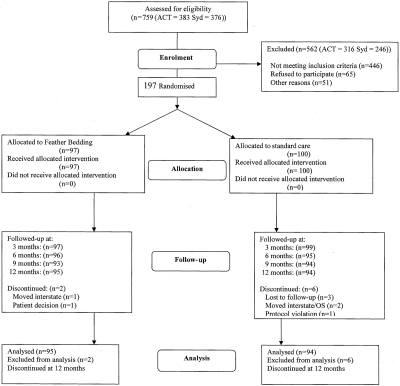
Patients: 197 children with HDM sensitisation and moderate to severe asthma. Intervention New upper bedding duck feather pillow and quilt and a mite-occlusive mattress cover (feather) versus standard care and a mite-occlusive mattress cover (standard).
Main outcome measures: The proportion of children reporting four or more episodes of wheeze in the past year; an episode of speech-limiting wheeze; or one or more episodes of sleep disturbance caused by wheezing; and spirometry with challenge testing. Statistical analysis included multiple logistic and linear regression.
Results: No differences between groups were found for primary end points--frequent wheeze (OR 1.51, 95% CI 0.83 to 2.76, p=0.17), speech-limiting wheeze (OR 0.70, 95% CI 0.32 to 1.48, p=0.35), sleep disturbed because of wheezing (OR 1.17, 95% CI 0.64 to 2.13, p=0.61) or for any secondary end points. Secondary analyses indicated the intervention reduced the risk of sleep being disturbed because of wheezing and severe wheeze to a greater extent for children who slept supine.
Conclusion: No differences in respiratory symptoms or lung function were observed 1 year after children with moderate-severe asthma and HDM sensitisation were given a mite-occlusive mattress cover and then received either feather upper bedding (pillow and quilt) or standard bedding care.
Conflict of interest statement
References
-
- Fitzharris P, Siebers R, Crane J. Pillow talk: have we made the wrong beds for our patients to lie in? Clin Exp Allergy 1999;29:429–32 - PubMed
-
- Custovic A, Woodcock A. Feather or synthetic? That is the question. Clin Exp Allergy 1999;29:144–7 - PubMed
-
- Zacharasiewicz A, Zidek T, Haidinger G, et al. Indoor factors and their association to respiratory symptoms suggestive of asthma in Austrian children aged 6–9 years. Wien Klin Wochenschr 1999;111:882–6 - PubMed
-
- Yemaneberhan H, Bekele Z, Venn A, et al. Prevalence of wheeze and asthma and relation to atopy in urban and rural Ethiopia. Lancet 1997;350:85–90 - PubMed
-
- Ponsonby AL, Kemp A, Dwyer T, et al. Feather bedding and house dust mite sensitization and airway disease in childhood. J Clin Epidemiol 2002;55:556–62 - PubMed
Publication types
MeSH terms
Substances
LinkOut - more resources
Full Text Sources
Medical
Miscellaneous