Review
. 2011 May 27;22(21):212001.
doi: 10.1088/0957-4484/22/21/212001. Epub 2011 Mar 31.

Nanoscale tissue engineering: spatial control over cell-materials interactions

Affiliations
Review

Nanoscale tissue engineering: spatial control over cell-materials interactions

Ian Wheeldon et al. Nanotechnology. .

Abstract

Cells interact with the surrounding environment by making tens to hundreds of thousands of nanoscale interactions with extracellular signals and features. The goal of nanoscale tissue engineering is to harness these interactions through nanoscale biomaterials engineering in order to study and direct cellular behavior. Here, we review two- and three-dimensional (2- and 3D) nanoscale tissue engineering technologies, and provide a holistic overview of the field. Techniques that can control the average spacing and clustering of cell adhesion ligands are well established and have been highly successful in describing cell adhesion and migration in 2D. Extension of these engineering tools to 3D biomaterials has created many new hydrogel and nanofiber scaffold technologies that are being used to design in vitro experiments with more physiologically relevant conditions. Researchers are beginning to study complex cell functions in 3D. However, there is a need for biomaterials systems that provide fine control over the nanoscale presentation of bioactive ligands in 3D. Additionally, there is a need for 2- and 3D techniques that can control the nanoscale presentation of multiple bioactive ligands and that can control the temporal changes in the cellular microenvironment.


Figures
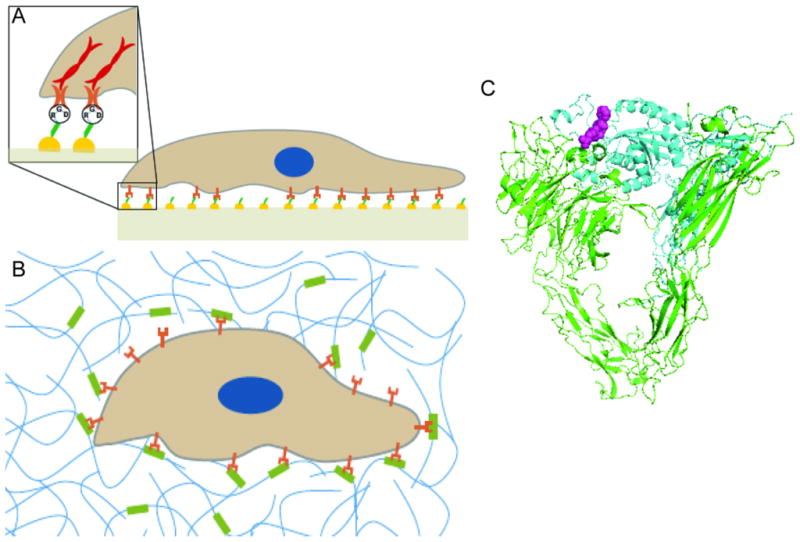
Figure 1
Figure 1
Cellular-ECM interaction. (A) Schematic of 2D cell-substrate interaction where cells acquire a non-physiologically flattened morphology. (B) Schematic of 3D cell-substrate interaction in which cells retain in vivo morphology. (C) The crystal structure of the extracellular domain of αV/β3 integrin (green/blue) with bound RGD ligand (purple) (1L5G).
Figure 2
Figure 2
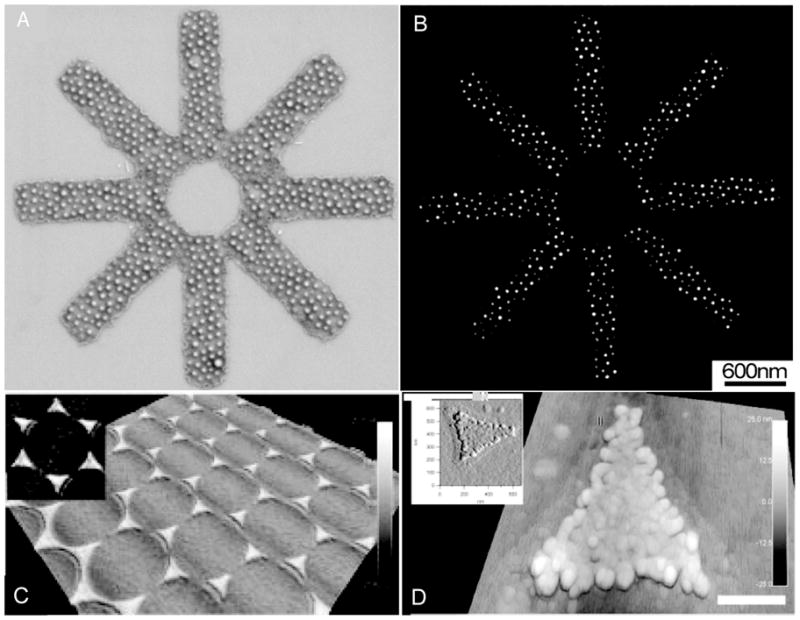
Examples of Nanoscale topographies for 2D cell-substrate investigations. (A, B) Hierarchal star structure is made by using a block copolymer templating technique where electron beam lithography is used to form 7 nm gold particles on substrate reproduced with permission from ref. (doi: 10.1088/0957-4484/14/10/314 ). (C, D) Nano-sized polystyrene is used to template a functional gold surface to create nano-features. [66]
Figure 3
Figure 3
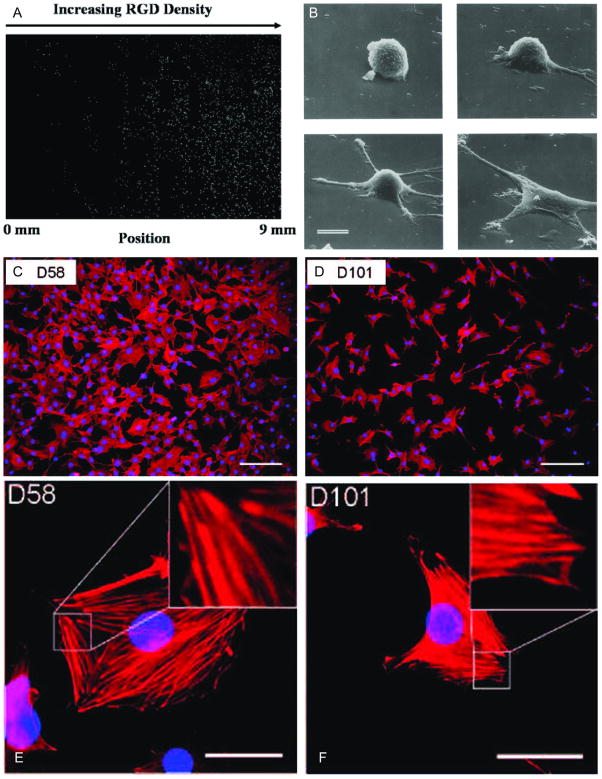
Examples of cellular morphology on 2D substrate with nanoscale presentation of bioactive ligands. (A) Image of nuclear stained cells on RGD density gradient. Cell density increase with increasing RGD density. [91] (B) Scanning electron microscope image of cell-substrate adhesion with different degrees of cell spreading. (© Rockefeller University Press, 1991. Originally published in J. Cell Biol. 114: 1089–1100). [28] (C, D) Attachment of osteoblasts on disordered RGD modified substrate. Decoupled RGD density from spacing demonstrated a significant decrease in cell attachment for RGD spacing >70 nm. (E, F) Higher magnification shows actin filament distribution caused by cell-substrate traction forces. Acin filament (red) nucleus (blue); numbers on top-left represent average RGD spacing. [96]
Figure 4
Figure 4
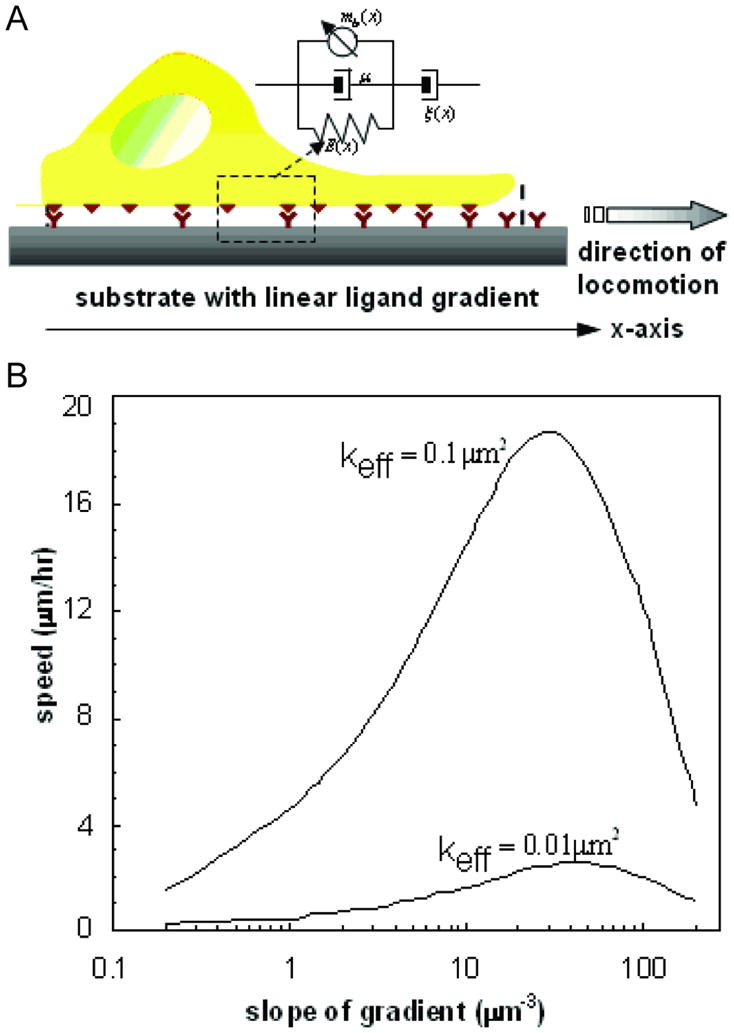
Modeling 2D cell migration. (A) Representation of forces involved in cell locomotion. ξ (x) is the position-dependant friction coefficient due to repetitive attachment-detachment interactions between the cell surface receptors and ligands on the substrate. E(x) and μ represent the elasticity and viscosity of cytoskeleton and cytosol, respectively. The myosin dynamics is described by the density of myosin molecules bound to actin microfilaments and generating contractile stress mb (x). (B) The speed of cell migration as a function of the slope of the gradient of cell adhesion ligands shows a biphasic distribution of cell migration. The speed of cell migration increases to a maximum prior to decreasing with increasing cell adhesion ligands.[112]
Figure 5
Figure 5
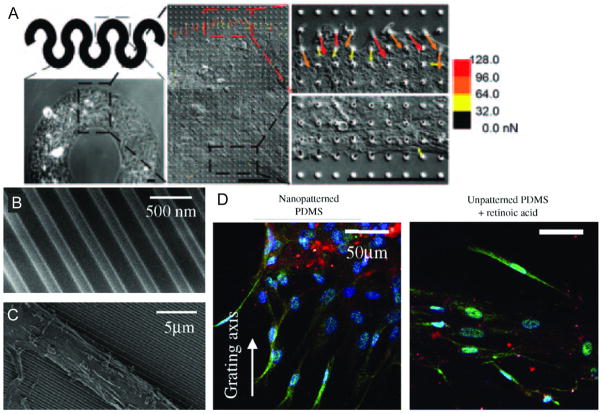
Complex cell behavior on nanopatterned substrates. (A) Geometric related tension on cells directs mesenchymal stem cell fate. Vector map on right panels sow traction forces imposed on cells. [29] (B) Scanning electron images of nanoscale graftings on 2D substrate. (C) Cellular elongation along axis of nanografting. (D) Cells grown on nanopatterned gratings shown to the left and planar substrate containing neuronal stimulator (retinoic acid0 are stained for cell nucleus (blue), nestin (red), MAP2 (green). [67]
Figure 6
Figure 6
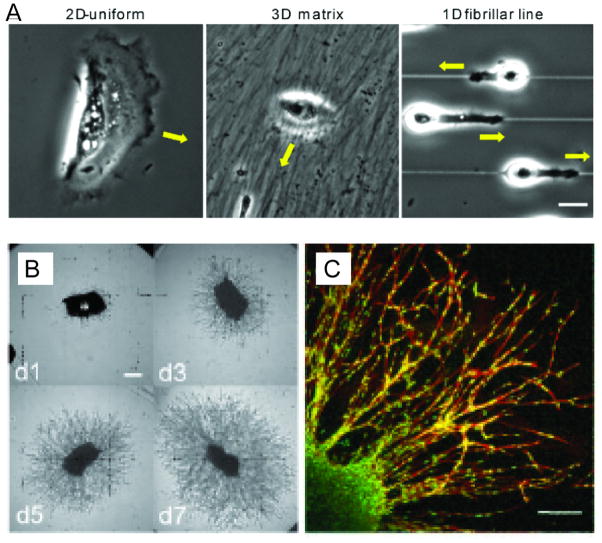
Cell migration in 3D. (A) A comparison of cell migration in 1D, 2D, and 3D(© Doyle et al., 2009. J. Cell Biol. doi:10.1083/jcb.200810041).[157] The images show fibroblast morphology and migration on microengineered fibronectin substrates including 2D (left) and 3D (middle) fibronectin substrates, and along 1D fibrillar lines. (B, C) Fibroblasts invading a PEG-based hydrogel that is sensitive to proteolytic cleavage from cell-secreted protease.[128]
Figure 7
Figure 7
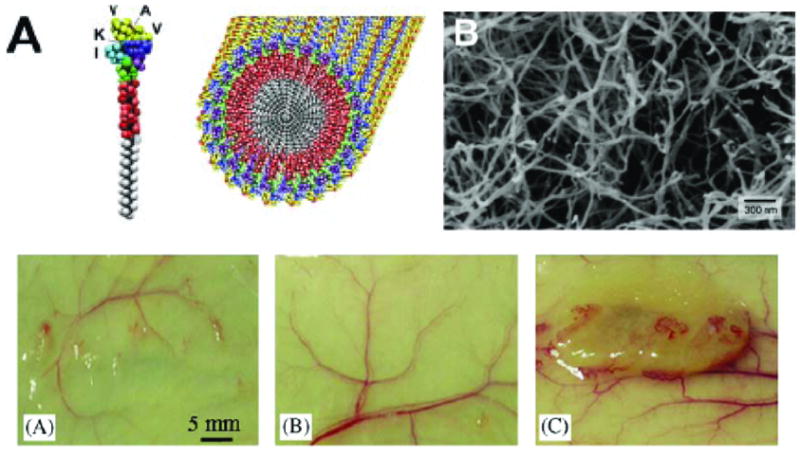
Nanofiber hydrogels from peptide amphphiles. Top: (A) Cartoon of the single peptide amphiphile and a self-assembled nanofiber.[132] (B) A scanning electron micrograph of a nanofiber network.[132] Bottom: (A) Representative photographs of tissue samples with injected angiogenetic peptide amphiphile hydrogels, (A) control nanofiber hydrogel, (B) control bFGF solution, and (C) bFBF containing nanofiber hydrogel.[156]

References

    1. Massia SP, Hubbell JA. Human endothelial cell interactions with surface-coupled adhesion peptides on a nonadhesive glass substrate and two polymeric biomaterials. J Biomed Mat Res. 1991;25(2):223–242. - PubMed
    1. Banerjee P, et al. Polymer latexes for cell-resistant and cell-interactive surfaces. J Biomed Mat Res. 2000;50(3):331–339. - PubMed
    1. Tong YW, Shoichet MS. Peptide surface modification of poly(tetrafluoroethylene-co-hexafluoropropylene) enhances its interaction with central nervous system neurons. J of Biomed Mat Res. 1998;42(1):85–95. - PubMed
    1. Nilsson K, Mosbach K. [2] Immobilization of ligands with organic sulfonyl chlorides. In: William BJ, editor. Methods in Enzymology. Academic Press; 1984. pp. 56–69. - PubMed
    1. Barrera DA, et al. Copolymerization and Degradation of Poly(lactic acid-co-lysine) Macromole. 1995;28(2):425–432.

Publication types

Substances