


The MATRICS consensus cognitive battery in patients with bipolar I disorder
- PMID: 21451499
- PMCID: PMC3138672
- DOI: 10.1038/npp.2011.36
The MATRICS consensus cognitive battery in patients with bipolar I disorder
Abstract
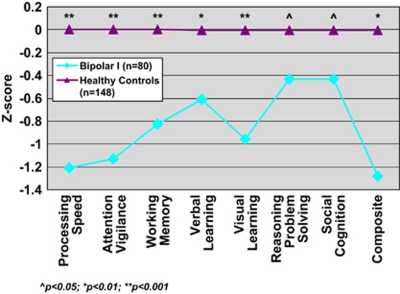
The Measurement and Treatment Research to Improve Cognition in Schizophrenia (MATRICS) initiative was devised to identify a neurocognitive battery to be used in clinical trials targeting cognition in schizophrenia, a process, which resulted in the MATRICS Consensus Cognitive Battery (MCCB). The MCCB has been selected by the United States Food and Drug Administration to be used as the primary outcome measure in registry trials for cognitive agents in schizophrenia. Given the clinical and cognitive overlap between schizophrenia and bipolar disorder (BPD), it is likely that any compound shown to have cognitive benefits in schizophrenia will subsequently be tested in BPD. Unlike the MCCB for schizophrenia, there remains no consensus regarding outcome measures if cognitive trials were to be undertaken in BPD. The utility of the MCCB in BPD has not yet been systematically investigated. We administered the MCCB to 80 bipolar I patients; 37 were strictly euthymic and 43 were symptomatic. We compared their performance with a demographically matched healthy sample (n=148) on seven MCCB domains, and the composite. BPD patients were statistically significantly impaired on five of seven MCCB domains at levels consistent with meta-analytic studies of cognition in BPD. In contrast, patients' performance was less impaired on the Reasoning and Problem-solving and Social Cognition domains, differences that did not survive statistical correction for multiple testing. Symptomatic status only modestly influenced performance. These data suggest that the MCCB, devised for use in schizophrenia, may also represent a useful outcome measure in cognitive trials for BPD. Additional studies should address important psychometric features such as repeatability and potential practice and/or ceiling effects.
Figures
References
-
- Arts B, Jabben N, Krabbendam L, van Os J. Meta-analyses of cognitive functioning in euthymic bipolar patients and their first-degree relatives. Psychol Med. 2008;38:771–785. - PubMed
-
- Bora E, Yucel M, Pantelis C. Cognitive endophenotypes of bipolar disorder: a meta-analysis of neuropsychological deficits in euthymic patients and their first-degree relatives. J Affect Disord. 2009a;113:1–20. - PubMed
-
- Bora E, Yucel M, Pantelis C. Theory of mind impairment: a distinct trait-marker for schizophrenia spectrum disorders and bipolar disorder. Acta Psychiatr Scand. 2009b;120:253–264. - PubMed
Publication types
MeSH terms
Grants and funding
LinkOut - more resources
Full Text Sources
Medical
Miscellaneous
