


Morningness-eveningness, chronotypes and health-impairing behaviors in adolescents
- PMID: 21452919
- PMCID: PMC3818690
- DOI: 10.3109/07420528.2010.549599
Morningness-eveningness, chronotypes and health-impairing behaviors in adolescents
Abstract
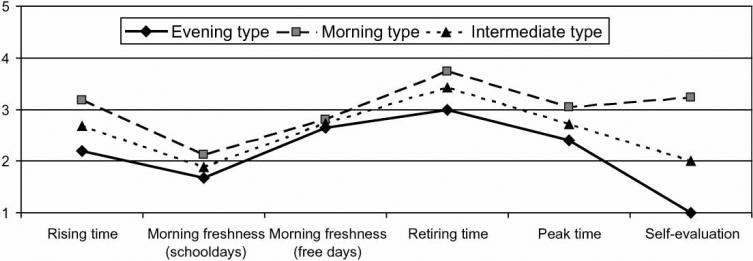
The impact of diurnal preferences on health-related behaviors is acknowledged but relatively understudied. The aim of this study was threefold: (1) testing the measurement model of the Hungarian version of the reduced Horne-Östberg Morningness-Eveningness Questionnaire (Hungarian Version of the rMEQ); (2) estimating chronotypes and their prevalence; and (3) analyzing the relationship between morningness-eveningness/chronotypes and health-impairing behaviors, including smoking, alcohol use, and physical inactivity in adolescents. Self-reported data on the Hungarian version of the rMEQ, smoking, alcohol use, and physical inactivity obtained from Hungarian high-school students (ninth grade, N = 2565) were analyzed with confirmatory factor analysis (CFA), latent profile analysis (LPA), structural equation modeling, and analysis of variance (ANOVA). A one-factor model of morningness was supported, which included rising time, peak time, retiring time, and self-evaluation of chronotype. Morningness was significantly associated with a lower likelihood of smoking and alcohol use, and also with a lower level of physical inactivity. Using LPA, the authors identified three chronotypes: intermediate type (50.7%), morning type (30.5%), and evening type (18.8%). Compared to the evening-type participants, intermediate- and morning-type participants were significantly less likely to experiment with smoking, to smoke nondaily, and to smoke daily. Moreover, both intermediate- and morning-type students reported less lifetime alcohol use and less physical inactivity than evening-type students. Chronopsychological research can help to understand the relatively unexplored determinants of health-impairing behaviors in adolescents associated with chronotype.
Figures
References
-
- Adan A. Chronotype and personality factors in the daily consumption of alcohol and psychostimulants. Addiction. 1994;89:455–462. - PubMed
-
- Adan A, Almirall H. Horne & Östberg Morningness-Eveningness Questionnaire: a reduced scale. Pers. Individ. Diff. 1991;12:241–253.
-
- Adan A, Sánchez-Turet M. Smoking effects on diurnal variations of cardiovascular parameters. Int. J. Psychophysiol. 1995;20:189–198. - PubMed
-
- Adan A, Prat G, Sánchez-Turet M. Effects of nicotine dependence on diurnal variations of subjective activation and mood. Addiction. 2004;9:1599–607. - PubMed
-
- Adan A, Lachica J, Caci H, Natale V. Circadian typology and temperament and character personality dimensions. Chronobiol. Int. 2010a;27:181–193. - PubMed
Publication types
MeSH terms
Grants and funding
LinkOut - more resources
Full Text Sources
Medical
Miscellaneous
