


Review
doi: 10.1586/erc.10.184.
Radiation exposure from imaging tests: is there an increased cancer risk?
Affiliations
- PMID: 21453214
- PMCID: PMC3102578
- DOI: 10.1586/erc.10.184
Item in Clipboard
Review
Radiation exposure from imaging tests: is there an increased cancer risk?
Expert Rev Cardiovasc Ther.
2011 Feb.
Abstract
The increasing exposure to low-dose radiation from diagnostic testing has prompted renewed interest in evaluating its carcinogenic risk, but quantifying health risk from low-dose radiation exposure remains controversial. The current approach is to adopt the linear non-threshold model, which is commonly applied to high-dose exposure, and apply it to assess risk from low-dose exposure. However, existing data are conflicting and limited to epidemiological studies and/or in vitro analyses. In this article, we will discuss the potential cancer risk from low- and high-dose radiation, their effects on DNA repair response pathways, and the best course of action for patients and providers to minimize risk.
Figures
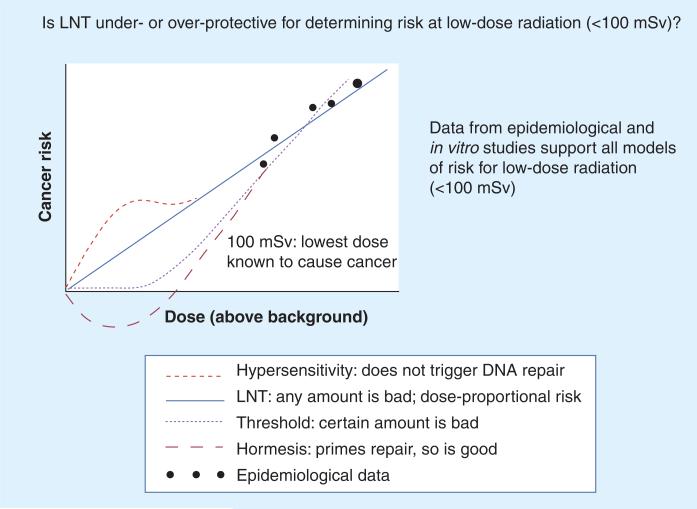
In the LNT model, risk is proportional to the dose, so even the smallest dose induces cancer. In the threshold model, a certain threshold needs to be reached before the risk of cancer increases. In the hypersensitivity model, risk at lower doses is even higher than predicted by the LNT model, because at low doses (<100 mSv) DNA repair systems are not triggered. In the hormesis model, risk at low doses (<100 mSv) is less than predicted by the LNT model because chronic exposure to low-dose radiation stimulates DNA repair mechanisms. LNT: Linear non-threshold; mSv: Millisieverts. Adapted with permission from the Canadian Nuclear Safety Commission.
References
-
- National Council on Radiation Protection and Measurements . Ionizing radiation exposure of the population of the United States. National Council on Radiation Protection and Measurements; MD, USA: 2009. National Council on Radiation Protection report no. 160.
-
- Einstein AJ, Moser KW, Thompson RC, Cerqueira MD, Henzlova MJ. Radiation dose to patients from cardiac diagnostic imaging. Circulation. 2007;116:1290–1305. - PubMed
-
- 2003 Nuclear Medicine Census Market Summary Report. IMV Medical Information Division; IL, USA: 2003. No authors listed.
-
- 2004 CT Census Market Summary Report. IMV Medical Information Division; IL, USA: 2005. No authors listed.
Website
-
- Canadian Nuclear Safety Commission: Low-level radiation: how the linear no-threshold model keeps canadians safe. http://nuclearsafety.gc.ca/eng/mediacentre/perspectives/linear_no_thresh....
Publication types
MeSH terms
Grants and funding
LinkOut - more resources
Full Text Sources
Medical
