


Isoflurane preconditioning at clinically relevant doses induce protective effects of heme oxygenase-1 on hepatic ischemia reperfusion in rats
- PMID: 21453462
- PMCID: PMC3088533
- DOI: 10.1186/1471-230X-11-31
Isoflurane preconditioning at clinically relevant doses induce protective effects of heme oxygenase-1 on hepatic ischemia reperfusion in rats
Abstract
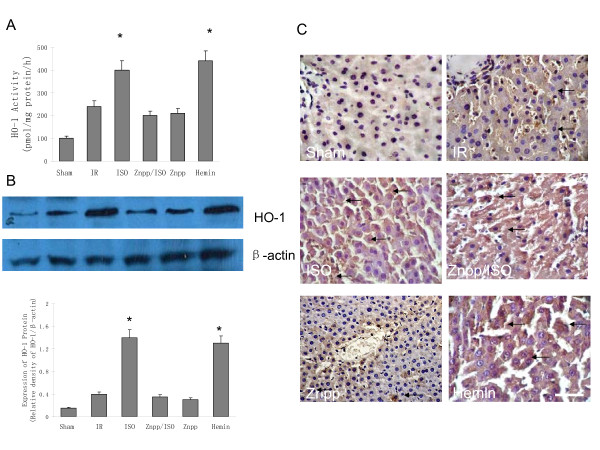
Background: Activation of heme oxygenase-1 (HO-1) has been proved to reduce damages to the liver in ischemia reperfusion injury. The objective of present study was to determine whether clinic relevant doses of isoflurane treatment could be sufficient to activate HO-1 inducing, which confers protective effect against hepatic ischemia-reperfusion injury.
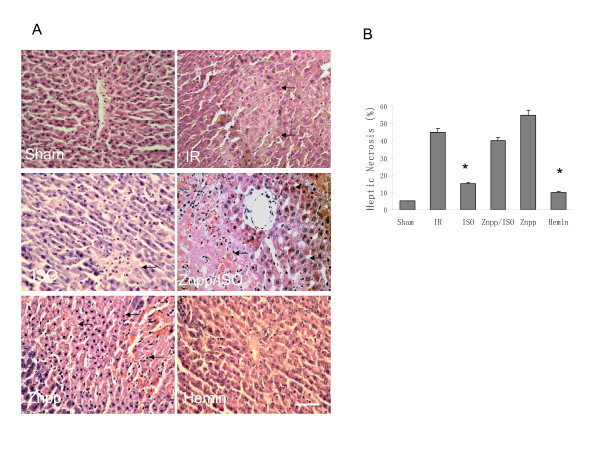
Methods: The hepatic artery and portal vein to the left and the median liver lobes of forty male Sprague-Dawley rats were occluded for 60 minutes. Reperfusion was allowed for 4 hours before the animal subjects were sacrificed. Six groups (n = 12) were included in the study. A negative control group received sham operation and positive control group a standard ischemia-reperfusion regimen. The third group was pretreated with isoflurane prior to the ischemia-reperfusion. The fourth group received an HO-1 inhibitor zinc protoporphyrin (Znpp) prior to the isoflurane pretreatment and the ischemia-reperfusion. The fifth group received Znpp alone before ischemia-reperfusion procedure, and the sixth group was administrated with a HO-1 inducer hemin prior to IR. HO-1 in the liver was measured using an enzymatic activity assay, a Western blot analysis, as well as immunohistochemical method. Extent of liver damage was estimated by determination of the serum transaminases, liver lipid peroxidation and hepatic histology. Infiltration of the liver by neutrophils was measured using a myeloperoxidase activity assay. TNFα mRNA in the liver was measured using RT-PCR.
Results: Isoflurane pretreatment significantly attenuated the hepatic injuries and inflammatory responses caused by the ischemia reperfusion. Selectively inhibiting HO-1 with ZnPP completed blocked the protective effects of isoflurane. Inducing HO-1 with hemin alone produced protective effects similar in magnitude to that of isoflurane.
Conclusions: Clinic relevant doses of isoflurane attenuate ischemia reperfusion injury in rats by increasing the HO-1 expression and activity.
Figures
References
-
- Suttner DM, Sridhar K, Lee CS, Tomura T, Hansen TN, Dennery PA. Protective effects of transient HO-1 overexpression on susceptibility to oxygen toxicity in lung cells. Am J Physiol. 1999;276(3 Pt 1):L443–451. - PubMed
-
- Ke B, Buelow R, Shen XD, Melinek J, Amersi F, Gao F, Ritter T, Volk HD, Busuttil RW, Kupiec-Weglinski JW. Heme oxygenase 1 gene transfer prevents CD95/Fas ligand-mediated apoptosis and improves liver allograft survival via carbon monoxide signaling pathway. Hum Gene Ther. 2002;13(10):1189–1199. doi: 10.1089/104303402320138970. - DOI - PubMed
-
- Takizawa S, Hirabayashi H, Matsushima K, Tokuoka K, Shinohara Y. Induction of heme oxygenase protein protects neurons in cortex and striatum, but not in hippocampus, against transient forebrain ischemia. J Cereb Blood Flow Metab. 1998;18(5):559–569. doi: 10.1097/00004647-199805000-00011. - DOI - PubMed
Publication types
MeSH terms
Substances
LinkOut - more resources
Full Text Sources
Research Materials
