


Elevated airway purines in COPD
- PMID: 21454402
- PMCID: PMC3186686
- DOI: 10.1378/chest.10-2471
Elevated airway purines in COPD
Abstract
Background: Adenosine and related purines have established roles in inflammation, and elevated airway concentrations are predicted in patients with COPD. However, accurate airway surface purine measurements can be confounded by stimulation of purine release during collection of typical respiratory samples.
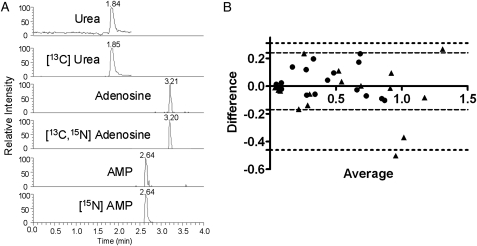
Methods: Airway samples were collected noninvasively as exhaled breath condensate (EBC) from 36 healthy nonsmokers (NS group), 28 healthy smokers (S group), and 89 subjects with COPD (29 with GOLD [Global Initiative for Chronic Obstructive Lung Disease] stage II, 29 with GOLD stage III, and 31 with GOLD stage IV) and analyzed with mass spectrometry for adenosine, adenosine monophosphate (AMP), and phenylalanine, plus urea as a dilution marker. Variable dilution of airway secretions in EBC was controlled using ratios to urea, and airway surface concentrations were calculated using EBC to serum urea-based dilution factors.
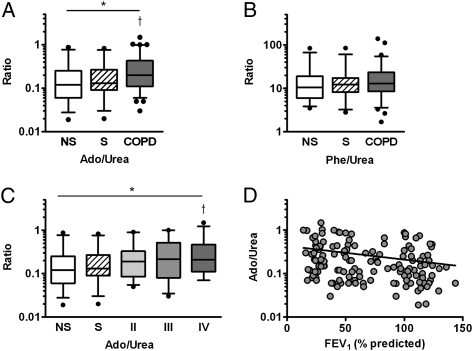
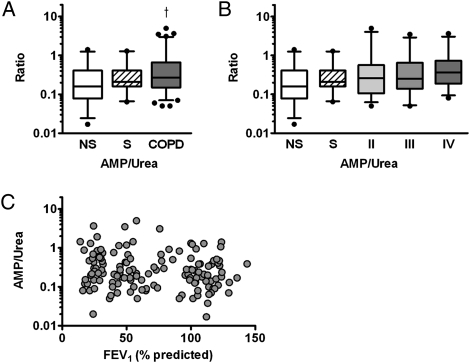
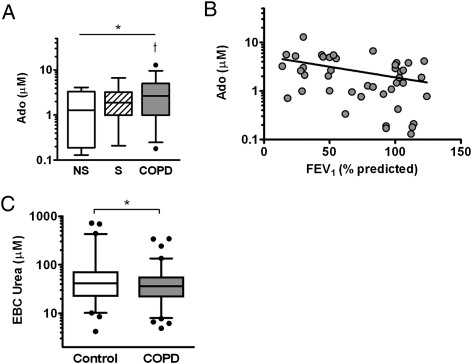
Results: EBC adenosine to urea ratios were similar in NS (0.20 ± 0.21) and S (0.22 ± 0.20) groups but elevated in those with COPD (0.32 ± 0.30, P < .01 vs NS). Adenosine to urea ratios were highest in the most severely affected cohort (GOLD IV, 0.35 ± 0.34, P < .01 vs NS) and negatively correlated with FEV(1) (r = -0.27, P < .01). Elevated AMP to urea ratios were also observed in the COPD group (0.58 ± 0.97 COPD, 0.29 ± 0.35 NS, P < .02), but phenylalanine to urea ratios were similar in all groups. Airway surface adenosine concentrations calculated in a subset of subjects were 3.2 ± 2.7 μM in those with COPD (n = 28) relative to 1.7 ± 1.5 μM in the NS group (n = 16, P < .05).
Conclusions: Airway purines are present on airway surfaces at physiologically significant concentrations, are elevated in COPD, and correlate with markers of COPD severity. Purinergic signaling pathways are potential therapeutic targets in COPD, and EBC purines are potential noninvasive biomarkers.
Figures
References
-
- Spicuzza L, Di Maria G, Polosa R. Adenosine in the airways: implications and applications. Eur J Pharmacol. 2006;533(1-3):77–88. - PubMed
-
- Mann JS, Holgate ST, Renwick AG, Cushley MJ. Airway effects of purine nucleosides and nucleotides and release with bronchial provocation in asthma. J Appl Physiol. 1986;61(5):1667–1676. - PubMed
-
- Vizi E, Huszár E, Csoma Z, et al. Plasma adenosine concentration increases during exercise: a possible contributing factor in exercise-induced bronchoconstriction in asthma. J Allergy Clin Immunol. 2002;109(3):446–448. - PubMed
-
- Driver AG, Kukoly CA, Ali S, Mustafa SJ. Adenosine in bronchoalveolar lavage fluid in asthma. Am Rev Respir Dis. 1993;148(1):91–97. - PubMed
-
- Huszár E, Vass G, Vizi E, et al. Adenosine in exhaled breath condensate in healthy volunteers and in patients with asthma. Eur Respir J. 2002;20(6):1393–1398. - PubMed
Publication types
MeSH terms
Substances
Grants and funding
LinkOut - more resources
Full Text Sources
Medical
Miscellaneous
