. 2011 May 6;286(18):16491-503.
doi: 10.1074/jbc.M110.194167. Epub 2011 Mar 18.

Single substitution within the RKTR motif impairs kinase activity but promotes dimerization of RAF kinase

Affiliations

Single substitution within the RKTR motif impairs kinase activity but promotes dimerization of RAF kinase

Angela Baljuls et al. J Biol Chem. .

Abstract

The serine/threonine kinase RAF is a central component of the MAPK cascade. Regulation of RAF activity is highly complex and involves recruitment to membranes and association with Ras and scaffold proteins as well as multiple phosphorylation and dephosphorylation events. Previously, we identified by molecular modeling an interaction between the N-region and the RKTR motif of the kinase domain in RAF and assigned a new function to this tetrapeptide segment. Here we found that a single substitution of each basic residue within the RKTR motif inhibited catalytic activity of all three RAF isoforms. However, the inhibition and phosphorylation pattern of C-RAF and A-RAF differed from B-RAF. Furthermore, substitution of the first arginine led to hyperphosphorylation and accumulation of A-RAF and C-RAF in plasma membrane fraction, indicating that this residue interferes with the recycling process of A-RAF and C-RAF but not B-RAF. In contrast, all RAF isoforms behave similarly with respect to the RKTR motif-dependent dimerization. The exchange of the second arginine led to exceedingly increased dimerization as long as one of the protomers was not mutated, suggesting that substitution of this residue with alanine may result in similar a structural rearrangement of the RAF kinase domain, as has been found for the C-RAF kinase domain co-crystallized with a dimerization-stabilizing RAF inhibitor. In summary, we provide evidence that each of the basic residues within the RKTR motif is indispensable for correct RAF function.


Figures

FIGURE 1.
FIGURE 1.
Molecular model for interaction between the N-region and the catalytic domain in B-RAF and C-RAF. A, shown is a schematic presentation of A-, B-, and C-RAF proteins and sequence alignment of the N-region and the RKTR motif. Conserved regulatory phosphorylation sites within the N-region and 14-3-3 binding segments are indicated. Light-shaded boxes, non-conserved parts of the sequence; dark-shaded boxes, conserved regions. CR1 comprises the Ras binding (RBD) and the cysteine-rich domain (CRD). CR2 is the serine-threonine rich domain, and CR3 is the kinase domain. The position of the N-region is highlighted in blue, whereas that of the RKTR motif is in red. B and C, modeling of the spatial orientation of the N-region relative to the RKTR motif of the kinase domain in B-RAF (A) and C-RAF (B). Although the structure of the kinase domain is highlighted in green, the N-region peptide is highlighted in light blue. Positions of the amino acids within the N-region and the amino acids of the kinase domain making interactions with the N-region are indicated.
FIGURE 2.
FIGURE 2.
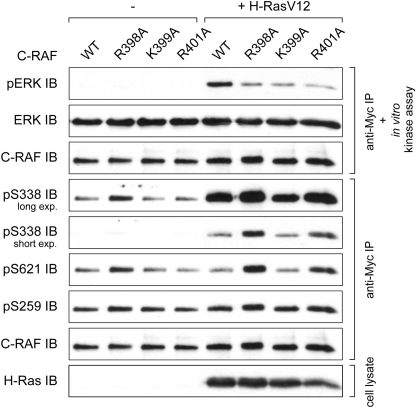
Single substitution of basic residues within the RKTR motif impairs catalytic activity of C-RAF. Kinase activity and phosphorylation status of the C-RAF RKTR mutants are shown. Myc-tagged C-RAF was expressed alone or together with H-RasV12 in COS7 cells. The kinase was immunoprecipitated by anti-Myc antibody, and catalytic activity was analyzed in an in vitro kinase assay using purified MEK and ERK as substrates. Phosphorylation status of C-RAF was analyzed by use of appropriate phosphospecific antibodies. Expression efficiency of H-RasV12 was determined by anti-H-Ras antibody.
FIGURE 3.
FIGURE 3.
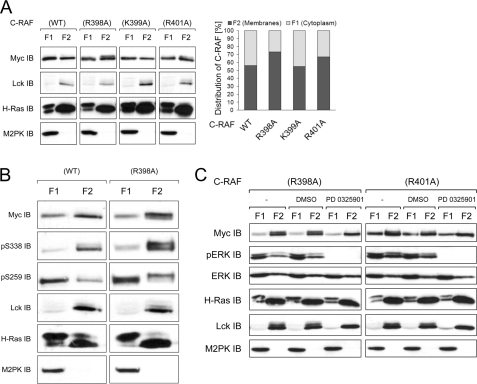
Membrane-located fraction of C-RAF-R398A and C-RAF-R401A display electrophoretic mobility shift. A, shown is subcellular distribution of the C-RAF RKTR mutants (immunoblot and quantification). Myc-tagged C-RAF WT and mutants were transfected together with H-RasV12 and Lck into COS7 cells. 24 h after transfection, cytoplasmic, membrane, nuclear (not shown), and cytoskeletal (not shown) fractions were collected. Data from three independent experiments were quantified by optical densitometry. Values represent the % ratio of C-RAF protein in each fraction relative to the total C-RAF protein detected in both cytosolic and membrane fractions together. B, phosphorylation status of the cytosol versus membrane-located C-RAF WT and C-RAF-R398A (close-up view) is shown. C, electrophoretic mobility of C-RAF-R398A and C-RAF-R401A upon treatment with the MEK inhibitor PD0325901 is shown. COS7 cells expressing Myc-tagged C-RAF-R398A and C-RAF-R401A together with H-RasV12 and Lck were treated with PD0325901 (10 μm) for 3 h before cytoplasmic, and membrane fractions were collected. PD0325901 mediated inhibition of ERK activity was confirmed by anti-pERK immunoblot. Although anti-ERK immunodetection was used as a loading control, anti-M2PK and anti-Lck were used as a control for cytosolic and membrane fraction, respectively. Expression efficiency of H-RasV12 and Lck were confirmed by appropriate antibodies.
FIGURE 4.
FIGURE 4.
Regulation of A-RAF by RKTR motif is similar to C-RAF. A, shown are kinase activity and the phosphorylation status of the A-RAF RKTR mutants. Myc-tagged A-RAF WT and indicated mutants were expressed alone or together with H-RasV12 and Lck in COS7 cells. The A-RAF proteins were immunoprecipitated by anti-Myc antibody, and catalytic activity was analyzed in an in vitro kinase assay using purified MEK and ERK as substrates. Phosphorylation status of A-RAF was analyzed by use of appropriate phosphospecific antibodies. B, subcellular distribution of the A-RAF RKTR mutants (immunoblot and quantification) is shown. Myc-tagged A-RAF WT and mutants were transfected together with H-RasV12 and Lck into COS7 cells. 24 h after transfection, cytoplasmic, membrane, nuclear (not shown), and cytoskeletal (not shown) fractions were collected. Data from three independent experiments were quantified by optical densitometry. Values represent the % ratio of A-RAF protein in each fraction relative to the total A-RAF protein detected in both cytosolic and membrane fractions together. Anti-M2PK and anti-Lck immunodetection was used as a fractionation control for cytosolic and membrane fraction, respectively. Expression efficiency of H-RasV12 and Lck were confirmed by appropriate antibodies. C, electrophoretic mobility of A-RAF-R359A upon treatment with the MEK inhibitor PD0325901 is shown. COS7 cells expressing Myc-tagged A-RAF-R359A together with H-RasV12 and Lck were treated as described in Fig. 3C.
FIGURE 5.
FIGURE 5.
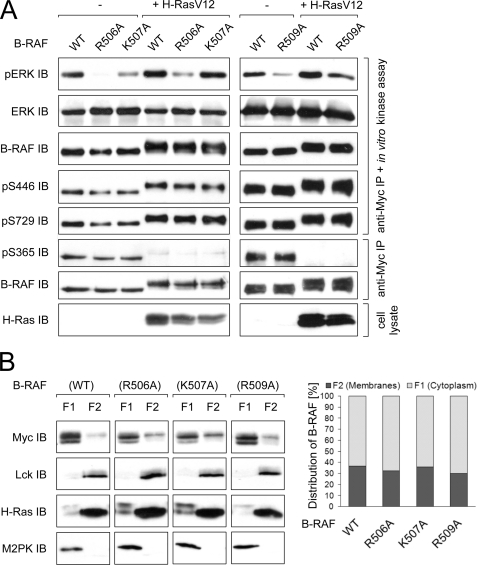
Regulation of B-RAF by RKTR motif differs significantly from C-RAF and A-RAF. A, kinase activity and phosphorylation status of the B-RAF RKTR mutants are shown. Myc-tagged B-RAF WT and the indicated mutants were expressed alone or together with H-RasV12 in COS7 cells. The B-RAF proteins were immunoprecipitated by anti-Myc antibody, and catalytic activity was analyzed in an in vitro kinase assay using purified MEK and ERK as substrates. Phosphorylation status of B-RAF was analyzed by use of appropriate phosphospecific antibodies. B, shown is subcellular distribution of the B-RAF RKTR mutants (immunoblot and quantification). Myc-tagged B-RAF WT and mutants were transfected together with H-RasV12 and Lck into COS7 cells. 24 h after transfection, cytoplasmic, membrane, nuclear (not shown), and cytoskeletal (not shown) fractions were collected. Data from three independent experiments were quantified by optical densitometry. Values represent the % ratio of B-RAF protein in each fraction relative to the total B-RAF protein detected in both cytosolic and membrane fractions together. Anti-M2PK and anti-Lck immunodetection was used as a fractionation control for cytosolic and membrane fraction, respectively. Expression efficiency of H-RasV12 was confirmed by appropriate antibody.
FIGURE 6.
FIGURE 6.
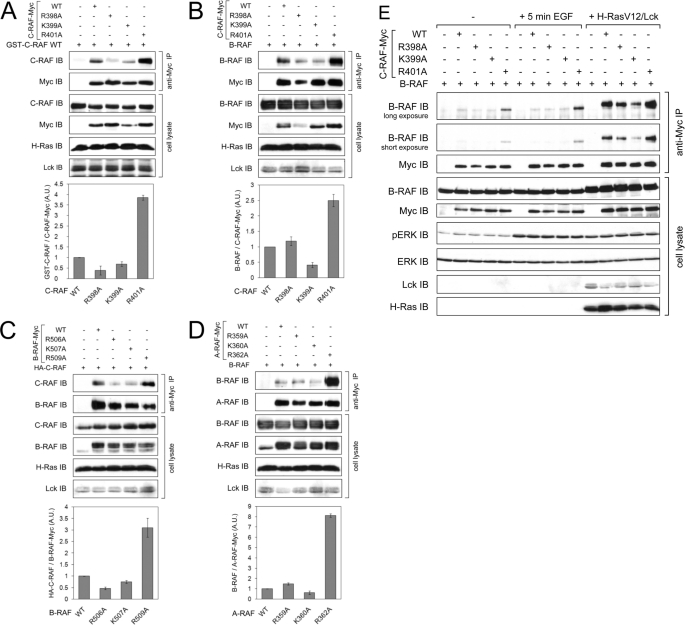
Substitution of the second arginine within the RKTR motif in one of the RAF protomers leads to a strongly increased homo- and heterodimer formation. Myc-tagged RAF WT or the indicated RKTR mutants were transfected into COS7 cells together with either untagged B-RAF WT, HA-tagged C-RAF WT, or GST-tagged C-RAF WT. Dimerization of RAF proteins was induced by co-transfection with H-RasV12 and Lck. RAF dimers were isolated from cell lysates by anti-Myc immunoprecipitation. Expression efficiency of H-RasV12 and Lck was confirmed by appropriate antibodies. For each part of the figure, data from three independent experiments were quantified by optical densitometry. The quantification results are expressed in terms of -fold dimer formation, where 1-fold represents the amount of immunoprecipitated dimer complexes for RAF WT. A, shown is homodimerization of Myc-tagged C-RAF WT and the indicated mutants with GST-tagged C-RAF WT. A.U., absorbance units. B, shown is heterodimerization of Myc-tagged C-RAF WT and the indicated mutants with untagged B-RAF WT. C, shown is heterodimerization of Myc-tagged B-RAF WT and the indicated mutants with HA-tagged C-RAF WT. D, shown is heterodimerization of Myc-tagged A-RAF WT and the indicated mutants with untagged B-RAF WT. E, shown is heterodimerization of Myc-tagged C-RAF WT and the indicated mutants with untagged B-RAF WT in non-stimulated cells, cells activated with EGF (100 ng/ml) for 5 min, and cells co-transfected with H-RasV12 and Lck.
FIGURE 7.
FIGURE 7.
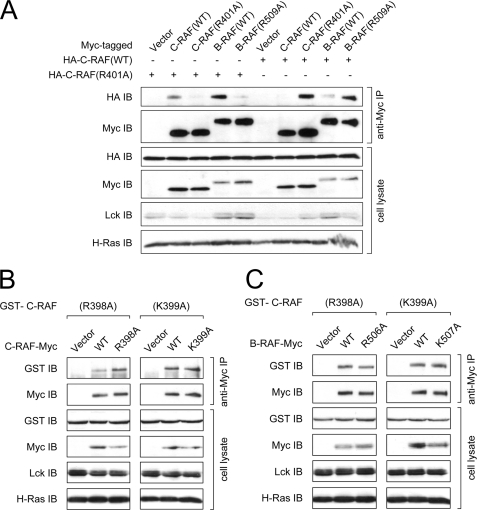
Increased dimerization of the C-RAF-R401A and B-RAF-R509A was reduced to the level of the wild type if both protomers were mutated. A, homo- and heterodimerization of C-RAF-R401A mutant is shown. For homodimerization, Myc-tagged C-RAF WT or C-RAF-R401A mutant were transfected into COS7 cells together with HA-tagged C-RAF WT or C-RAF-R401A, whereas for heterodimerization, Myc-tagged B-RAF WT or B-RAF-R509A mutant were transfected together with HA-tagged C-RAF WT or C-RAF-R401A. B, homodimerization of C-RAF-R398A and C-RAF-K399A mutants is shown. For homodimerization, Myc-tagged C-RAF WT, C-RAF-R398A, or C-RAF-K399A mutants were transfected into COS7 cells together with GST-tagged C-RAF-R398A or C-RAF-K399A. C, for heterodimerization, Myc-tagged B-RAF WT, B-RAF-R506A, or B-RAF-K507A mutants were transfected into COS7 cells together with GST-tagged C-RAF-R398A or C-RAF-K399A. Dimerization of RAF proteins was induced by co-transfection with H-RasV12 and Lck. RAF dimers were isolated from cell lysates by anti-Myc immunoprecipitation. Expression efficiency of H-RasV12 and Lck were confirmed by appropriate antibodies.

References

    1. Rapp U. R., Goldsborough M. D., Mark G. E., Bonner T. I., Groffen J., Reynolds F. H., Jr., Stephenson J. R. (1983) Proc. Natl. Acad. Sci. U.S.A. 80, 4218–4222 - PMC - PubMed
    1. Dhillon A. S., Kolch W. (2002) Arch. Biochem. Biophys. 404, 3–9 - PubMed
    1. Wellbrock C., Karasarides M., Marais R. (2004) Nat. Rev. Mol. Cell Biol. 5, 875–885 - PubMed
    1. Rapp U. R., Götz R., Albert S. (2006) Cancer Cell 9, 9–12 - PubMed
    1. Polzien L., Baljuls A., Rennefahrt U. E., Fischer A., Schmitz W., Zahedi R. P., Sickmann A., Metz R., Albert S., Benz R., Hekman M., Rapp U. R. (2009) J. Biol. Chem. 284, 28004–28020 - PMC - PubMed

Publication types