. 2011 May 27;286(21):18658-63.
doi: 10.1074/jbc.M111.232876. Epub 2011 Mar 18.

Direct evidence for methyl group coordination by carbon-oxygen hydrogen bonds in the lysine methyltransferase SET7/9

Affiliations

Direct evidence for methyl group coordination by carbon-oxygen hydrogen bonds in the lysine methyltransferase SET7/9

Scott Horowitz et al. J Biol Chem. .

Abstract

SET domain lysine methyltransferases (KMTs) are S-adenosylmethionine (AdoMet)-dependent enzymes that catalyze the site-specific methylation of lysyl residues in histone and non-histone proteins. Based on crystallographic and cofactor binding studies, carbon-oxygen (CH · · · O) hydrogen bonds have been proposed to coordinate the methyl groups of AdoMet and methyllysine within the SET domain active site. However, the presence of these hydrogen bonds has only been inferred due to the uncertainty of hydrogen atom positions in x-ray crystal structures. To experimentally resolve the positions of the methyl hydrogen atoms, we used NMR (1)H chemical shift coupled with quantum mechanics calculations to examine the interactions of the AdoMet methyl group in the active site of the human KMT SET7/9. Our results indicated that at least two of the three hydrogens in the AdoMet methyl group engage in CH · · · O hydrogen bonding. These findings represent direct, quantitative evidence of CH · · · O hydrogen bond formation in the SET domain active site and suggest a role for these interactions in catalysis. Furthermore, thermodynamic analysis of AdoMet binding indicated that these interactions are important for cofactor binding across SET domain enzymes.


Figures
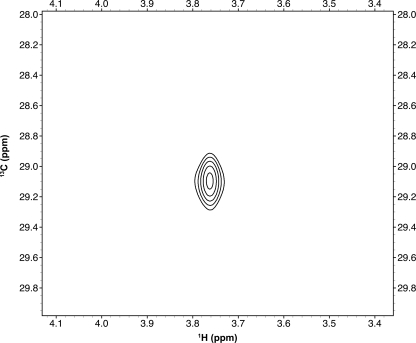
FIGURE 1.
FIGURE 1.
Two-dimensional HSQC of the SET7/9·[methyl-13C]AdoMet complex.
FIGURE 2.
FIGURE 2.
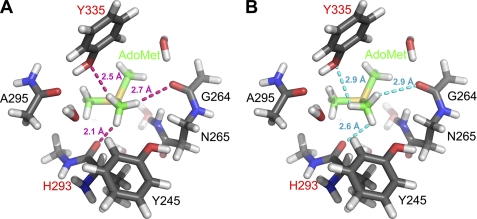
Optimized active site with bound AdoMet (A) and manually rotated geometry (B) to eliminate CH···O hydrogen bonds. Truncated AdoMet and the protein are depicted with green and gray carbon atoms, respectively. Residues labeled in red designate CH···O acceptors. H···O distances from methyl protons to nearest oxygen atom for optimized and broken geometry are shown in magenta and cyan, respectively. The crystal structure of the SET7/9·AdoMet complex (Protein Data Bank code 1N6A) was used as the model for the calculations.
FIGURE 3.
FIGURE 3.
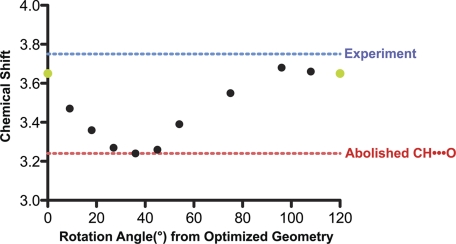
Chemical shift of the AdoMet methyl group as a function of rotation angle. 0° and 120°, rendered in green, are equivalent geometry optimized positions (displayed in Fig. 2A), whereas all other points were derived from manual rotation of the AdoMet methyl group. The point at 36° represents the chemical shift calculated from the AdoMet methyl conformation shown in Fig. 2B. The blue and red dashed lines indicate the experimental chemical shift and the structure calculated to contain the least CH···O hydrogen bonding, respectively.
FIGURE 4.
FIGURE 4.
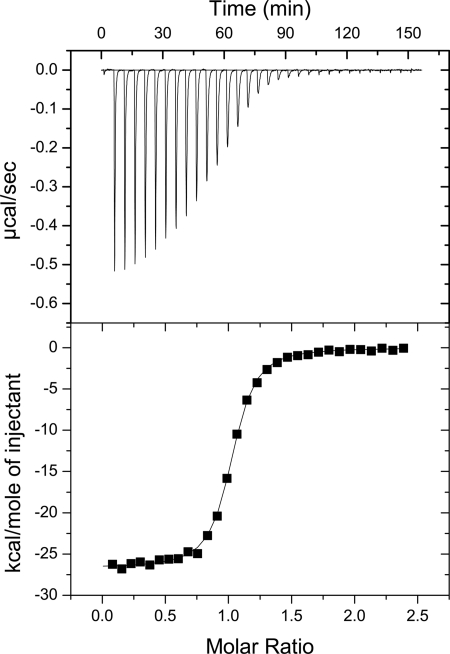
ITC analysis of AdoMet binding to SET7/9. The top panel represents the titration of AdoMet into SET7/9, whereas the bottom panel represents the binding isotherm with fitted curve.

References

    1. Albert M., Helin K. (2010) Semin. Cell Dev. Biol. 21, 209–220 - PubMed
    1. Dillon S. C., Zhang X., Trievel R. C., Cheng X. D. (2005) Genome Biol. 6, 227. - PMC - PubMed
    1. Pradhan S., Chin H. G., Esteve P. O., Jacobsen S. E. (2009) Epigenetics 4, 282–285 - PMC - PubMed
    1. Kwon T., Chang J. H., Kwak E., Lee C. W., Joachimiak A., Kim Y. C., Lee J., Cho Y. (2003) EMBO J. 22, 292–303 - PMC - PubMed
    1. Xiao B., Jing C., Wilson J. R., Walker P. A., Vasisht N., Kelly G., Howell S., Taylor I. A., Blackburn G. M., Gamblin S. J. (2003) Nature 421, 652–656 - PubMed

Publication types

LinkOut - more resources