


Long-term effects of Irbesartan treatment and smoking on nucleic acid oxidation in patients with type 2 diabetes and microalbuminuria: an Irbesartan in patients with type 2 diabetes and Microalbuminuria (IRMA 2) substudy
- PMID: 21454798
- PMCID: PMC3114487
- DOI: 10.2337/dc10-2214
Long-term effects of Irbesartan treatment and smoking on nucleic acid oxidation in patients with type 2 diabetes and microalbuminuria: an Irbesartan in patients with type 2 diabetes and Microalbuminuria (IRMA 2) substudy
Abstract
Objective: We tested whether long-term treatment with the angiotensin II receptor antagonist irbesartan reduces nucleic acid oxidation in patients with type 2 diabetes and microalbuminuria.
Research design and methods: The Irbesartan in Patients With Type 2 Diabetes and Microalbuminuria (IRMA 2) study was a 2-year multicenter randomized double-blind trial comparing irbesartan (150 and 300 mg once daily) with placebo. We studied a subgroup of 50 patients where urine samples were available for analysis of albumin and the oxidatively modified guanine nucleosides 8-oxo-7,8-dihydro-2'-deoxyguanosine (8-oxodG) and 8-oxo-7,8-dihydroguanosine (8-oxoGuo).
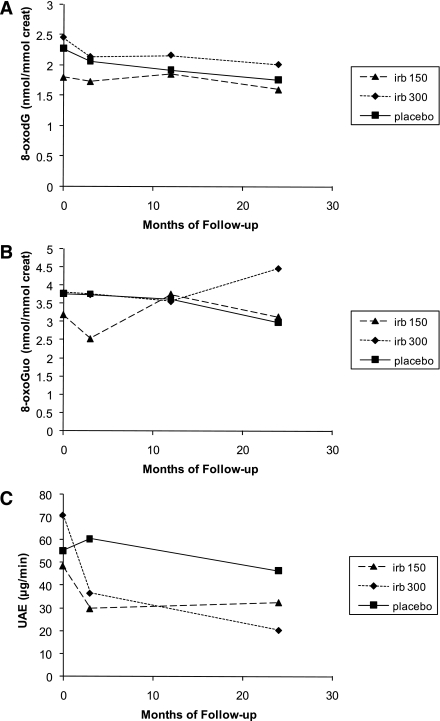
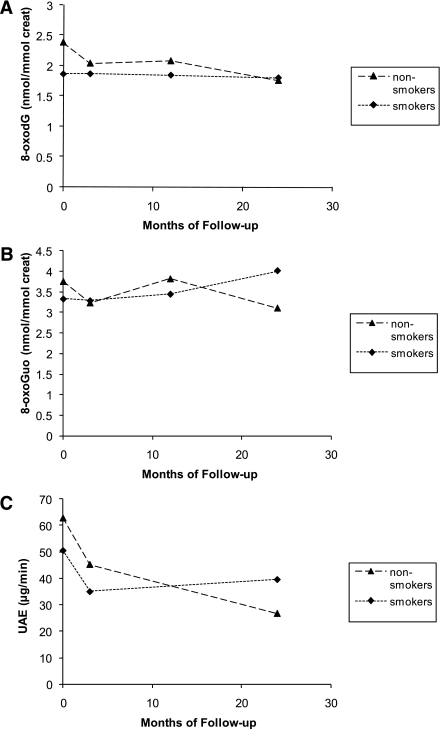
Results: During the 2-year trial, no significant differences in 8-oxodG and 8-oxoGuo excretions between placebo and irbesartan treatment were seen. 8-oxodG and albumin excretion decreased with time (P = 0.0004 and P < 0.0001, respectively), whereas treatment-related differences were shown for albumin excretion (P = 0.0008) only, as previously reported. Important secondary findings were significant associations between changes in 8-oxodG excretion and changes in albumin excretion and glycated hemoglobin (HbA(1c)). During the study period, 8-oxodG excretion decreased by 3 and 26% in smokers and nonsmokers, respectively (P = 0.015), and urinary albumin excretion decreased 22% in smokers and 58% in nonsmokers (P = 0.011).
Conclusions: Irbesartan treatment was not significantly more effective than placebo in reducing nucleic acid oxidation. The results indicate that DNA oxidation in diabetes patients is reduced by various components in the treatment of diabetes where glycemic control seems to be important and addition of angiotensin II receptor antagonists does not lead to any substantial additional reduction. Furthermore, the reductions in DNA oxidation and albumin excretion seem to be counteracted by smoking.
Figures
References
-
- Heart Outcomes Prevention Evaluation Study Investigators Effects of ramipril on cardiovascular and microvascular outcomes in people with diabetes mellitus: results of the HOPE study and MICRO-HOPE substudy. Lancet 2000;355:253–259 - PubMed
-
- Yusuf S, Sleight P, Pogue J, Bosch J, Davies R, Dagenais G, The Heart Outcomes Prevention Evaluation Study Investigators Effects of an angiotensin-converting-enzyme inhibitor, ramipril, on cardiovascular events in high-risk patients. N Engl J Med 2000;342:145–153 - PubMed
-
- Ogawa S, Mori T, Nako K, Kato T, Takeuchi K, Ito S. Angiotensin II type 1 receptor blockers reduce urinary oxidative stress markers in hypertensive diabetic nephropathy. Hypertension 2006;47:699–705 - PubMed
-
- Mistry V, Teichert F, Sandhu JK, et al. Non-invasive assessment of oxidatively damaged DNA: liquid chromatography-tandem mass spectrometry analysis of urinary 8-oxo-7,8-dihydro-2′-deoxyguanosine. Methods Mol Biol 2011;682:279–289 - PubMed
-
- Dohi Y, Ohashi M, Sugiyama M, Takase H, Sato K, Ueda R. Candesartan reduces oxidative stress and inflammation in patients with essential hypertension. Hypertens Res 2003;26:691–697 - PubMed
Publication types
MeSH terms
Substances
LinkOut - more resources
Full Text Sources
Medical
Miscellaneous
