


Malaria diagnostic testing and treatment practices in three different Plasmodium falciparum transmission settings in Tanzania: before and after a government policy change
- PMID: 21457570
- PMCID: PMC3080800
- DOI: 10.1186/1475-2875-10-76
Malaria diagnostic testing and treatment practices in three different Plasmodium falciparum transmission settings in Tanzania: before and after a government policy change
Abstract
Background: Patterns of decreasing malaria transmission intensity make presumptive treatment of malaria an unjustifiable approach in many African settings. The controlled use of anti-malarials after laboratory confirmed diagnosis is preferable in low endemic areas. Diagnosis may be facilitated by malaria rapid diagnostic tests (RDTs). In this study, the impact of a government policy change, comprising the provision of RDTs and advice to restrict anti-malarial treatment to RDT-positive individuals, was assessed by describing diagnostic behaviour and treatment decision-making in febrile outpatients <10 years of age in three hospitals in the Kagera and Mwanza Region in northern Tanzania.
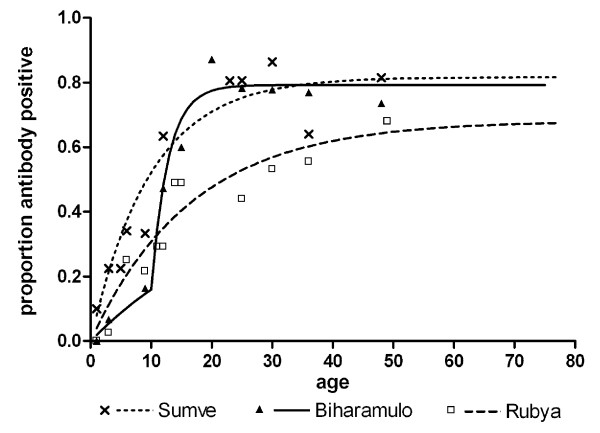
Methods: Prospective data from Biharamulo and Rubya Designated District Hospital (DDH) were collected before and after policy change, in Sumve DDH no new policy was implemented. Diagnosis of malaria was confirmed by RDT; transmission intensity was evaluated by a serological marker of malaria exposure in hospital attendees.
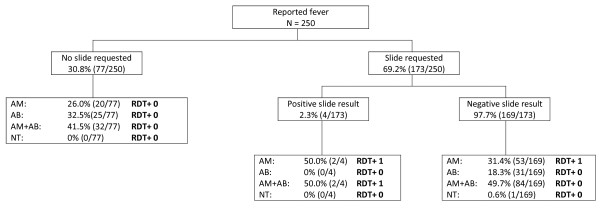
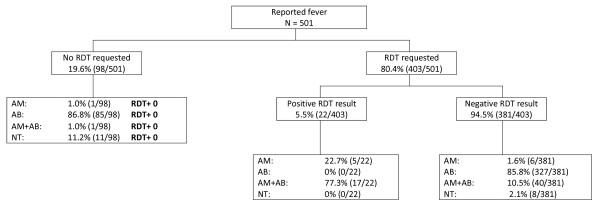
Results: Prior to policy change, there was no evident association between the actual level of transmission intensity and drug-prescribing behaviour. After policy change, there was a substantial decrease in anti-malarial prescription and an increase in prescription of antibiotics. The proportion of parasite-negative individuals who received anti-malarials decreased from 89.1% (244/274) to 38.7% (46/119) in Biharamulo and from 76.9% (190/247) to 10.0% (48/479) in Rubya after policy change.
Conclusion: This study shows that an official policy change, where RDTs were provided and healthcare providers were advised to adhere to RDT results in prescribing drugs can be followed by more rational drug-prescribing behaviour. The current findings are promising for improving treatment policy in Tanzanian hospitals.
Figures
References
-
- World Health Organization. World Malaria Report 2009. 2009.
-
- Mboera LE, Makundi EA, Kitua AY. Uncertainty in malaria control in Tanzania: crossroads and challenges for future interventions. Am J Trop Med Hyg. 2007;77:112–118. - PubMed
-
- Mugittu K, Abdulla S, Falk N, Masanja H, Felger I, Mshinda H, Beck HP, Genton B. Efficacy of sulfadoxine-pyrimethamine in Tanzania after two years as first-line drug for uncomplicated malaria: assessment protocol and implication for treatment policy strategies. Malar J. 2005;4:55. doi: 10.1186/1475-2875-4-55. - DOI - PMC - PubMed
-
- Alifrangis M, Lusingu JP, Mmbando B, Dalgaard MB, Vestergaard LS, Ishengoma D, Khalil IF, Theander TG, Lemnge MM, Bygbjerg IC. Five-year surveillance of molecular markers of Plasmodium falciparum antimalarial drug resistance in Korogwe District, Tanzania: accumulation of the 581G mutation in the P. falciparum dihydropteroate synthase gene. Am J Trop Med Hyg. 2009;80:523–527. - PubMed
MeSH terms
Substances
LinkOut - more resources
Full Text Sources
Medical
Research Materials
