


The impact of change in visual field on health-related quality of life the los angeles latino eye study
- PMID: 21458074
- PMCID: PMC3129408
- DOI: 10.1016/j.ophtha.2010.12.018
The impact of change in visual field on health-related quality of life the los angeles latino eye study
Abstract
Purpose: To assess the impact of change in visual field (VF) on change in health-related quality of life (HRQoL) at the population level.
Design: Prospective cohort study.
Participants: Three thousand one hundred seventy-five Los Angles Latino Eye Study participants.
Methods: Objective measures of VF and visual acuity and self-reported HRQoL were collected at baseline and at the 4-year follow-up. Analysis of covariance was used to evaluate mean differences in change of HRQoL across severity levels of change in VF and to test for effect modification by covariates.
Main outcome measures: General and vision-specific HRQoL.
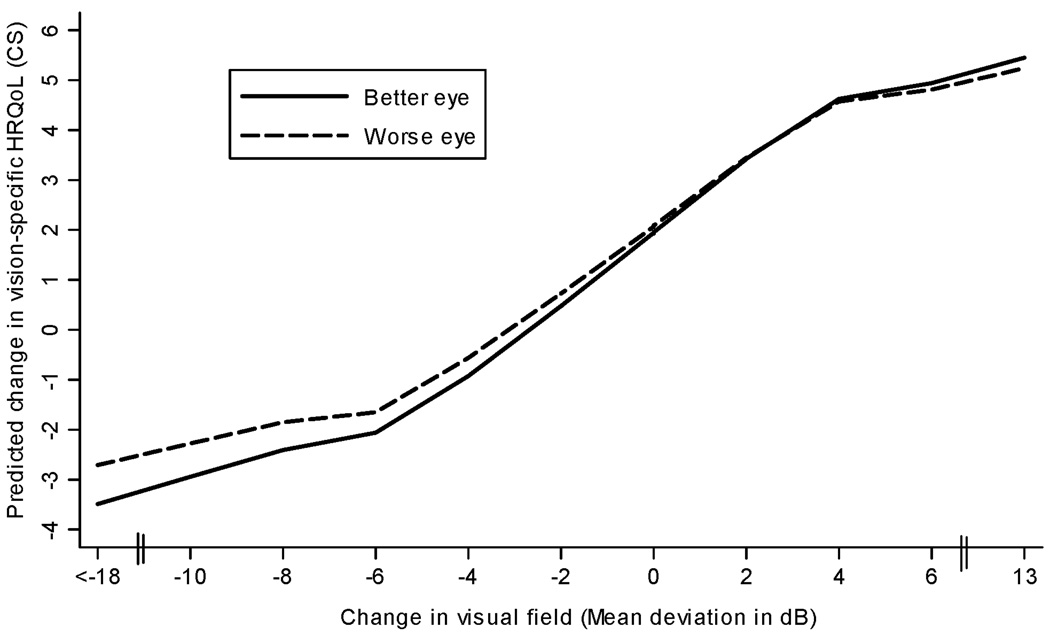
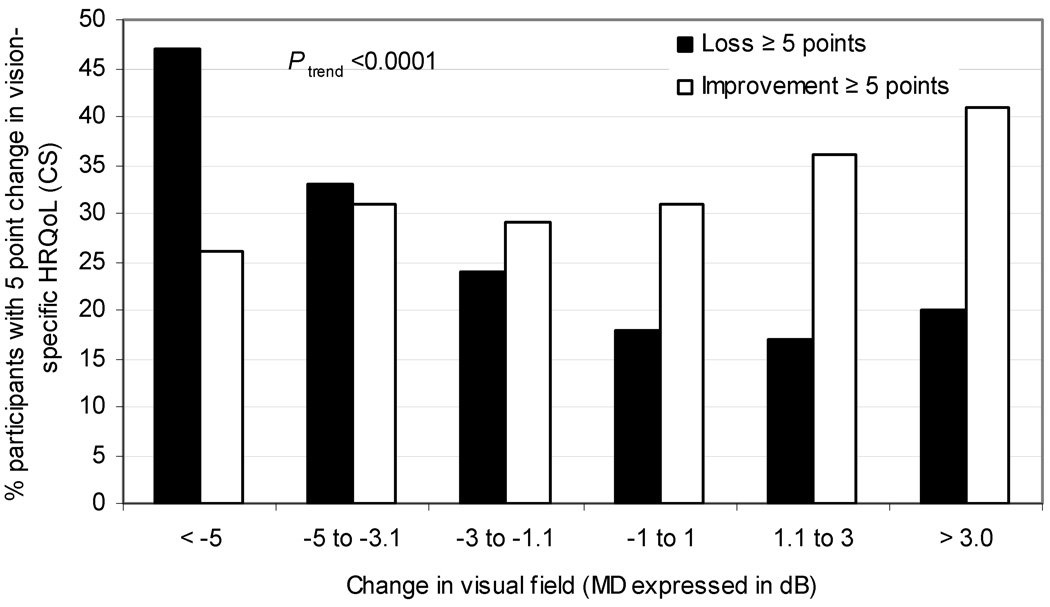
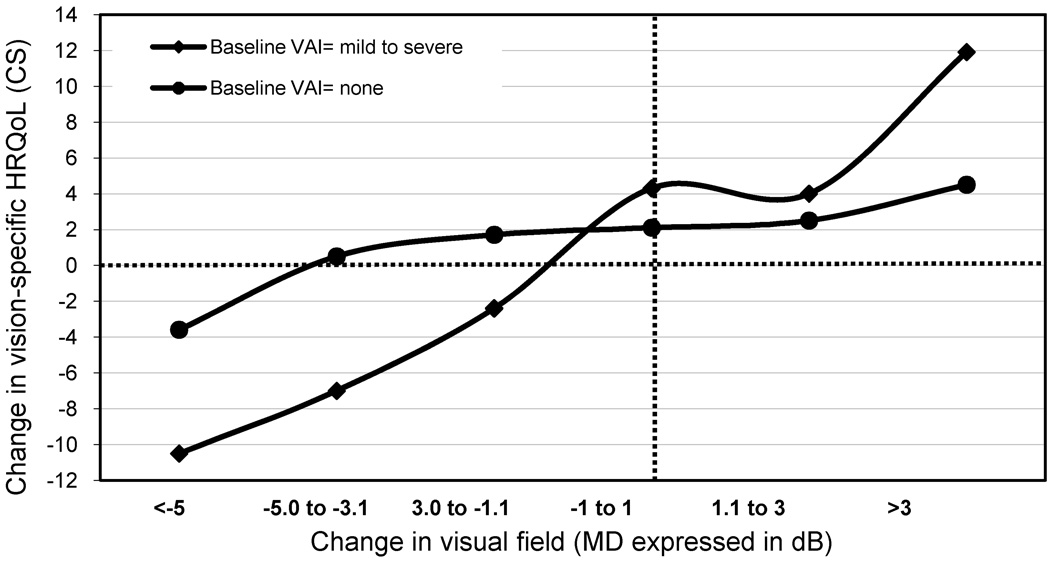
Results: Of 3175 participants, 1430 (45%) showed a change in VF (≥1 decibel [dB]) and 1715 (54%) reported a clinically important change (≥5 points) in vision-specific HRQoL. Progressive worsening and improvement in the VF were associated with increasing losses and gains in vision-specific HRQoL for the composite score and 10 of its 11 subscales (all P(trend)<0.05). Losses in VF of more than 5 dB and gains of more than 3 dB were associated with clinically meaningful losses and gains in vision-specific HRQoL, respectively. Areas of vision-specific HRQoL most affected by greater losses in VF were driving, dependency, role-functioning, and mental health. The effect of change in VF (loss or gain) on mean change in vision-specific HRQoL varied by level of baseline vision loss (in VF, visual acuity, or both) and by change in visual acuity (all P(interaction)<0.05). Those with moderate or severe VF loss at baseline and with a more than 5 dB loss in VF during the study period had a mean loss of vision-specific HRQoL of 11.3 points, whereas those with no VF loss at baseline had a mean loss of 0.97 points. Similarly, with a more than 5 dB loss in VF and baseline visual acuity impairment (mild or severe), there was a loss in vision-specific HRQoL of 10.5 points, whereas with no visual acuity impairment at baseline, there was a loss of vision-specific HRQoL of 3.7 points.
Conclusions: Both losses and gains in VF produce clinically meaningful changes in vision-specific HRQoL. In the presence of pre-existing vision loss (VF and visual acuity), similar levels of VF change produce greater losses in QOL.
Copyright © 2011 American Academy of Ophthalmology. Published by Elsevier Inc. All rights reserved.
Figures
References
-
- World Health Organization. Visual impairment and blindness. 2009. May [Accessed March 15, 2010]. Fact sheet no. 282.. Available at: www.who.int/mediacentre/factsheets/fs282/en/print.html.
-
- Bailey RN, Indian RW, Zhang X, et al. Centers for Disease Control and Prevention. Visual impairment and eye care among older adults-five states, 2005. MMWR Morb Mortal Wkly Rep. 2006;55:1321–1325. - PubMed
-
- McNeil JM, Binette J. Prevalence of disabilities and associated health conditions among adults--United States, 1999. MMWR Morb Mortal Wkly Rep. 2001;50:120–125. - PubMed
-
- Centers for Disease Control and Prevention. Vision Health Initiative (VHI) [Accessed March 15, 2010]. Available at: http://www.cdc.gov/visionhealth/
-
- Agency for Healthcare Research and Quality. Vision rehabilitation: care and benefit plan models. [Accessed March 15, 2010]. Available at: http://www.ahrq.gov/clinic/vision/vision1.htm#definitionandgoals.
Publication types
MeSH terms
Grants and funding
LinkOut - more resources
Full Text Sources
Other Literature Sources
Medical
Miscellaneous
