


Anatomic features of enhancing renal masses predict malignant and high-grade pathology: a preoperative nomogram using the RENAL Nephrometry score
- PMID: 21458155
- PMCID: PMC3124570
- DOI: 10.1016/j.eururo.2011.03.029
Anatomic features of enhancing renal masses predict malignant and high-grade pathology: a preoperative nomogram using the RENAL Nephrometry score
Abstract
Background: Counseling patients with enhancing renal mass currently occurs in the context of significant uncertainty regarding tumor pathology.
Objective: We evaluated whether radiographic features of renal masses could predict tumor pathology and developed a comprehensive nomogram to quantitate the likelihood of malignancy and high-grade pathology based on these features.
Design, setting, and participants: We retrospectively queried Fox Chase Cancer Center's prospectively maintained database for consecutive renal masses where a Nephrometry score was available.
Intervention: All patients in the cohort underwent either partial or radical nephrectomy.
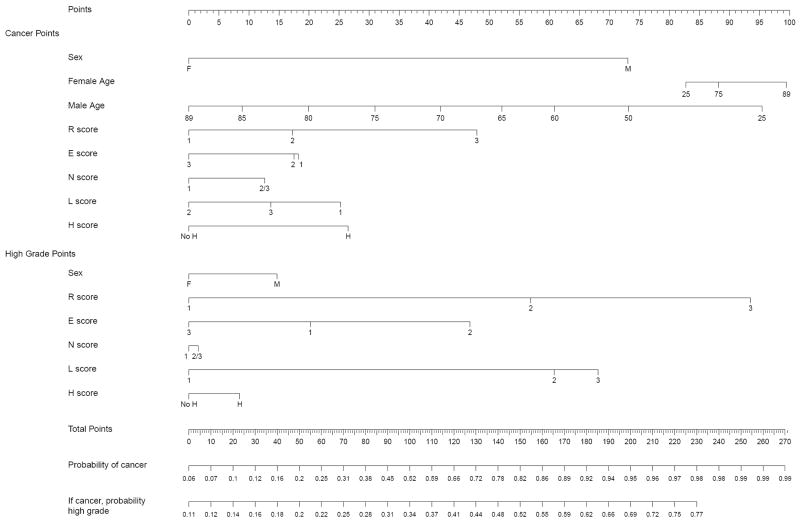
Measurements: The individual components of Nephrometry were compared with histology and grade of resected tumors. We used multiple logistic regression to develop nomograms predicting the malignancy of tumors and likelihood of high-grade disease among malignant tumors.
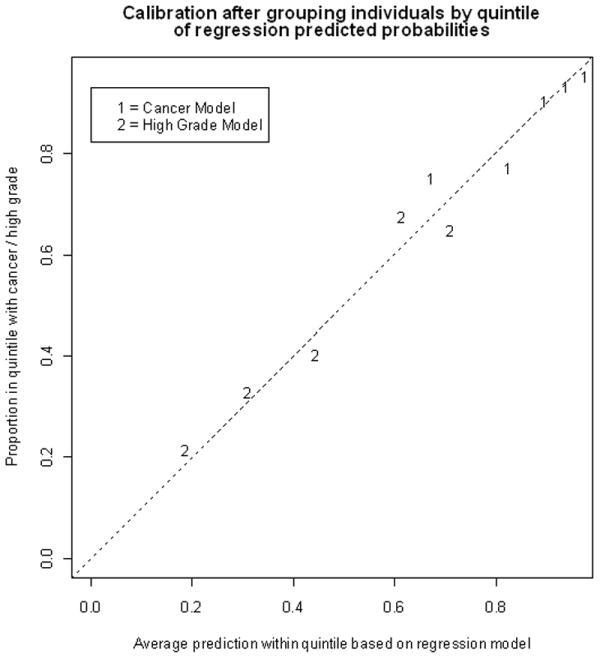
Results and limitations: Nephrometry score was available for 525 of 1750 renal masses. Nephrometry score correlated with both tumor grade (p < 0.0001) and histology (p < 0.0001), such that small endophytic nonhilar tumors were more likely to represent benign pathology. Conversely, large interpolar and hilar tumors more often represented high-grade cancers. The resulting nomogram from these data offers a useful tool for the preoperative prediction of tumor histology (area under the curve [AUC]: 0.76) and grade (AUC: 0.73). The model was subjected to out-of-sample cross-validation; however, lack of external validation is a limitation of the study.
Conclusions: The current study is the first to objectify the relationship between tumor anatomy and pathology. Using the Nephrometry score, we developed a tool to quantitate the preoperative likelihood of malignant and high-grade pathology of an enhancing renal mass.
Copyright © 2011 European Association of Urology. Published by Elsevier B.V. All rights reserved.
Conflict of interest statement
Figures
Comment in
-
The RENAL nephrometry nomogram: statistically significant, but is it clinically relevant?Eur Urol. 2011 Aug;60(2):249-51; discussion 251-2. doi: 10.1016/j.eururo.2011.04.005. Epub 2011 Apr 16. Eur Urol. 2011. PMID: 21514040 No abstract available.
References
-
- Parsons JK, Schoenberg MS, Carter HB. Incidental renal tumors: casting doubt on the efficacy of early intervention. Urology. 2001;57:1013–5. - PubMed
-
- Campbell SC, Novick AC, Belldegrun A, et al. Guideline for management of the clinical T1 renal mass. J Urol. 2009;182:1271–9. - PubMed
-
- Frank I, Blute ML, Cheville JC, et al. Solid renal tumors: an analysis of pathological features related to tumor size. J Urol. 2003;170:2217–20. - PubMed
-
- Hollingsworth JM, Miller DC, Daignault S, et al. Rising incidence of small renal masses: a need to reassess treatment effect. J Natl Cancer Inst. 2006;98:1331–4. - PubMed
Publication types
MeSH terms
Grants and funding
LinkOut - more resources
Full Text Sources
Other Literature Sources
Medical
