


Are time- and event-based prospective memory comparably affected in HIV infection?
- PMID: 21459901
- PMCID: PMC3081684
- DOI: 10.1093/arclin/acr020
Are time- and event-based prospective memory comparably affected in HIV infection?
Abstract
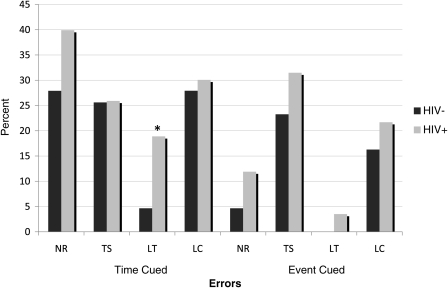
According to the multi-process theory of prospective memory (ProM), time-based tasks rely more heavily on strategic processes dependent on prefrontal systems than do event-based tasks. Given the prominent frontostriatal pathophysiology of HIV infection, one would expect HIV-infected individuals to demonstrate greater deficits in time-based versus event-based ProM. However, the two prior studies examining this question have produced variable results. We evaluated this hypothesis in 143 individuals with HIV infection and 43 demographically similar seronegative adults (HIV-) who completed the research version of the Memory for Intentions Screening Test, which yields parallel subscales of time- and event-based ProM. Results showed main effects of HIV serostatus and cue type, but no interaction between serostatus and cue. Planned pair-wise comparisons showed a significant effect of HIV on time-based ProM and a trend-level effect on event-based ProM that was driven primarily by the subset of participants with HIV-associated neurocognitive disorders. Nevertheless, time-based ProM was more strongly correlated with measures of executive functions, attention/working memory, and verbal fluency in HIV-infected persons. Although HIV-associated deficits in time- and event-based ProM appear to be of comparable severity, the cognitive architecture of time-based ProM may be more strongly influenced by strategic monitoring and retrieval processes.
Figures
References
-
- American Psychiatric Association. Diagnostic and statistical manual of mental disorders. 4th ed. Washington, DC: Author; 1994.
-
- Benton A. L., Hamsher K., Sivan A. B. Multilingual aphasia examination. Iowa City, IA: AJA Associates; 1983.
-
- Burgess P. W., Quayle A., Frith C. D. Brain regions involved in prospective memory as determined by positron emission tomography. Neuropsychologia. 2001;39:545–555. doi:10.1016/S0028-3932(00)00149-4. - DOI - PubMed
-
- Burgess P. W., Scott S. K., Frith C. D. The role of the rostral frontal cortex (area 10) in prospective memory: A lateral versus medial dissociation. Neuropsychologia. 2003;41:906–918. doi:10.1016/S0028-3932(02)00327-5. - DOI - PubMed
Publication types
MeSH terms
Grants and funding
LinkOut - more resources
Full Text Sources
Medical
