. 2011 Apr;84(4):641-6.
doi: 10.4269/ajtmh.2011.10-0187.

Rift Valley fever virus infection in African buffalo (Syncerus caffer) herds in rural South Africa: evidence of interepidemic transmission

Affiliations

Rift Valley fever virus infection in African buffalo (Syncerus caffer) herds in rural South Africa: evidence of interepidemic transmission

A Desirée LaBeaud et al. Am J Trop Med Hyg. 2011 Apr.

Abstract

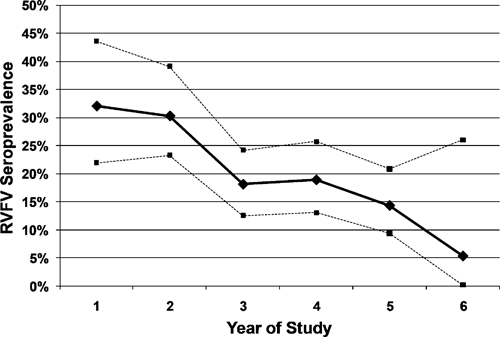
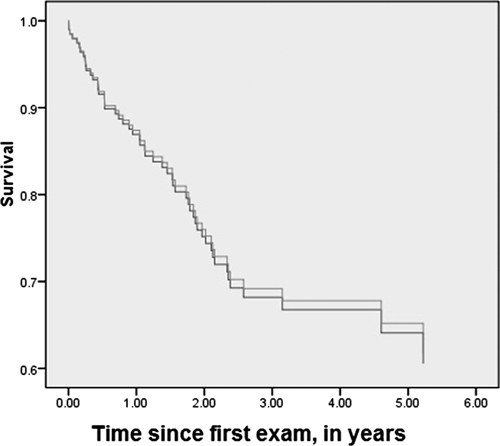
Rift Valley fever virus (RVFV) is an emerging biodefense pathogen that poses significant threats to human and livestock health. To date, the interepidemic reservoirs of RVFV are not well defined. In a longitudinal survey of infectious diseases among African buffalo during 2000-2006, 550 buffalo were tested for antibodies against RVFV in 820 capture events in 302 georeferenced locations in Kruger National Park, South Africa. Overall, 115 buffalo (21%) were seropositive. Seroprevalence of RVFV was highest (32%) in the first study year, and decreased progressively in subsequent years, but had no detectable impact on survival. Nine (7%) of 126 resampled, initially seronegative animals seroconverted during periods outside any reported regional RVFV outbreaks. Seroconversions for RVFV were detected in significant temporal clusters during 2001-2003 and in 2004. These findings highlight the potential importance of wildlife as reservoirs for RVFV and interepidemic RVFV transmission in perpetuating regional RVFV transmission risk.


Figures
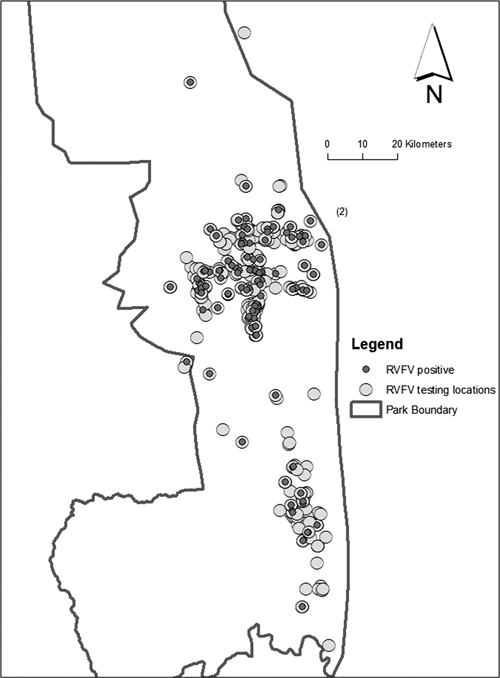
Figure 1.
Figure 1.
Kruger National Park in northeastern South Africa, showing the 820 capture locations of African buffalo (Syncerus caffer caffer) (light circles) during the November 2000–July 2006 study period. Capture locations of animals detected to be seropositive for antibody against Rift Valley fever virus (n = 115) are indicated by smaller dark circles.
Figure 2.
Figure 2.
Overall prevalence of seropositivity for antibodies against Rift Valley fever virus (solid line indicates prevalence and dashed lines indicate upper and lower 95% confidence limits) among 550 African buffalo captured and serotested in Kruger National Park during the 2000–2006 study period. Numbers tested each year were as follows: year 1 = 78; year 2 = 142; year 3 = 177; year 4 = 159; year 5 = 161; year 6 = 19. Total number of tests indicates that 126 animals had repeated sampling during the study.
Figure 3.
Figure 3.
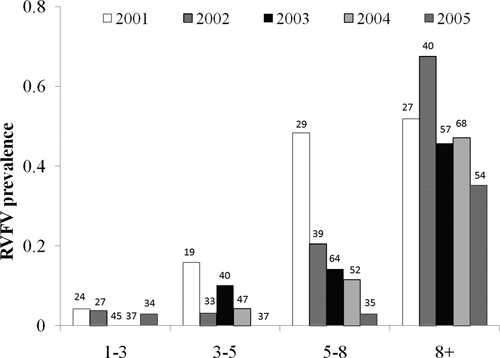
Seroprevalence of antibody against Rift Valley fever virus, by age category, among African buffalo in Kruger National Park during initial years 1–5 of the study (2001–2005). Bars indicate age-specific seroprevalence (in each year) for animal subgroups (defined as youngest group = 1–3 years of age; middle-low group = 3–5 years of age; middle-high group = 5–8 years of age; oldest group = more than 8 years of age) during that particular study year. Numbers above each bar indicate the number of animals that were tested in that age group in that study year.
Figure 4.
Figure 4.
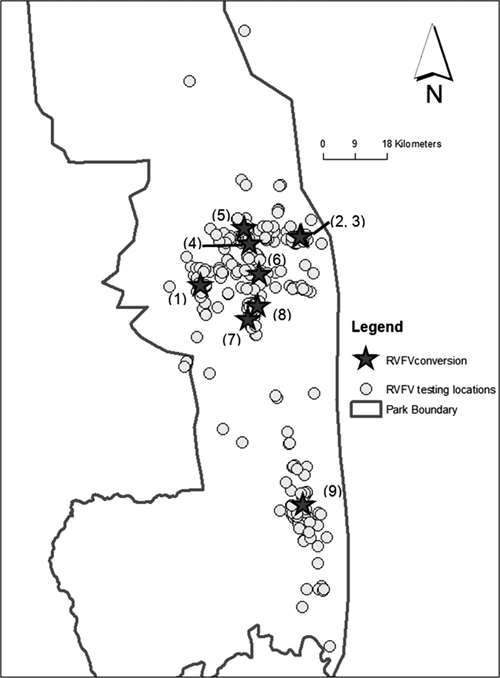
Capture locations (gray stars) of nine African buffalo found to have seroconverted for antibodies against Rift Valley fever virus (upon recapture and repeat serologic testing). Numbers next to starred locations indicate the order of detection of these seroconverting animals. Open circles indicate the distribution of all other capture events during November 2000–July 2006. Borders of Kruger National Park are indicated by the solid line.
Figure 5.
Figure 5.
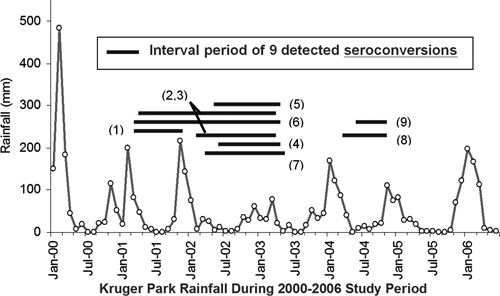
Time series of seroconversion events, relative to rainfall, in Kruger National Park. Circles indicate monthly rainfall for the study area during 2000–2006. Horizontal gray bars indicate the intervals (period between observations) for the nine seroconversion events to antibody against Rift Valley fever virus among 126 initially seronegative buffalo that were repeatedly sampled during the study. To indicate their location, numbers in parentheses correspond to sites indicated in Figure 4 and reflect the order of detection of seroconverted animals during the period of the study.
Figure 6.
Figure 6.
Kaplan-Meier survival plots of African buffalo in the Kruger Park study according to their serostatus for antibody against Rift Valley fever virus (RVFV). Lines indicate the cumulative age- and sex-adjusted percent survival (in years) of 51 animals seropositive for antibodies against RVFV (gray line) or 116 animals seronegative for antibodies against RVFV (dark line) that were serially monitored for survival during the period of the study.

References

    1. Davies FG. The historical and recent impact of Rift Valley fever in Africa. Am J Trop Med Hyg. 2010;83:73–74. - PMC - PubMed
    1. Laughlin LW, Meegan JM, Strausbaugh LJ. Epidemic Rift Valley fever in Egypt: observations of the spectrum of human illness. Trans R Soc Trop Med Hyg. 1979;73:630–633. - PubMed
    1. Murithi RM, Munyua P, Ithondeka PM, Macharia JM, Hightower A, Luman ET, Breiman RF, Njenga MK. Rift Valley fever in Kenya: history of epizootics and identification of vulnerable districts. Epidemiol Infect. 2011;139:372–380. - PubMed
    1. Peters CJ, Spertzel R, Patrick W. In: Biological Threats and Terrorism: Assessing the Science and Response Capabilities. Knobler SL, Mahmoud AAF, Pray LA, editors. Washington: National Academy Press; 2002. pp. 66–77. (Aerosol technology and biological weapons). - PubMed
    1. Davies FG, Highton RB. Possible vectors of Rift Valley fever in Kenya. Trans R Soc Trop Med Hyg. 1980;74:815–816. - PubMed

Publication types

Substances

LinkOut - more resources