


Diversity, evolution, and functionality of clustered regularly interspaced short palindromic repeat (CRISPR) regions in the fire blight pathogen Erwinia amylovora
- PMID: 21460108
- PMCID: PMC3127596
- DOI: 10.1128/AEM.00177-11
Diversity, evolution, and functionality of clustered regularly interspaced short palindromic repeat (CRISPR) regions in the fire blight pathogen Erwinia amylovora
Abstract
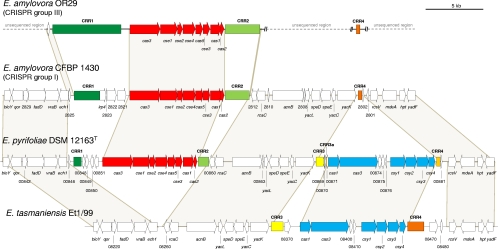
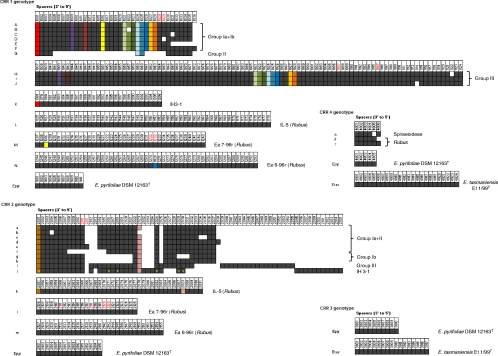
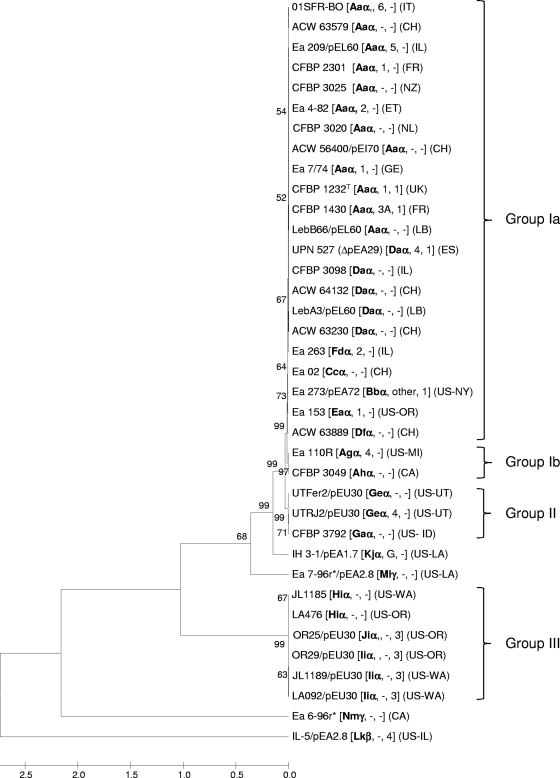
The clustered regularly interspaced short palindromic repeat (CRISPR)/Cas system confers acquired heritable immunity against mobile nucleic acid elements in prokaryotes, limiting phage infection and horizontal gene transfer of plasmids. In CRISPR arrays, characteristic repeats are interspersed with similarly sized nonrepetitive spacers derived from transmissible genetic elements and acquired when the cell is challenged with foreign DNA. New spacers are added sequentially and the number and type of CRISPR units can differ among strains, providing a record of phage/plasmid exposure within a species and giving a valuable typing tool. The aim of this work was to investigate CRISPR diversity in the highly homogeneous species Erwinia amylovora, the causal agent of fire blight. A total of 18 CRISPR genotypes were defined within a collection of 37 cosmopolitan strains. Strains from Spiraeoideae plants clustered in three major groups: groups II and III were composed exclusively of bacteria originating from the United States, whereas group I generally contained strains of more recent dissemination obtained in Europe, New Zealand, and the Middle East. Strains from Rosoideae and Indian hawthorn (Rhaphiolepis indica) clustered separately and displayed a higher intrinsic diversity than that of isolates from Spiraeoideae plants. Reciprocal exclusion was generally observed between plasmid content and cognate spacer sequences, supporting the role of the CRISPR/Cas system in protecting against foreign DNA elements. However, in several group III strains, retention of plasmid pEU30 is inconsistent with a functional CRISPR/Cas system.
Figures
References
-
- Barionovi D., Giorgi S., Stoeger A. R., Ruppitsch W., Scortichini M. 2006. Characterization of Erwinia amylovora strains from different host plants using repetitive-sequences PCR analysis, and restriction fragment length polymorphism and short-sequence DNA repeats of plasmid pEA29. J. Appl. Microbiol. 100:1084–1094 - PubMed
-
- Barrangou R., et al. 2007. CRISPR provides acquired resistance against viruses in prokaryotes. Science 315:1709–1712 - PubMed
-
- Bolotin A., Quinquis B., Sorokin A., Ehrlich S. D. 2005. Clustered regularly interspaced short palindrome repeats (CRISPRs) have spacers of extrachromosomal origin. Microbiology 151:2551–2561 - PubMed
-
- Bonn W. G., van der Zwet T. 2000. Distribution and economic importance of fire blight, p. 37–53 In Vanneste J. L. (ed.), Fire blight: the disease and its causative agent, Erwinia amylovora. CAB International, Wallingford, United Kingdom
Publication types
MeSH terms
LinkOut - more resources
Full Text Sources
