. 2011 Apr 21;472(7343):375-8.
doi: 10.1038/nature09869. Epub 2011 Apr 3.

Genome-wide analysis reveals novel molecular features of mouse recombination hotspots

Affiliations

Genome-wide analysis reveals novel molecular features of mouse recombination hotspots

Fatima Smagulova et al. Nature. .

Abstract

Meiotic recombination predominantly occurs at discrete genomic loci called recombination hotspots, but the features defining these areas are still largely unknown (reviewed in refs 1-5). To allow a comprehensive analysis of hotspot-associated DNA and chromatin characteristics, we developed a direct molecular approach for mapping meiotic DNA double-strand breaks that initiate recombination. Here we present the genome-wide distribution of recombination initiation sites in the mouse genome. Hotspot centres are mapped with approximately 200-nucleotide precision, which allows analysis of the fine structural details of the preferred recombination sites. We determine that hotspots share a centrally distributed consensus motif, possess a nucleotide skew that changes polarity at the centres of hotspots and have an intrinsic preference to be occupied by a nucleosome. Furthermore, we find that the vast majority of recombination initiation sites in mouse males are associated with testis-specific trimethylation of lysine 4 on histone H3 that is distinct from histone H3 lysine 4 trimethylation marks associated with transcription. The recombination map presented here has been derived from a homogeneous mouse population with a defined genetic background and therefore lends itself to extensive future experimental exploration. We note that the mapping technique developed here does not depend on the availability of genetic markers and hence can be easily adapted to other species with complex genomes. Our findings uncover several fundamental features of mammalian recombination hotspots and underline the power of the new recombination map for future studies of genetic recombination, genome stability and evolution.


Figures
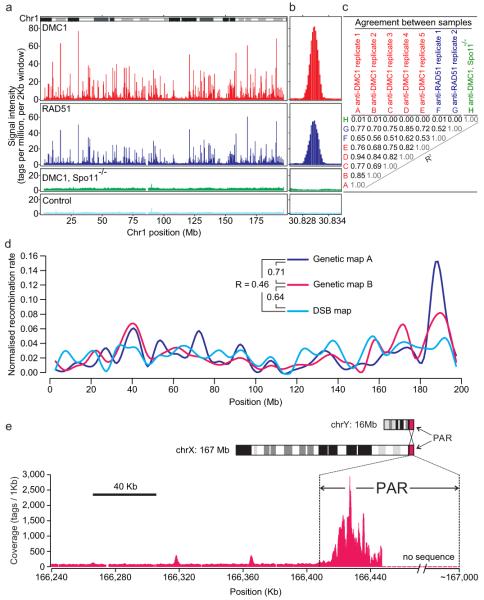
Figure 1
Figure 1
DSB hotspots in the mouse genome. a. The ChIP-seq tag density profiles. DMC1 and RAD51: anti-DMC1 and anti-RAD51 ChIP. DMC1, Spo11-/-: anti-DMC1 ChIP from Spo11-/- mice that do not form DSBs. Control: IgG ChIP and input DNA pool. b. Close-up of a representative hotspot. c. Agreement between ChIP-Seq samples (correlations in 2 kb bins across genome). d. Correlation between the DSB hotspot map and the published genetic maps A15 and B16 for chromosome 1. The DSB map is generated from hotspot strengths (Supplementary Methods). All maps are generated in 5 Mb windows and normalized by area of the map. e. PAR contains a large cluster of overlapping hotspots. DMC1 ChIP-Seq tag coverage (smoothing window = 1 kb, step size = 100 bp).
Figure 2
Figure 2
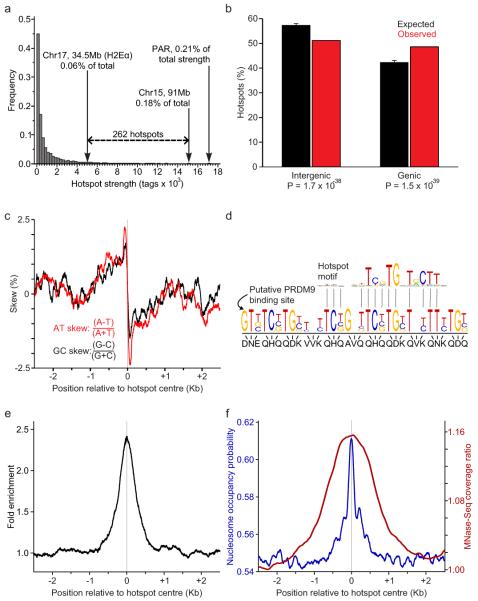
Characteristics of mouse DSB hotspots. a. The H2Eα hotspot and the PAR hotspot cluster are among the strongest in the mouse genome. The strength of the hottest individual hotspot identified in this study (Chromosome 15, ~91 Mb) is also indicated. b. Mouse DSB hotspots are significantly enriched in genes (one-sided binomial tests). Genic regions are defined from start to stop codons including introns. Error bars represent the 5th to 95th percentiles of the expected value distributions (n = 10,000 iterations). c. A purine-pyrimidine skew is apparent at DSB hotspots. Skew is calculated in 100 bp windows with a step size of 1 bp. d. Consensus hotspot motif is similar to the predicted binding site of PRDM9. e. Consensus motif is present in the centres of DSB hotspots. Distribution of hits to the consensus motif is shown in the 5 kb regions around hotspots (window: 200 bp, step: 1 bp). f. Both predicted (blue) and experimentally determined (red) nucleosome occupancy profiles peak at the centre of DSB hotspots. MNase-Seq coverage ratio is plotted as the whole fragment coverage ratio of micrococcal nuclease-digested chromatin to randomly fragmented chromatin in sliding 500 bp windows (step: 1 bp).
Figure 3
Figure 3
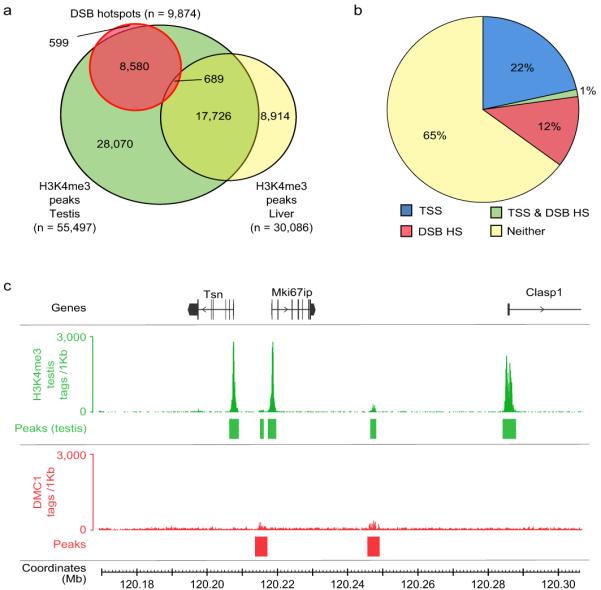
Specific H3K4me3 marks are associated with DSB hotspots. a. The vast majority (93.9%) of DSB hotspots overlap H3K4me3 marks, most of which (86.9%) are testis-specific. The six DSB hotspots that overlap liver-specific H3K4me3 marks are not shown. Peak calling for each dataset was performed using an equal number of tags. b. DSB hotspots are associated with a set of H3K4me3 marks that are distinct from those at transcription start sites (TSSs). c. H3K4me3 marks at DSB hotspots are generally weaker than TSS-associated marks, and are also spatially distinct despite being sometimes in very close proximity. Tag coverage is displayed in 100 bp steps.

References

    1. Arnheim N, Calabrese P, Tiemann-Boege I. Mammalian meiotic recombination hot spots. Annu Rev Genet. 2007;41:369–399. doi:10.1146/annurev.genet.41.110306.130301. - PubMed
    1. Buard J, de Massy B. Playing hide and seek with mammalian meiotic crossover hotspots. Trends Genet. 2007;23:301–309. doi:S0168-9525(07)00117-5 [pii] 10.1016/j.tig.2007.03.014. - PubMed
    1. Lichten M. Meiotic Chromatin: The Substrate for Recombination Initiation. Genome Dyn Stab. 2008;3:165–193.
    1. Paigen K, Petkov P. Mammalian recombination hot spots: properties, control and evolution. Nat Rev Genet. 2010;11:221–233. doi:nrg2712 [pii] 10.1038/nrg2712. - PMC - PubMed
    1. Clark AG, Wang X, Matise T. Contrasting methods of quantifying fine structure of human recombination. Annu Rev Genomics Hum Genet. 2010;11:45–64. doi:10.1146/annurev-genom-082908-150031. - PMC - PubMed

Publication types

MeSH terms

Associated data