


Temozolomide modifies caveolin-1 expression in experimental malignant gliomas in vitro and in vivo
- PMID: 21461172
- PMCID: PMC3069652
- DOI: 10.1593/tlo.10205
Temozolomide modifies caveolin-1 expression in experimental malignant gliomas in vitro and in vivo
Abstract
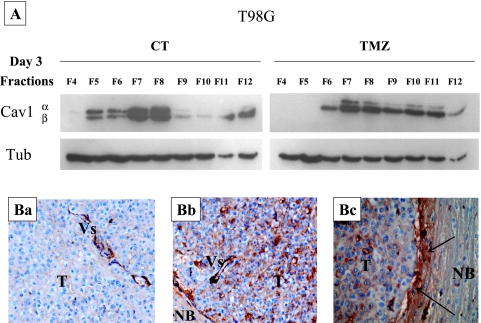
Background: Caveolin-1 is a protein that displays promotive versus preventive roles in cancer progression according to circumstances. Temozolomide (TMZ) is the standard chemotherapeutic to treat glioma patients. The present work aims to characterizeTMZ-induced effects on caveolin-1 expression in glioma cells.
Methods: Human astroglioma (U373 and T98G) and oligodendroglioma (Hs683) cell lines were used in vitro as well as in vivo orthotopic xenografts (Hs683 and U373) into the brains of immunocompromisedmice. In vitro TMZ-induced effects on protein expression and cellular localization were determined by Western blot analysis and on the actin cytoskeleton organization by means of immunofluorescence approaches. In vivo TMZ-induced effects in caveolin-1 expression in human glioma xenografts were monitored by means of immunohistochemistry.
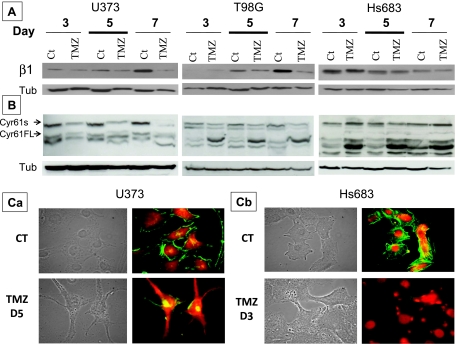
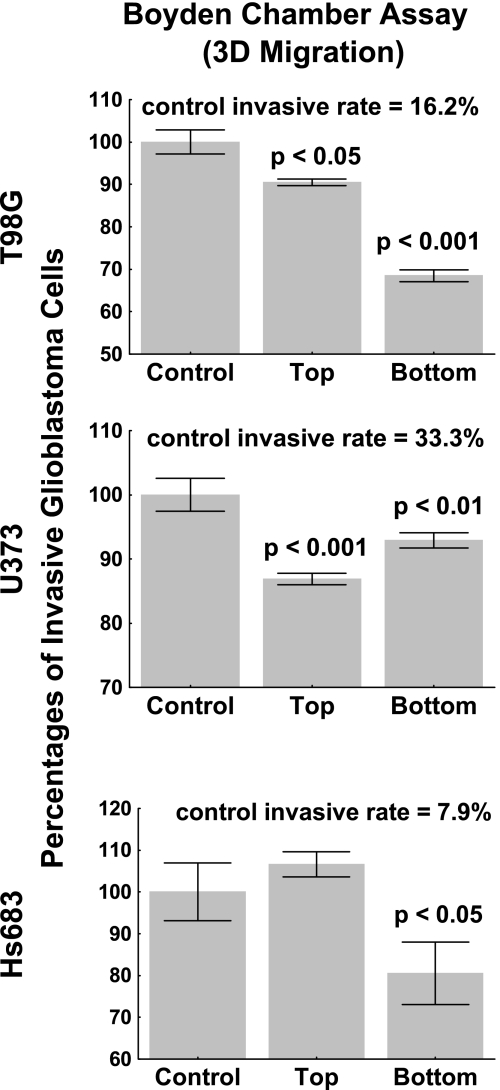
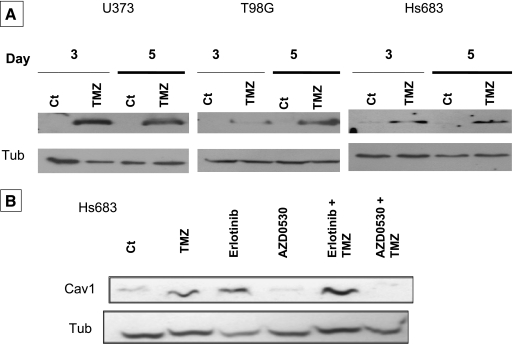
Results: TMZ modified caveolin-1 expression and localization in vitro and in vivo after an administration schedule that slightly, if at all, impaired cell growth characteristics in vitro. Caveolin-1 by itself (at a 100-ng/ml concentration) was able to significantly reduce invasiveness (Boyden chambers) of the three human glioma cell lines. The TMZ-inducedmodification in caveolin-1 expression in flotation/raft compartments was paralleled by altered Cyr61 and β(1) integrin expression, two elements that have already been reported to collaborate with caveolin-1 in regulating glioma cell biology, and all these features led to profound reorganization of the actin cytoskeleton. An experimental Src kinase inhibitor, AZD0530, almost completely antagonized the TMZ-induced modulation in caveolin-1 expression.
Conclusion: TMZ modifies caveolin-1 expression in vitro and in vivo in glioma cells, a feature that directly affects glioma cell migration properties.
Figures
References
-
- Lefranc F, Sadeghi N, Camby I, Metens T, Dewitte O, Kiss R. Present and potential future issues in glioblastoma treatment. Expert Rev Anticancer Ther. 2006;6:719–732. - PubMed
-
- Stupp R, Hegi ME, Mason WP, van den Bent MJ, Taphoorn MJ, Janzer RC, Ludwin SK, Allgeier A, Fisher B, Belanger K, et al. Effects of radiotherapy with concomitant and adjuvant temozolomide versus radiotherapy alone on survival in glioblastoma in a randomised phase III study: 5-year analysis of the EORTC-NCIC trial. Lancet Oncol. 2009;10:459–466. - PubMed
-
- Lefranc F, Brotchi J, Kiss R. Possible future issues in the treatment of glioblastomas: special emphasis on cell migration and the resistance of migrating glioblastoma cells to apoptosis. J Clin Oncol. 2005;23:2411–2422. - PubMed
-
- Le Calvé B, Rynkowski M, Le Mercier M, Bruyère C, Lonez C, Gras T, Haibe-Kains B, Bontempi G, Decaestecker C, Ruysschaert JM, et al. Long term in vitro treatment of human glioblastoma cells with temozolomide confers resistance in vivo through up-regulation of GLUT transporter and aldo-keto reductase enzyme AKR1C expression. Neoplasia. 2010;12:727–739. - PMC - PubMed
-
- Hegi ME, Liu L, Herman JG, Stupp R, Wick W, Weller M, Mehta MP, Gilbert MR. Correlation of O6-methylguanine methyltransferase (MGMT) promoter methylation with clinical outcomes in glioblastoma and clinical strategies to modulate MGMTactivity. J Clin Oncol. 2008;26:4189–4199. - PubMed
LinkOut - more resources
Full Text Sources
Other Literature Sources
Miscellaneous