


Patterns of condemnation rates in swine from a federally inspected abattoir in relation to disease outbreak information in Ontario (2005-2007)
- PMID: 21461204
- PMCID: PMC3003572
Patterns of condemnation rates in swine from a federally inspected abattoir in relation to disease outbreak information in Ontario (2005-2007)
Abstract
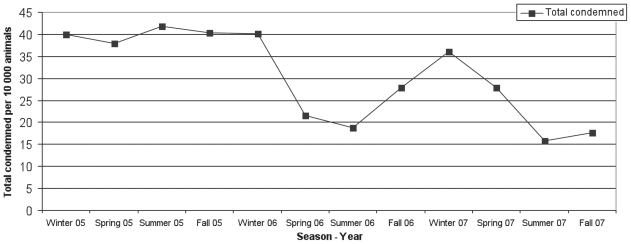
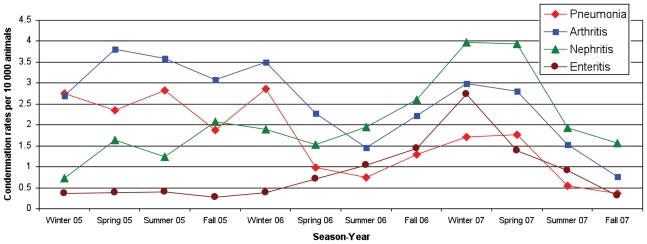
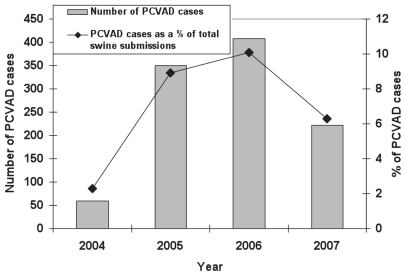
Strong correlations between clinical signs on farms and the presence of lesions at slaughter have been reported. The objective of this study was to determine if changes in condemnation rates provide a data source for surveillance of disease outbreaks in pigs. The data were obtained from 1 abattoir in Ontario (2005-2007). The epidemiological relevance of the results was based on an outbreak of porcine circovirus associated disease (PCVAD) in Ontario in 2005. The total condemnations and condemnations due to arthritis and pneumonia patterns reflected the field infection of PCVAD in 2005 followed by the widespread use of porcine circovirus type 2 (PCV-2) vaccine in 2007. In contrast, increased rates of nephritis and enteritis suggested areas for enhanced surveillance for unexplained changes in disease patterns not identified through traditional passive surveillance. Further studies looking at the benefits of using abattoir data should compare condemnation patterns with multiple sources of swine health data.
Schémas des taux de réforme chez les porcs dans un abattoir inspecté par le gouvernement fédéral en rapport avec l’information sur l’éclosion de maladies en Ontario (de 2005 à 2007). De fortes corrélations entre les signes cliniques à la ferme et la présence de lésions lors de l’abattage ont été signalées. L’objectif de la présente étude consistait à déterminer si les changements des taux de réforme fournissent une source de données pour la surveillance des éclosions de maladie chez les porcs. Les données ont été obtenues dans 1 abattoir en Ontario (de 2005 à 2007). La pertinence épidémiologique des résultats s’est fondée sur une éclosion de maladie associée au circovirus porcin (MACVP) en Ontario en 2005. Le total des réformes et les réformes attribuables aux patrons d’arthrite et de pneumonie ont reflété l’infection sur le terrain par le MACVP en 2005, suivie de l’usage généralisé du vaccin contre le circovirus porcin de type 2 (PCV-2) en 2007. Par contraste, les taux accrus de néphrite et d’entérite ont suggéré des domaines de surveillance accrue pour des changements inexpliqués au niveau des patrons de maladies non identifiés lors de la surveillance passive traditionnelle. De nouvelles études examinant les avantages de l’utilisation des données de l’abattoir devraient comparer les patrons de réforme avec des sources multiples de données sur la santé porcine.
(Traduit par Isabelle Vallières)
Figures
References
-
- Christensen J, Ellegaard B, Kirkegaard Petersen B, Willeberg P, Mousing J. Pig health and production surveillance in Denmark: Sampling design, data recording, and measures of disease frequency. Prev Vet Med. 1994;20:47–61.
-
- Brown C. Emerging zoonoses and pathogens of public health significance — An overview. Rev ScTech Off Int Epiz. 2004;23:435–442. - PubMed
-
- Henning KJ, Mostashari F. Syndromic surveillance. Issues in Science and Technology. 2004;21:10.
-
- Dufour B, Hendrikx P, Toma B. The design and establishment of epidemiological surveillance systems for high-risk diseases in developed countries. Rev Sci Tech Off Int Epi. 2006;25:187–198. - PubMed
-
- Glickman LT, Moore GE, Glickman NW, Caldanaro RJ, Aucoin D, Lewis HB. Purdue University-Banfield National Companion Animal Surveillance Program for Emerging and Zoonotic Diseases. Vector Borne Zoonotic Dis. 2006;6:14–23. - PubMed
Publication types
MeSH terms
LinkOut - more resources
Full Text Sources