Miltefosine-induced apoptotic cell death on Leishmania major and L. tropica strains
- PMID: 21461264
- PMCID: PMC3063921
- DOI: 10.3347/kjp.2011.49.1.17
Miltefosine-induced apoptotic cell death on Leishmania major and L. tropica strains
Abstract
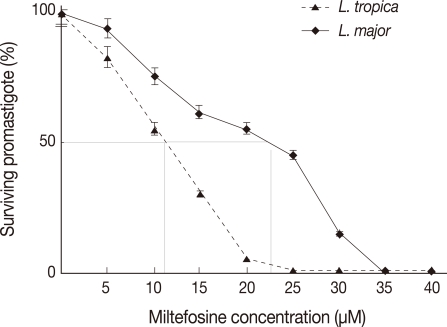
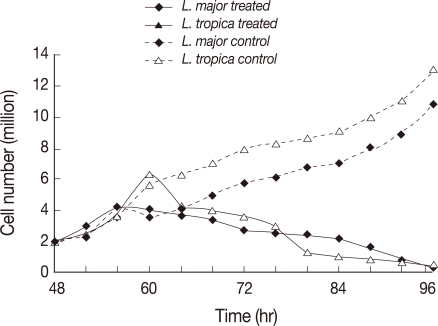
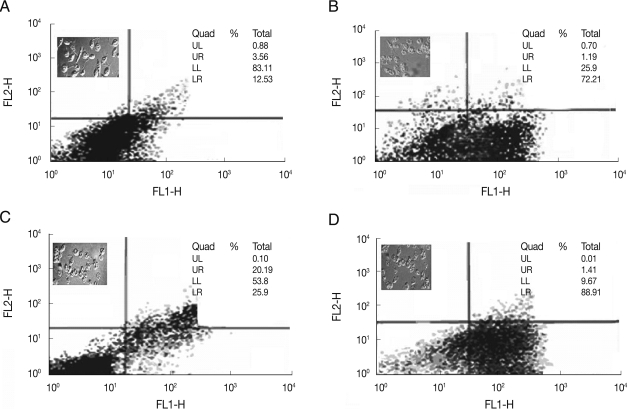
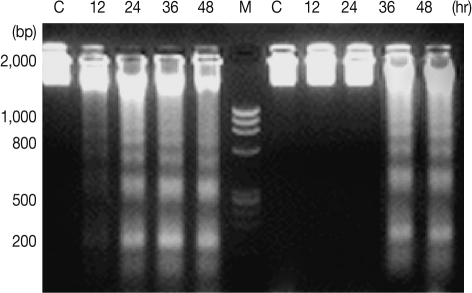
The aim of this study was to assess the cytotoxic effects of various concentrations of miltefosine on Leishmania major (MRHO/IR/75/ER) and L. tropica (MHOM/IR/02/Mash10) promastigotes and to observe the programmed cell death features. The colorimetric MTT assay was used to find L. major and L. tropica viability and the obtained results were expressed as 50% inhibitory concentration (IC50). Also, 50% effective doses (ED50) for L. major and L. tropica amastigotes were also determined. Annexin-V FLUOS staining was performed to study the cell death properties of miltefosine using FACS analysis. Qualitative analysis of the total genomic DNA fragmentation was performed by agarose gel electrophoresis. Furthermore, to observe changes in cell morphology, promastigotes were examined using light microscopy. In both strains of L. major and L. tropica, miltefosine induced dose-dependent death with features of apoptosis, including cell shrinkage, DNA laddering, and externalization of phosphatidylserine. The IC50 was achieved at 22 µM and 11 µM for L. major and L. tropica after 48 hr of incubation, respectively. ED50 of L. major and L. tropica amastigotes were 5.7 µM and 4.2 µM, respectively. Our results indicate that miltefosine induces apoptosis of the causative agent of cutaneous leishmaniasis in a dose-dependent manner. Interestingly, L. major did not display any apoptotic changes when it was exposed to miltefosine in concentrations sufficient to kill L. tropica.
Keywords: ED50; IC50; Leishmania major; Leishmania tropica; apoptosis; miltefosine.
Figures
References
-
- Ellis RE, Yuan JY, Horvitz HR. Mechanisms and functions of cell death. Ann Rev Cell Biol. 1991;7:663–698. - PubMed
-
- Raff MC. Social controls on cell survival and cell death. Nature. 1992;356(6368):397–400. - PubMed
-
- Steller H. Mechanisms and genes of cellular suicide. Science. 1995;267(5203):1445–1449. - PubMed
-
- Heussler VT, Küenzi P, Rottenberg S. Inhibition of apoptosis by intracellular protozoan parasites. Int J Parasitol. 2001;31:1166–1176. - PubMed
MeSH terms
Substances
LinkOut - more resources
Full Text Sources