


The association between insomnia severity and healthcare and productivity costs in a health plan sample
- PMID: 21461322
- PMCID: PMC3065254
- DOI: 10.1093/sleep/34.4.443
The association between insomnia severity and healthcare and productivity costs in a health plan sample
Abstract
Study objectives: Insomnia is a chronic condition with significant burden on health care and productivity costs. Despite this recognized burden, very few studies have examined associations between insomnia severity and healthcare and productivity costs.
Design: A retrospective study linking health claims data with a telephone survey of members of a health plan in the Midwestern region of the United States.
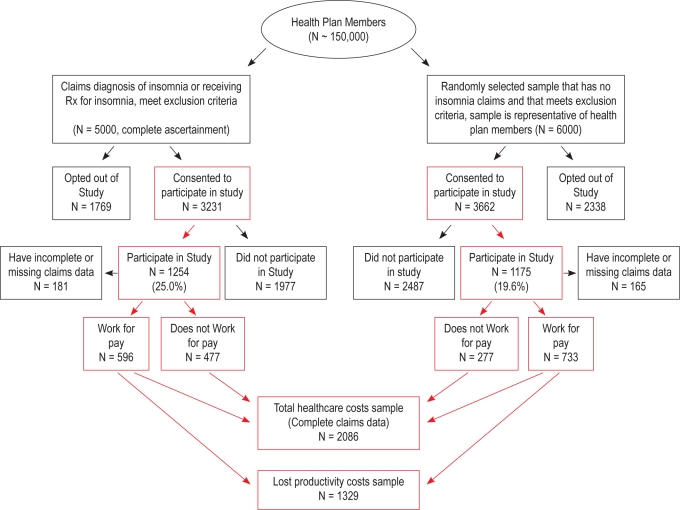
Participants: The total healthcare costs study sample consisted of 2086 health plan members who completed the survey and who had complete health claims data. The productivity costs sample consisted of 1329 health plan members who worked for pay-a subset of the total healthcare costs sample.
Measurements: Subjects' age, gender, demographic variables, comorbidities, and total health care costs were ascertained using health claims. Insomnia severity and lost productivity related variables were assessed using telephone interview.
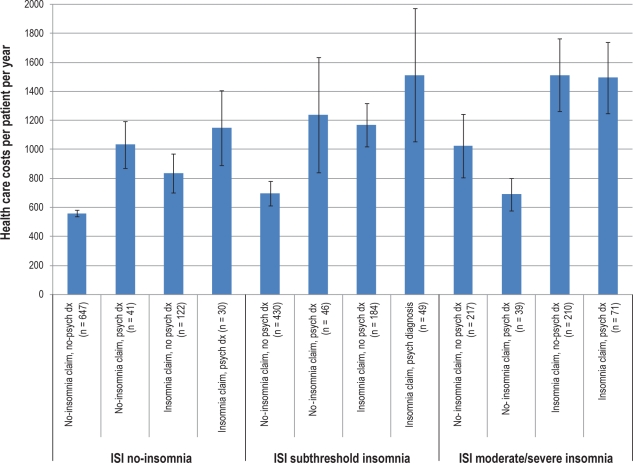
Results: Compared with the no insomnia group, mean total healthcare costs were 75% larger in the group with moderate and severe insomnia ($1323 vs. $757, P<0.05). Compared with the no insomnia group, mean lost productivity costs were 72% larger in the moderate and severe insomnia group ($1739 vs. $1013, P<0.001). Chronic medical comorbidities and psychiatric comorbidities were positively associated with health care cost. In contrast, psychiatric comorbidities were associated with lost productivity; while, medical comorbidities were not associated with lost productivity.
Conclusions: Health care and lost productivity costs were consistently found to be greater in moderate and severe insomniacs compared with non-insomniacs. Factors associated with lost productivity and health care costs may be fundamentally different and may require different kinds of interventions. Future studies should focus on better understanding mechanisms linking insomnia to healthcare and productivity costs and to understanding whether developing targeted interventions will reduce these costs.
Keywords: Insomnia severity; administrative health claims-linked survey; healthcare costs; insomnia costs; productivity costs.
Figures
Comment in
-
One more step towards justifying targeted treatment for insomnia.Sleep. 2011 Apr 1;34(4):417-8. doi: 10.1093/sleep/34.4.417. Sleep. 2011. PMID: 21461319 Free PMC article. No abstract available.
References
-
- Morin CM, LeBlanc M, Daley M, Gregoire JP, Merette C. Epidemiology of insomnia: prevalence, self-help treatments, consultations, and determinants of help-seeking behaviors. Sleep Med. 2006;7:123–30. - PubMed
-
- Ohayon MM. Epidemiology of insomnia: what we know and what we still need to learn. Sleep Med Rev. 2002;6:97–111. - PubMed
-
- Chilcott LA, Shapiro CM. The socioeconomic impact of insomnia. An overview. Pharmacoeconomics. 1996;10(Suppl 1):1–14. - PubMed
-
- Fullerton DS. The economic impact of insomnia in managed care: a clearer picture emerges. Am J Manag Care. 2006;12:S246–52. - PubMed
-
- Hatoum HT, Kong SX, Kania CM, Wong JM, Mendelson WB. Insomnia, health-related quality of life and healthcare resource consumption. A study of managed-care organisation enrollees. Pharmacoeconomics. 1998;14:629–37. - PubMed
Publication types
MeSH terms
LinkOut - more resources
Full Text Sources
Medical
