


Immunomodulatory effects of aerobic training in obesity
- PMID: 21461352
- PMCID: PMC3065046
- DOI: 10.1155/2011/308965
Immunomodulatory effects of aerobic training in obesity
Abstract
Introduction: Physical inactivity and obesity are independent risk factors for atherosclerosis. We analyzed the immunomodulatory capacity of 10-week intensified exercise training (ET) in obese and lean athletes. Markers of the innate immune response were investigated in obese (ONE: ET≤40 km/week) and lean athletes (LNE: ET≤40 km/week and LE: ET≥55 km/week).
Methods: Circulating dendritic cells (DC) were analyzed by flow-cytometry for BDCA-1/-2-expression. TLR-2/-4/-7 and MyD88 were analyzed by RT-PCR and Western blot. Circulating oxLDL levels were analyzed by ELISA.
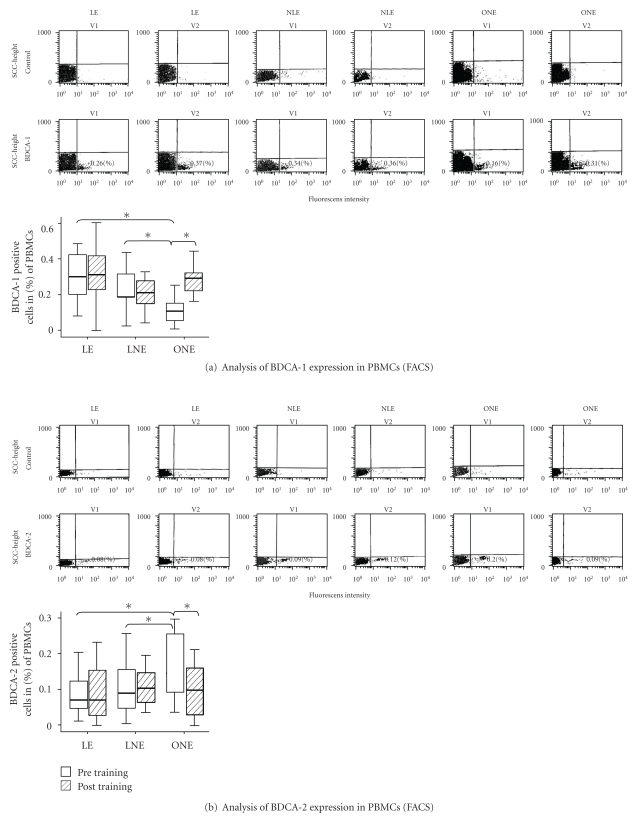
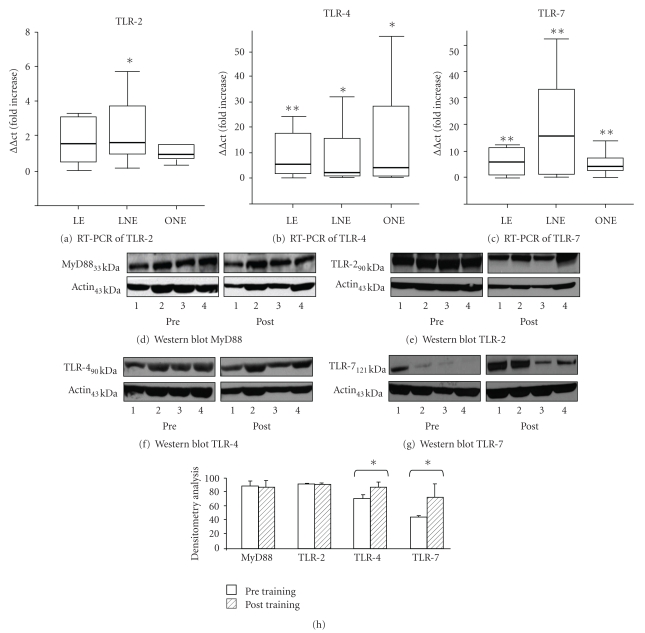
Results: BDCA-1 expression at baseline was lower in ONE compared to both other groups (ONE 0.15%; LNE 0.27%; LE 0.33%; P < .05), but significantly increased in ONE after training (+50%; P < .05). In contrast, BDCA-2 expression at baseline was higher in ONE (ONE 0.25%; LNE 0.11%; LE 0.09%; P < .05) and decreased in ONE after the 10-week training period (-27%; P < .05). Gene activations of TLR-4 and TLR-7 with corresponding protein increase were found for all three groups (P < .01/P < .05) compared to pre training. A reduction of oxLDL levels was seen in ONE (-61%; P < .05).
Conclusions: Intensified exercise induces an increase of BDCA-1+ DCs and TLR-4/-7 in obese athletes. We hereby describe new immune modulatory effects, which-through regular aerobic exercise-modulate innate immunity and pro-inflammatory cytokines in obesity.
Figures
References
-
- Clark AM, Hartling L, Vandermeer B, McAlister FA. Meta-analysis: secondary prevention programs for patients with coronary artery. Annals of Internal Medicine. 2005;143(9):659–I87. - PubMed
-
- Murthy N, Mukherjee S, Ray G, Ray A. Dietary factors and cancer chemoprevention: an overview of obesity-related malignancies. Journal of Postgraduate Medicine. 2009;55(1):45–54. - PubMed
-
- Yusuf PS, Hawken S, Ôunpuu S, et al. Effect of potentially modifiable risk factors associated with myocardial infarction in 52 countries (the INTERHEART study): case-control study. The Lancet. 2004;364(9438):937–952. - PubMed
Publication types
MeSH terms
Substances
LinkOut - more resources
Full Text Sources
Medical
