. 2011 Apr 1;34(4):419-23.
doi: 10.1093/sleep/34.4.419.

Evidence that neurons of the sublaterodorsal tegmental nucleus triggering paradoxical (REM) sleep are glutamatergic

Affiliations

Evidence that neurons of the sublaterodorsal tegmental nucleus triggering paradoxical (REM) sleep are glutamatergic

Olivier Clément et al. Sleep. .

Abstract

Study objectives: To determine whether sublaterodorsal tegmental nucleus (SLD) neurons triggering paradoxical (REM) sleep (PS) are glutamatergic.

Design: Three groups of rats were used: controls, rats deprived of PS for 72 h, and rats allowed to recover for 3 h after deprivation. Brain sections were processed for double labeling combining Fos immunohistochemistry and vesicular glutamate transporter 2 (vGLUT2) in situ hybridization.

Measurements and results: The number of single Fos+ and Fos/vGLUT2+ double-labeled neurons was counted for each experimental condition. A very large number of Fos+ neurons expressing vGLUT2 mRNA specifically after PS hypersomnia was counted in the SLD. These double-labeled cells accounted for 84% of the total number of Fos+ cells.

Conclusions: This finding adds further evidence to the concept that PS-on neurons of the SLD generating PS are of small size and glutamatergic in nature. By means of their descending projections to medullary and/or spinal glycinergic/GABAergic premotoneurons, they may be especially important for the induction of muscle atonia during PS, a disturbed phenomenon in narcolepsy and REM sleep behavior disorder.

Keywords: Parkinson; REM sleep behavior disorder; brainstem reticular formation; cataplexy; hypocretin.


Figures
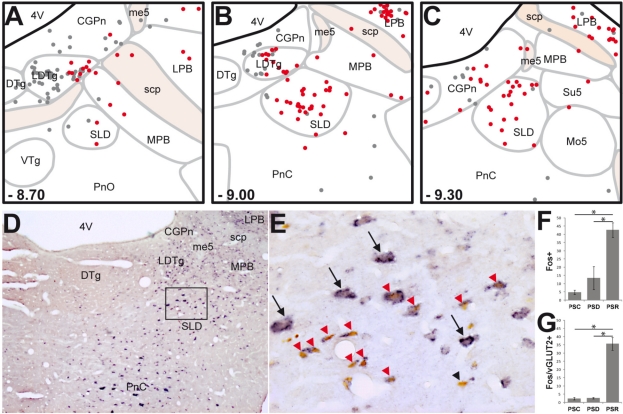
Figure 1
Figure 1
SLD neurons expressing Fos after PS-recovery are mostly glutamatergic. (A-C) Schematic distribution of Fos+ (gray dots) and Fos-vGLUT2+ (red dots) neurons on coronal sections taken at 300 μm intervals through the full rostro-caudal extent of the SLD in a representative PSR animal. Rostro-caudal localization of each section is indicated from Bregma at the bottom left corner of each drawing. (D-E) Photomicrographs showing Fos (brown nuclear staining) and vGLUT2 (blue diffuse cytoplasmic staining) double staining at SLD level. (E) is a higher magnification of the rectangular box in D. Note the dense cluster of double-labeled neurons into the SLD of a PSR rat. Interestingly, most of the large glutamatergic SLD neurons do not express Fos after PS hypersomnia (black arrows). Conversely, double-labeled neurons after PS hypersomnia are rather of small size (red arrowheads). Only one neuron labeled for Fos after PS-hypersomnia does not express vGLUT2 mRNA (black arrowhead). (F-G) Number of Fos+ and Fos/vGLUT2+ neurons in the SLD in control (PSC), PS deprived (PSP) and PS recovery (PSR) conditions. Values are mean ± SEM. *P < 0.05. 4V, 4th ventricle; CGPn, central gray of the pons; DTg, dorsal tegmental nucleus; LDTg, laterodorsal tegmental nucleus; LPB, lateral parabrachial nucleus; me5, mesencephalic trigeminal tract; Mo5, motor trigeminal nucleus; MPB, medial parabrachial nucleus; PnC, pontine reticular nucleus, caudal part; PnO, pontine reticular nucleus, oral part; scp, superior cerebellar peduncle; SLD, sublaterodorsal tegmental nucleus; su5, supratrigeminal nucleus; VTg, ventral tegmental nucleus.
Figure 2
Figure 2
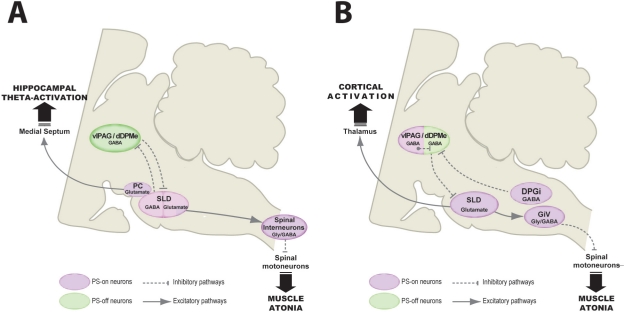
Models of the pontine network responsible for paradoxical (REM) sleep generation. This figure aims to compare our model (B) and that of Lu et al. (A). In both models, the SLD contains PS-on glutamatergic neurons generating PS. Their activation at the onset of PS is gated by the removal of a tonic GABAergic input activated during waking and SWS and arising from vlPAG/dDpMe neurons. Lu et al. further hypothesized that the SLD also contains a population of GABAergic PS-on neurons inhibiting at the onset of and during PS the vlPAG/dDpMe PS-off neurons. They proposed that a flip-flop switch between these 2 populations of GABAergic neurons control PS occurrence. In our model, PS-on GABAergic neurons also control PS occurrence by means of their projections to the vlPAG/dDpMe PS-off GABAergic neurons, but they are localized in the vlPAG/dDpMe and a medullary nucleus named the dorsal paragigantocellular reticular nucleus (DPGi)., We propose that their activation at the onset of PS is due to an intrinsic “clock like” mechanism. Another major difference between the two models concerns the pathways by which SLD triggers the muscle atonia during PS. We propose that SLD PS-on glutamatergic neurons activate glycinergic/GABAergic neurons localized in the GiV, which in turn, hyperpolarize cranial and spinal motoneurons, leading to muscle atonia. Lu et al. proposed that SLD PS-on glutamatergic neurons inhibit spinal motoneurons via direct projections to spinal interneurons co-containing GABA and glycine. One could argue that these two hypotheses are not mutually exclusive. We finally propose that SLD PS-on neurons activate the cortex by means of their projection to intralaminar thalamic nuclei whereas Lu et al. proposed that a small nucleus close to the SLD named precoeruleus (PC) generate theta oscillations during PS via projections to the medial septum. DPGi, dorsal paragigantocellular reticular nucleus; dDpMe, dorsal part of the deep mesencephalic nucleus; GiV, ventral gigantocellular reticular nucleus; PC, precoeruleus nucleus; SLD, sublaterodorsal tegmental nucleus; vlPAG, ventrolateral periaqueductal gray.

References

    1. Boissard R, Gervasoni D, Schmidt MH, Barbagli B, Fort P, Luppi PH. The rat ponto-medullary network responsible for paradoxical sleep onset and maintenance: a combined microinjection and functional neuroanatomical study. Eur J Neurosci. 2002;16:1959–73. - PubMed
    1. Fort P, Bassetti CL, Luppi PH. Alternating vigilance states: new insights regarding neuronal networks and mechanisms. Eur J Neurosci. 2009;29:1741–53. - PubMed
    1. Luppi PH, Gervasoni D, Verret L, et al. Paradoxical (REM) sleep genesis: the switch from an aminergic-cholinergic to a GABAergic-glutamatergic hypothesis. J Physiol Paris. 2006;100:271–83. - PubMed
    1. Lu J, Sherman D, Devor M, Saper CB. A putative flip-flop switch for control of REM sleep. Nature. 2006;441:589–94. - PubMed
    1. Verret L, Leger L, Fort P, Luppi PH. Cholinergic and noncholinergic brainstem neurons expressing Fos after paradoxical (REM) sleep deprivation and recovery. Eur J Neurosci. 2005;21:2488–504. - PubMed

Publication types

Substances