


Nature and nurturing: parenting in the context of child temperament
- PMID: 21461681
- PMCID: PMC3163750
- DOI: 10.1007/s10567-011-0093-4
Nature and nurturing: parenting in the context of child temperament
Abstract
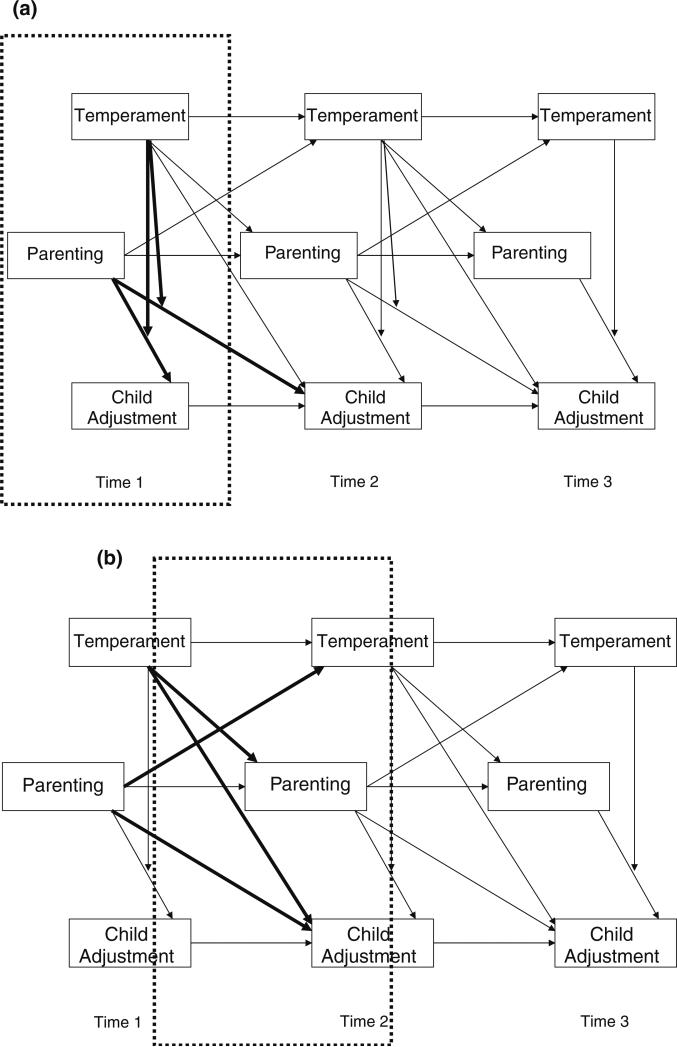
Accounting for both bidirectional and interactive effects between parenting and child temperament can fine-tune theoretical models of the role of parenting and temperament in children's development of adjustment problems. Evidence for bidirectional and interactive effects between parenting and children's characteristics of frustration, fear, self-regulation, and impulsivity was reviewed, and an overall model of children's individual differences in response to parenting is proposed. In general, children high in frustration, impulsivity and low in effortful control are more vulnerable to the adverse effects of negative parenting, while in turn, many negative parenting behaviors predict increases in these characteristics. Frustration, fearfulness, and effortful control also appear to elicit parenting behaviors that can predict increases in these characteristics. Irritability renders children more susceptible to negative parenting behaviors. Fearfulness operates in a very complex manner, sometimes increasing children's responses to parenting behaviors and sometimes mitigating them and apparently operating differently across gender. Important directions for future research include the use of study designs and analytic approaches that account for the direction of effects and for developmental changes in parenting and temperament over time.
Figures
References
-
- Aiken LA, West SG. Multiple regression: Testing and interpreting interactions. Sage; Newberry Park: 1991.
-
- Arcus D. Inhibited and uninhibited children: Biology in the social context. In: Wachs TD, Kohnstamm GA, editors. Temperament in context. Lawrence Erlbaum; Mahwah, NJ: 2001. pp. 43–60.
-
- Bakermans-Kranenburg MJ, van Ijzendoorn MH. Gene-Environment interaction of the dopamine D4 receptor (DRD4) and observe maternal insensitivity predicting externalizing behavior in preschoolers. Developmental Psychobiology. 2006;10:406–409. - PubMed
-
- Barber BK. Parental psychological control: Revisiting a neglected construct. Child Development. 1996;67:3296–3319. - PubMed
-
- Barber BK, Bean RL, Erickson LD. Expanding the study and understanding of psychological control. In: Barber BK, editor. Intrusive parenting: How psychological control affects children and adolescents. American Psychological Association; Washington, DC: 2002. pp. 263–289.
Publication types
MeSH terms
Grants and funding
LinkOut - more resources
Full Text Sources
Medical
