


doi: 10.1111/j.1474-9726.2011.00711.x.
Epub 2011 Apr 25.
The dynamin-related protein DRP-1 and the insulin signaling pathway cooperate to modulate Caenorhabditis elegans longevity
Affiliations
- PMID: 21463460
- PMCID: PMC3135752
- DOI: 10.1111/j.1474-9726.2011.00711.x
Item in Clipboard
The dynamin-related protein DRP-1 and the insulin signaling pathway cooperate to modulate Caenorhabditis elegans longevity
Aging Cell.
2011 Aug.
Abstract
Here, we report that inactivation of the Caenorhabditis elegans dynamin-related protein DRP-1, a key component responsible for mitochondrial fission and conserved from yeast to humans, dramatically enhanced the effect of reduced insulin signaling (IIS) to extend lifespan. This represents the first report of a beneficial impact of manipulating mitochondrial dynamics on animal lifespan and suggests that mitochondrial morphology and IIS cooperate to modulate aging.
© 2011 The Authors. Aging Cell © 2011 Blackwell Publishing Ltd/Anatomical Society of Great Britain and Ireland.
Figures
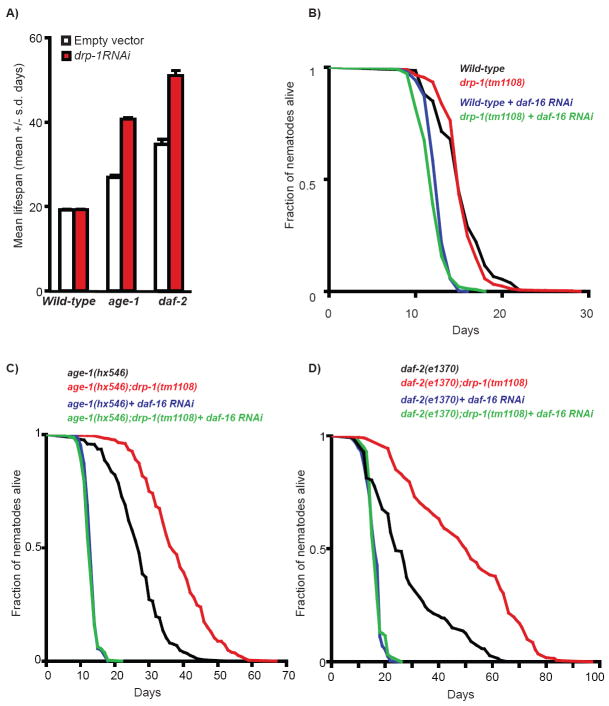
(A) Mean adult lifespan (+/- s.d) of wild-type, age-1 and daf-2 mutant worms treated with empty vector (empty bars) or drp-1 RNAi (red bars). Note that quantitative PCR data showed that drp-1 mRNA expression was reduced by ~50% in all strains upon drp-1 RNAi treatment (data not shown). Adult lifespan of wild-type and drp-1 mutant worms (B); age-1 and age-1;drp-1 mutant worms (C); daf-2 and daf-2;drp-1 mutant worms (D) treated or not with daf-16 RNAi (as indicated). Quantitative data and statistical analysis are presented in Table S1.
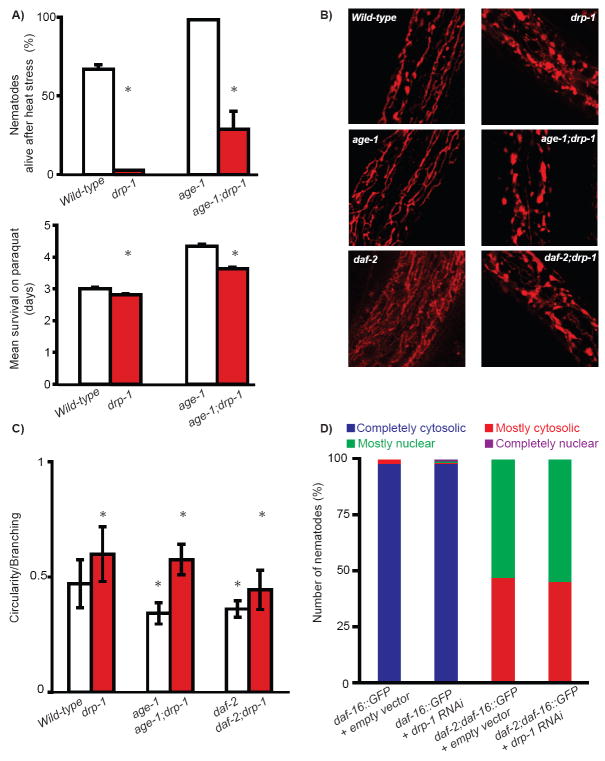
(A) Percentage of worms alive (+/- s.d) after 8 hours at 37°C (upper graph) and mean survival (+/- s.d) upon treatment with 25 mM paraquat (bottom graph) in the indicated strains. * indicates p<0.001 (Student’s t-test for heat stress and log-rank test for paraquat). TMRE staining (B) and circularity index (+/- s.d) (C) of the mitochondrial network in the indicated strains. In (C), * indicates p<0.005 when compared to single mutant counterpart and p<0.005 when compared to wild-type worms using a Student’s t-test. In agreement with previous studies (Labrousse et al. 1999), drp-1 mutant worms exhibited disrupted structure of the tubular mitochondrial network in which mitochondria tended to form large blebs as reflected by an increased circularity index. (D) DAF-16∷GFP was categorized by sub-cellular localization in daf-2 worms treated with empty vector or drp-1 RNAi. The data obtained at Day 3 of adulthood are presented.
References
-
- Artal-Sanz M, Tavernarakis N. Prohibitin couples diapause signalling to mitochondrial metabolism during ageing in C. elegans. Nature. 2009;461:793–797. - PubMed
-
- Feng J, Bussiere F, Hekimi S. Mitochondrial electron transport is a key determinant of life span in Caenorhabditis elegans. Dev Cell. 2001;1:633–644. - PubMed
Publication types
MeSH terms
Substances
Grants and funding
LinkOut - more resources
Full Text Sources
Other Literature Sources
Medical
Research Materials
Miscellaneous
