


Treatment of experimental adjuvant arthritis with a novel folate receptor-targeted folic acid-aminopterin conjugate
- PMID: 21463515
- PMCID: PMC3132048
- DOI: 10.1186/ar3304
Treatment of experimental adjuvant arthritis with a novel folate receptor-targeted folic acid-aminopterin conjugate
Abstract
Introduction: Folate receptor (FR)-expressing macrophages have been shown to accumulate at sites of inflammation, where they promote development of inflammatory symptoms. To target such a macrophage population, we designed and evaluated the biologic activity of EC0746, a novel folic acid conjugate of the highly potent antifolate, aminopterin.
Methods: Using a FR-positive subclone of murine macrophage-derived RAW264.7 cells and rat thioglycollate-elicited macrophages, we studied the effect of EC0746 on dihydrofolate reductase activity, cell proliferation, and cellular response towards bacterial lipopolysaccharide as well as IFNγ activation. The EC0746 anti-inflammatory activity, pharmacokinetics, and toxicity were also evaluated in normal rats or in rats with adjuvant-induced arthritis; that is, a FR-positive macrophage model that closely resembles rheumatoid arthritis in humans.
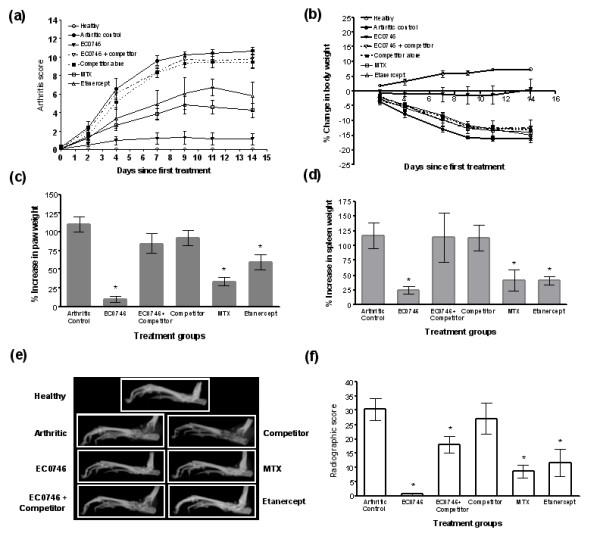
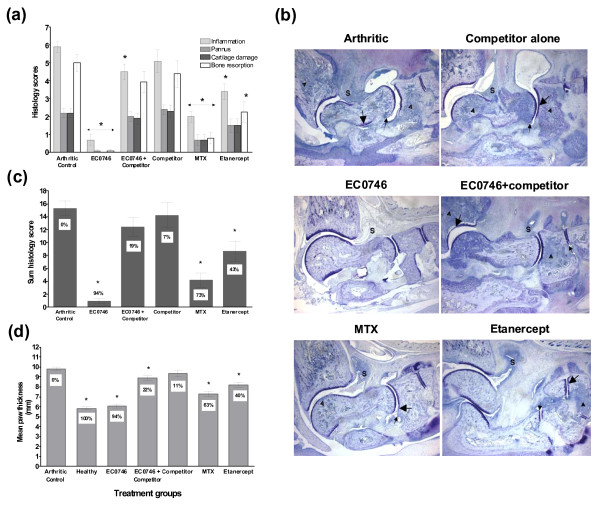
Results: EC0746 suppresses the proliferation of RAW264.7 cells and prevents the ability of nonproliferating rat macrophages to respond to inflammatory stimuli. In the macrophage-rich rat arthritis model, brief treatment with subcutaneously administered EC0746 is shown to mediate an FR-specific anti-inflammatory response that is more potent than either orally administered methotrexate or subcutaneously delivered etanercept. More importantly, EC0746 therapy is also shown to be ~40-fold less toxic than unmodified aminopterin, with fewer bone marrow and gastrointestinal problems.
Conclusions: EC0746 is the first high FR-binding dihydrofolate reductase inhibitor that demonstrates FR-specific anti-inflammatory activities both in vitro and in vivo. Our data reveal that a relatively toxic anti-inflammatory drug, such as aminopterin, can be targeted with folic acid to inflammatory macrophages and thereby relieve inflammatory symptoms with greatly reduced toxicity.
Figures
Comment in
-
A new weapon against an old target.Arthritis Res Ther. 2011 Aug 12;13(4):122. doi: 10.1186/ar3392. Arthritis Res Ther. 2011. PMID: 21861856 Free PMC article.
References
-
- Haringman JJ, Gerlag DM, Zwinderman AH, Smeets TJ, Kraan MC, Baeten D, McInnes IB, Bresnihan B, Tak PP. Synovial tissue macrophages: a sensitive biomarker for response to treatment in patients with rheumatoid arthritis. Ann Rheum Dis. 2005;64:834–838. doi: 10.1136/ard.2004.029751. - DOI - PMC - PubMed
MeSH terms
Substances
LinkOut - more resources
Full Text Sources
Other Literature Sources
Medical
