Monoamine oxidase A inhibitor occupancy during treatment of major depressive episodes with moclobemide or St. John's wort: an [11C]-harmine PET study
- PMID: 21463543
- PMCID: PMC3201991
- DOI: 10.1503/jpn.100117
Monoamine oxidase A inhibitor occupancy during treatment of major depressive episodes with moclobemide or St. John's wort: an [11C]-harmine PET study
Abstract
Background: Monoamine oxidase A (MAO-A) inhibitor antidepressants raise levels of multiple monoamines, whereas the selective serotonin reuptake inhibitors (SSRIs) only raise extracellular serotonin. Despite this advantage of MAO-A inhibitors, there is much less frequent development of MAO inhibitors compared with SSRIs. We sought to measure brain MAO-A occupancy after 6 weeks of treatment in depressed patients with a clinically effective dose of a selective MAO-A inhibitor and measure MAO-A occupancy after repeated administration of St. John's wort, an herb purported to have MAO-A inhibitor properties.
Methods: Participants underwent 2 [(11)C]-harmine positron emission tomography scans. Healthy controls completed a test-retest condition, and depressed patients were scanned before and after repeated administration of moclobemide or St. John's wort for 6 weeks at the assigned dose. We measured MAO-A VT, an index of MAO-A density, in the prefrontal, anterior cingulate and anterior temporal cortices, putamen, thalamus, midbrain and hippocampus.
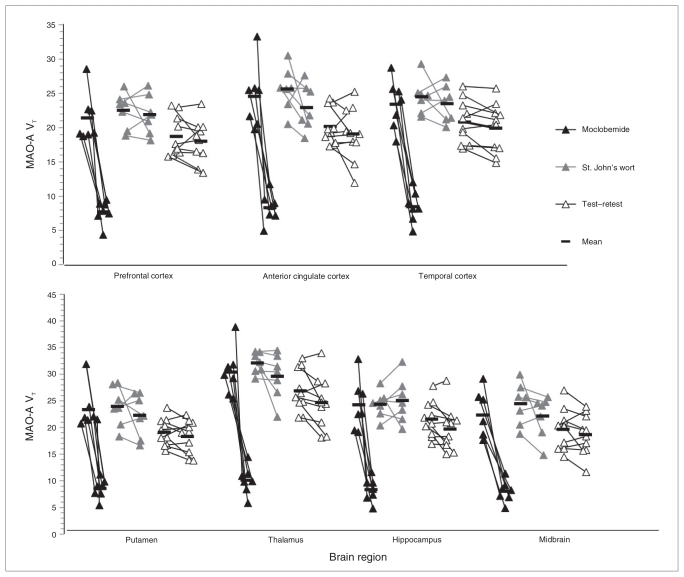
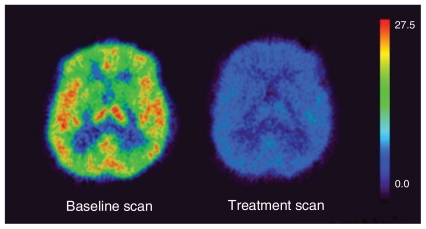
Results: We included 23 participants (10 controls and 13 patients with major depressive disorder [MDD]) in our study. Monoamine oxidase A VT decreased significantly throughout all regions after moclobemide treatment in patients with MDD compared with controls (repeated-measures analysis of variance, F1,15 = 71.08-130.06, p < 0.001 for all regions, mean occupancy 74% [standard deviation 6%]). Treatment with St. John's wort did not significantly alter MAO-A VT.
Limitations: The occupancy estimates are limited by the sample size of each treatment group; hence, our estimate for the overall moclobemide occupancy of 74% has a 95% confidence interval of 70%-78%, and we can estimate with 95% certainty that the occupancy of St. John's wort is less than 5%.
Conclusion: For new MAO-A inhibitors, about 74% occupancy at steady-state dosing is desirable. Consistent with this, St. John's wort should not be classified as an MAO-A inhibitor. The magnitude of MAO-A blockade during moclobemide treatment exceeds the elevation of MAO-A binding during illness by at least 30%, suggesting that the treatment effect should exceed the disease effect when designing selective antidepressants for this target.
© 2011 Canadian Medical Association
Figures
References
-
- Kessler RC, Berglund P, Demler O, et al. The epidemiology of major depressive disorder: results from the National Comorbidity Survey Replication (NCS-R) JAMA. 2003;289:3095–105. - PubMed
-
- Ustün TB, Ayuso-Mateos JL, Chatterji S, et al. Global burden of depressive disorders in the year 2000. Br J Psychiatry. 2004;184:386–92. - PubMed
-
- Thase ME, Friedman ES, Biggs MM, et al. Cognitive therapy versus medication in augmentation and switch strategies as second-step treatments: a STAR*D report. Am J Psychiatry. 2007;164:739–52. - PubMed
-
- Youdim MB, Edmondson D, Tipton KF. The therapeutic potential of monoamine oxidase inhibitors. Nat Rev Neurosci. 2006;7:295–309. - PubMed
Publication types
MeSH terms
Substances
Grants and funding
LinkOut - more resources
Full Text Sources