


Microsecond simulations indicate that ethanol binds between subunits and could stabilize an open-state model of a glycine receptor
- PMID: 21463577
- PMCID: PMC3072665
- DOI: 10.1016/j.bpj.2011.02.032
Microsecond simulations indicate that ethanol binds between subunits and could stabilize an open-state model of a glycine receptor
Abstract
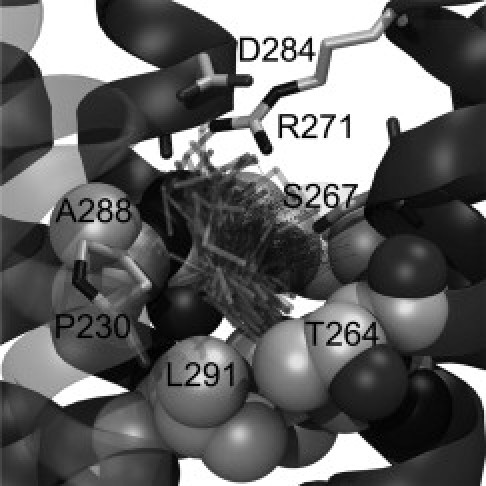
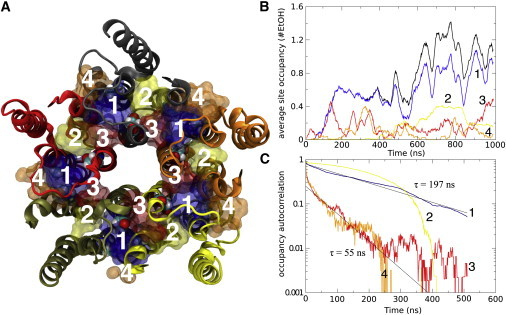
Cys-loop receptors constitute a superfamily of ion channels gated by ligands such as acetylcholine, serotonin, glycine, and γ-aminobutyric acid. All of these receptors are thought to share structural characteristics, but due to high sequence variation and limited structure availability, our knowledge about allosteric binding sites is still limited. These sites are frequent targets of anesthetic and alcohol molecules, and are of high pharmacological importance. We used molecular simulations to study ethanol binding and equilibrium exchange for the homomeric α1 glycine receptor (GlyRα1), modeled on the structure of the Gloeobacter violaceus pentameric ligand-gated channel. Ethanol has a well-known potentiating effect and can be used in high concentrations. By performing two microsecond-scale simulations of GlyR with/without ethanol, we were able to observe spontaneous binding in cavities and equilibrium ligand exchange. Of interest, it appears that there are ethanol-binding sites both between and within the GlyR transmembrane subunits, with the intersubunit site having the highest occupancy and slowest exchange (∼200 ns). This model site involves several residues that were previously identified via mutations as being crucial for potentiation. Finally, ethanol appears to stabilize the GlyR model built on a presumably open form of the ligand-gated channel. This stabilization could help explain the effects of allosteric ligand binding in Cys-loop receptors.
Copyright © 2011 Biophysical Society. Published by Elsevier Inc. All rights reserved.
Figures
References
-
- Brejc K., van Dijk W.J., Sixma T.K. Crystal structure of an ACh-binding protein reveals the ligand-binding domain of nicotinic receptors. Nature. 2001;411:269–276. - PubMed
-
- Unwin N. Refined structure of the nicotinic acetylcholine receptor at 4A resolution. J. Mol. Biol. 2005;346:967–989. - PubMed
-
- Hilf R.J., Dutzler R. A prokaryotic perspective on pentameric ligand-gated ion channel structure. Curr. Opin. Struct. Biol. 2009;19:418–424. - PubMed
-
- Celentano J.J., Gibbs T.T., Farb D.H. Ethanol potentiates GABA- and glycine-induced chloride currents in chick spinal cord neurons. Brain Res. 1988;455:377–380. - PubMed
-
- Ye Q., Koltchine V.V., Harris R.A. Enhancement of glycine receptor function by ethanol is inversely correlated with molecular volume at position α267. J. Biol. Chem. 1998;273:3314–3319. - PubMed
Publication types
MeSH terms
Substances
Grants and funding
LinkOut - more resources
Full Text Sources
Other Literature Sources
Miscellaneous
