. 2011 Apr 19;108(16):6462-7.
doi: 10.1073/pnas.1018260108. Epub 2011 Apr 4.

Real-time label-free monitoring of adipose-derived stem cell differentiation with electric cell-substrate impedance sensing

Affiliations

Real-time label-free monitoring of adipose-derived stem cell differentiation with electric cell-substrate impedance sensing

Pierre O Bagnaninchi et al. Proc Natl Acad Sci U S A. .

Abstract

Real-time monitoring of stem cells (SCs) differentiation will be critical to scale-up SC technologies, while label-free techniques will be desirable to quality-control SCs without precluding their therapeutic potential. We cultured adipose-derived stem cells (ADSCs) on top of multielectrode arrays and measured variations in the complex impedance Z* throughout induction of ADSCs toward osteoblasts and adipocytes. Z* was measured up to 17 d, every 180 s, over a 62.5-64 kHz frequency range with an ECIS Z instrument. We found that osteogenesis and adipogenesis were characterized by distinct Z* time-courses. Significant differences were found (P = 0.007) as soon as 12 h post induction. An increase in the barrier resistance (Rb) up to 1.7 ohm·cm(2) was associated with early osteo-induction, whereas Rb peaked at 0.63 ohm·cm(2) for adipo-induced cells before falling to zero at t = 129 h. Dissimilarities in Z* throughout early induction (<24 h) were essentially attributed to variations in the cell-substrate parameter α. Four days after induction, cell membrane capacitance (Cm) of osteo-induced cells (Cm = 1.72 ± 0.10 μF/cm(2)) was significantly different from that of adipo-induced cells (Cm = 2.25 ± 0.27 μF/cm(2)), indicating that Cm could be used as an early marker of differentiation. Finally, we demonstrated long-term monitoring and measured a shift in the complex plane in the middle frequency range (1 kHz to 8 kHz) between early (t = 100 h) and late induction (t = 380 h). This study demonstrated that the osteoblast and adipocyte lineages have distinct dielectric properties and that such differences can be used to perform real-time label-free quantitative monitoring of adult stem cell differentiation with impedance sensing.


Conflict of interest statement

The authors declare no conflict of interest.

Figures
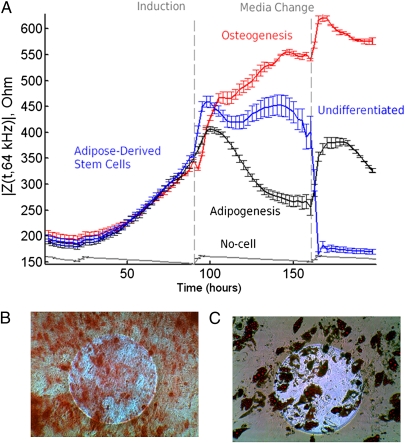
Fig. 1.
Fig. 1.
Real-time and label-free monitoring of ADSCs induced toward osteoblasts and adipocytes. (A) Time-course measurement of mean impedance, |Z(t,f)|, at 64 kHz, for different groups throughout early induction. ADSCs were seeded (t = 0) on multiwell preprinted electrodes arrays. At t = 93 h, ADSCs were induced toward osteoblasts (n = 3) and adipocytes (n = 3) with, respectively, osteogenesis and adipogenesis differentiation medium. Noninduced ADSCs (n = 3) were kept growing after confluency until cell detachment occurred. Clear differences in |Z(t,f)| can be observed between all groups. After several days (>14) after induction, histochemical end-point staining was performed to assess that cells underwent osteogenesis (B) (Alizarin red stain) and adipogenesis (C) (Oil Red O stain). Circular microelectrodes were 250 μm in diameter and appeared as bright circle on the micrograph.
Fig. 2.
Fig. 2.
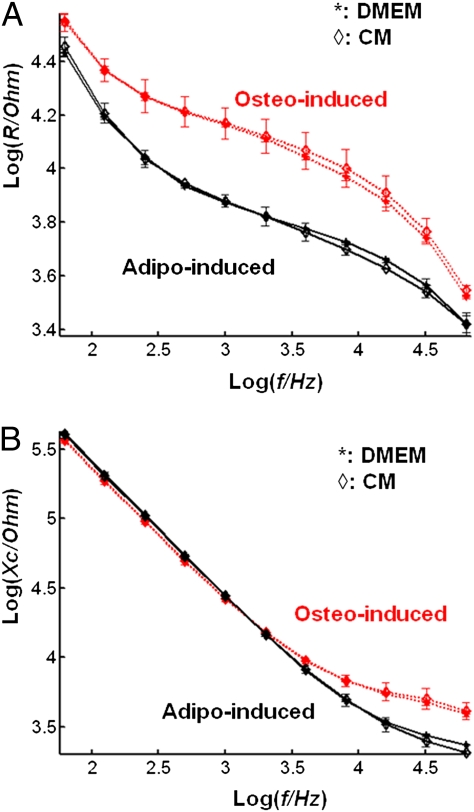
Frequency-dependent resistance and capacitive reactance of osteo-induced and adipo-induced cells in different culture medium. The logarithm of the resistance, R (A), and of the capacitive reactance, Xc (B), were plotted against the logarithm of the frequency for the osteo-induced and adipo-induced groups. No significant differences were found when their respective differentiation complete medium (CM) was switched for 10% FCS supplemented DMEM (DMEM). Differences observed between the two groups did not arise from differences in the differentiation media.
Fig. 3.
Fig. 3.
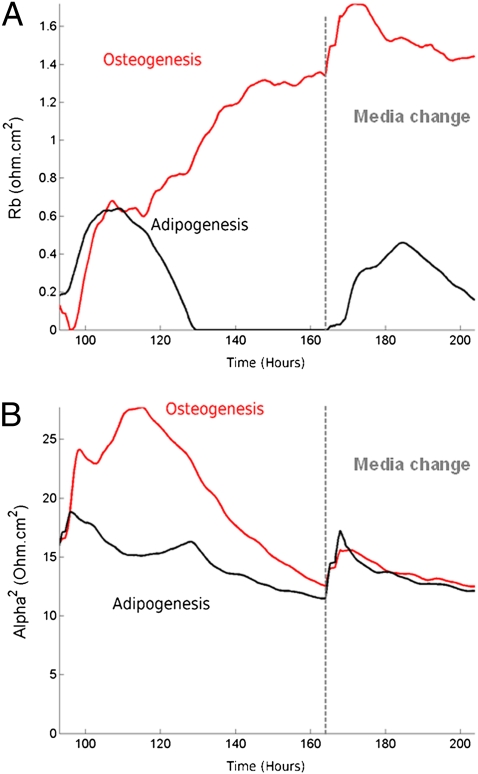
Elucidating variation in impedance throughout early induction. (A) During osteogenesis, the barrier resistance, Rb, was found to increase steadily after induction (t = 96 h) to 1.7 ohm·cm2 and leveled off at 1.4 ohm·cm2 after the media was changed (t = 164 h). Rb declined after the first day of adipogenesis to reach zero at t = 129 h. The change of media was characterized by a re-establishment of the cell-to-cell junction over the next 48 h. (B) α2, the cell-to substrate parameter, rose over the first day of osteo-induction to 22.5 ohm·cm2 before falling to a mean value of 14 ohm·cm2. α2 decreased slowly after induction for the adipo-induction group.
Fig. 4.
Fig. 4.
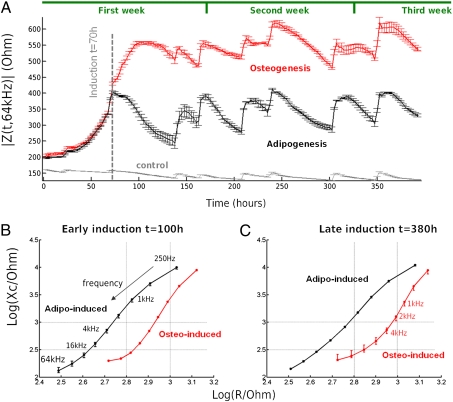
Long-term monitoring of osteogenesis and adipogenesis with electric cell-substrate impedance sensing. (A) Long-term monitoring of |Z(t,f)| was demonstrated throughout differentiation (t > 400 h) and plotted at 64 kHz. At t = 70 h, ADSCs were induced toward osteoblasts (n = 3) and adipocytes (n = 3). (B) Mean complex impedance (Z = R + iXc) and SD represented at multiple frequencies (250 Hz to 64 kHz) in the complex plane on a logarithmic scale. Differences in the complex spectra were observed between osteo-induced and adipo-induced cells at early (t = 100 h) (B) and late (C) stage (t = 380 h) of differentiation. A shift in the complex plane can be observed between cells at early and late differentiation stage, indicating a possible correlation in the middle frequency range with the apparition of specialized functions.

References

    1. Zuk PA, et al. Multilineage cells from human adipose tissue: Implications for cell-based therapies. Tissue Eng. 2001;7:211–228. - PubMed
    1. Zuk PA, et al. Human adipose tissue is a source of multipotent stem cells. Mol Biol Cell. 2002;13:4279–4295. - PMC - PubMed
    1. Zuk PA. The adipose-derived stem cell: Looking back and looking ahead. Mol Biol Cell. 2010;21:1783–1787. - PMC - PubMed
    1. Giaever I, Keese CR. Monitoring fibroblast behavior in tissue culture with an applied electric field. Proc Natl Acad Sci USA. 1984;81:3761–3764. - PMC - PubMed
    1. Giaever I, Keese CR. Use of electric fields to monitor the dynamical aspect of cell behavior in tissue culture. IEEE Trans Biomed Eng. 1986;33:242–247. - PubMed

Publication types