


Ethnicity modifies the relationships of insulin resistance, inflammation, and adiponectin with obesity in a multiethnic Asian population
- PMID: 21464462
- PMCID: PMC3114514
- DOI: 10.2337/dc10-2097
Ethnicity modifies the relationships of insulin resistance, inflammation, and adiponectin with obesity in a multiethnic Asian population
Abstract
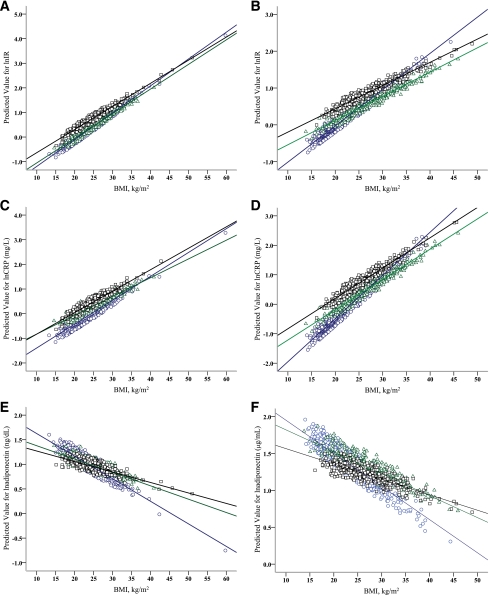
Objective: The development of obesity-related metabolic disorders varies with ethnicity. We examined whether ethnicity modifies the relationship between BMI and three metabolic pathways (insulin resistance, inflammation, and adiponectin) that are involved in the pathogenesis of diabetes and cardiovascular disease (CVD).
Research design and methods: We analyzed data from 4,804 Chinese, Malay, and Asian-Indian residents of Singapore with complete data on insulin resistance (IR), C-reactive protein (CRP), and total adiponectin levels. Linear regression models with an interaction term ethnicity*BMI were used to evaluate whether ethnicity modifies the association between BMI and IR, CRP, and adiponectin.
Results: In both uni- and multivariate analyses, BMI was directly associated with IR and CRP and inversely with adiponectin across all ethnic groups. When compared with Chinese and Malays, Asian-Indians had higher IR and CRP and lower adiponectin levels. The associations between BMI and its metabolic pathways were significantly stronger in Chinese than in other ethnic groups. The increase in IR and CRP and the decrease in adiponectin for each unit increase in BMI were greater in Chinese than in other ethnic groups. The findings were similar when waist circumference was used in the analyses instead of BMI.
Conclusions: The impact of BMI on IR, CRP, and adiponectin appears greater in Chinese as compared with other major Asian ethnic groups. This may partly explain the rapid increase in the prevalence of diabetes and CVD in Chinese populations and highlights the importance of weight management in Asian ethnic groups despite the apparently low levels of obesity.
Figures
References
-
- Chan JC, Malik V, Jia W, et al. Diabetes in Asia: epidemiology, risk factors, and pathophysiology. JAMA 2009;301:2129–2140 - PubMed
-
- Lillioja S, Mott DM, Howard BV, et al. Impaired glucose tolerance as a disorder of insulin action. Longitudinal and cross-sectional studies in Pima Indians. N Engl J Med 1988;318:1217–1225 - PubMed
-
- Abbasi F, Brown BW, Jr, Lamendola C, McLaughlin T, Reaven GM. Relationship between obesity, insulin resistance, and coronary heart disease risk. J Am Coll Cardiol 2002;40:937–943 - PubMed
-
- WHO Expert Consultation Appropriate body-mass index for Asian populations and its implications for policy and intervention strategies. Lancet 2004;363:157–163 - PubMed
-
- Mente A, Razak F, Blankenberg S, et al. ; Study of the Health Assessment And Risk Evaluation; Study of the Health Assessment And Risk Evaluation in Aboriginal Peoples Investigators Ethnic variation in adiponectin and leptin levels and their association with adiposity and insulin resistance. Diabetes Care 2010;33:1629–1634 - PMC - PubMed
Publication types
MeSH terms
Substances
LinkOut - more resources
Full Text Sources
Medical
Molecular Biology Databases
Research Materials
Miscellaneous
