


Slaughterhouse pigs are a major reservoir of Streptococcus suis serotype 2 capable of causing human infection in southern Vietnam
- PMID: 21464930
- PMCID: PMC3065462
- DOI: 10.1371/journal.pone.0017943
Slaughterhouse pigs are a major reservoir of Streptococcus suis serotype 2 capable of causing human infection in southern Vietnam
Abstract
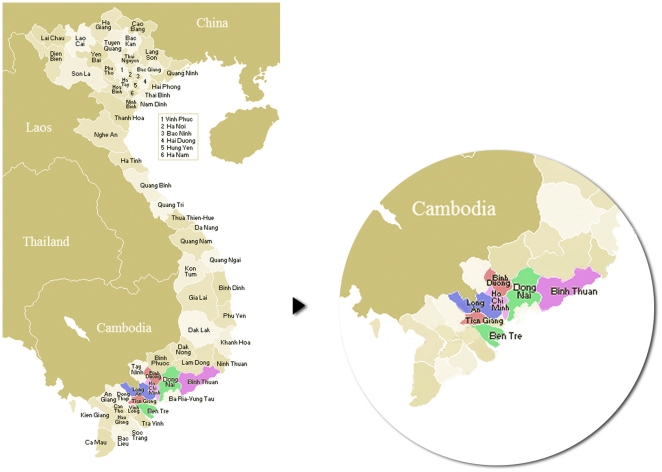
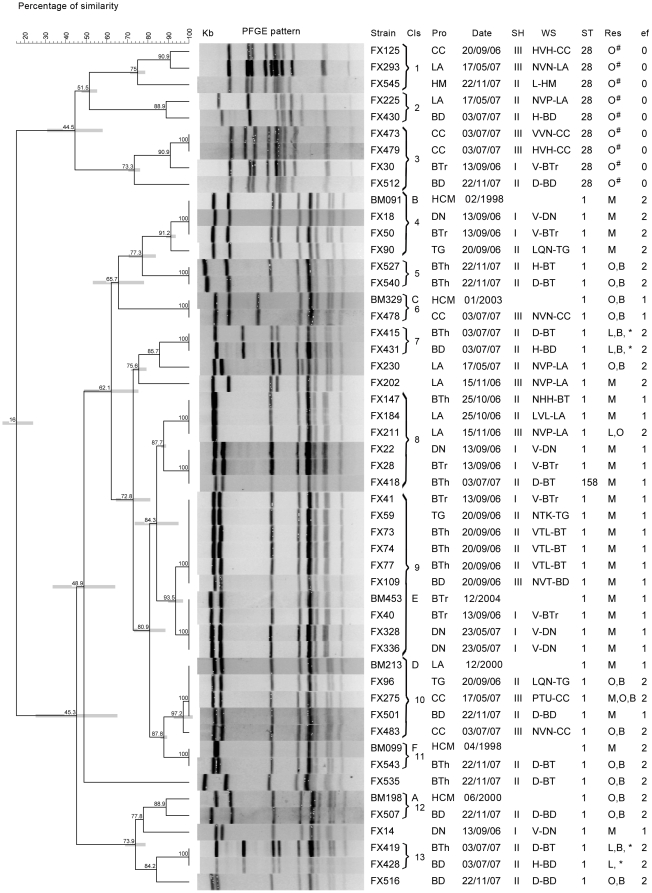
Streptococcus suis is a pathogen of major economic significance to the swine industry and is increasingly recognized as an emerging zoonotic agent in Asia. In Vietnam, S. suis is the leading cause of bacterial meningitis in adult humans. Zoonotic transmission is most frequently associated with serotype 2 strains and occupational exposure to pigs or consumption of infected pork. To gain insight into the role of pigs for human consumption as a reservoir for zoonotic infection in southern Vietnam, we determined the prevalence and diversity of S. suis carriage in healthy slaughterhouse pigs. Nasopharyngeal tonsils were sampled from pigs at slaughterhouses serving six provinces in southern Vietnam and Ho Chi Minh City area from September 2006 to November 2007. Samples were screened by bacterial culture. Isolates of S. suis were serotyped and characterized by multi locus sequence typing (MLST) and pulse field gel electrophoresis (PFGE). Antibiotic susceptibility profiles and associated genetic resistance determinants, and the presence of putative virulence factors were determined. 41% (222/542) of pigs carried S. suis of one or multiple serotypes. 8% (45/542) carried S. suis serotype 2 which was the most common serotype found (45/317 strains, 14%). 80% of serotype 2 strains belonged to the MLST clonal complex 1,which was previously associated with meningitis cases in Vietnam and outbreaks of severe disease in China in 1998 and 2005. These strains clustered with representative strains isolated from patients with meningitis in PFGE analysis, and showed similar antimicrobial resistance and virulence factor profiles. Slaughterhouse pigs are a major reservoir of S. suis serotype 2 capable of causing human infection in southern Vietnam. Strict hygiene at processing facilities, and health education programs addressing food safety and proper handling of pork should be encouraged.
Conflict of interest statement
Figures
References
-
- Gottschalk M, Segura M, Xu J. Streptococcus suis infections in humans: the Chinese experience and the situation in North America. Anim Health Res Rev. 2007;8:29–45. - PubMed
-
- Mai NT, Hoa NT, Nga TV, Linh le D, Chau TT, et al. Streptococcus suis meningitis in adults in Vietnam. Clin Infect Dis. 2008;46:659–667. - PubMed
-
- Wisselink HJ, Smith HE, Stockhofe-Zurwieden N, Peperkamp K, Vecht U. Distribution of capsular types and production of muramidase-released protein (MRP) and extracellular factor (EF) of Streptococcus suis strains isolated from diseased pigs in seven European countries. Vet Microbiol. 2000;74:237–248. - PubMed
-
- Gottschalk M, Xu J, Lecours MP, Grenier D, Fittipaldi N, et al. Streptococcus suis Infections in Humans: What is the prognosis for Western countries? (Part II). Clinical Microbiology Newsletter. 2010b;32:97–102.
Publication types
MeSH terms
Grants and funding
LinkOut - more resources
Full Text Sources
Other Literature Sources
Medical
