


Expression of Siglec-11 by human and chimpanzee ovarian stromal cells, with uniquely human ligands: implications for human ovarian physiology and pathology
- PMID: 21467073
- PMCID: PMC3130538
- DOI: 10.1093/glycob/cwr039
Expression of Siglec-11 by human and chimpanzee ovarian stromal cells, with uniquely human ligands: implications for human ovarian physiology and pathology
Abstract
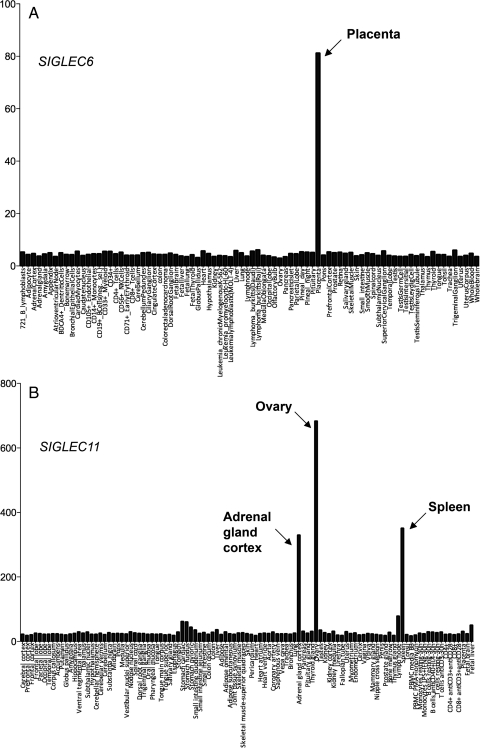
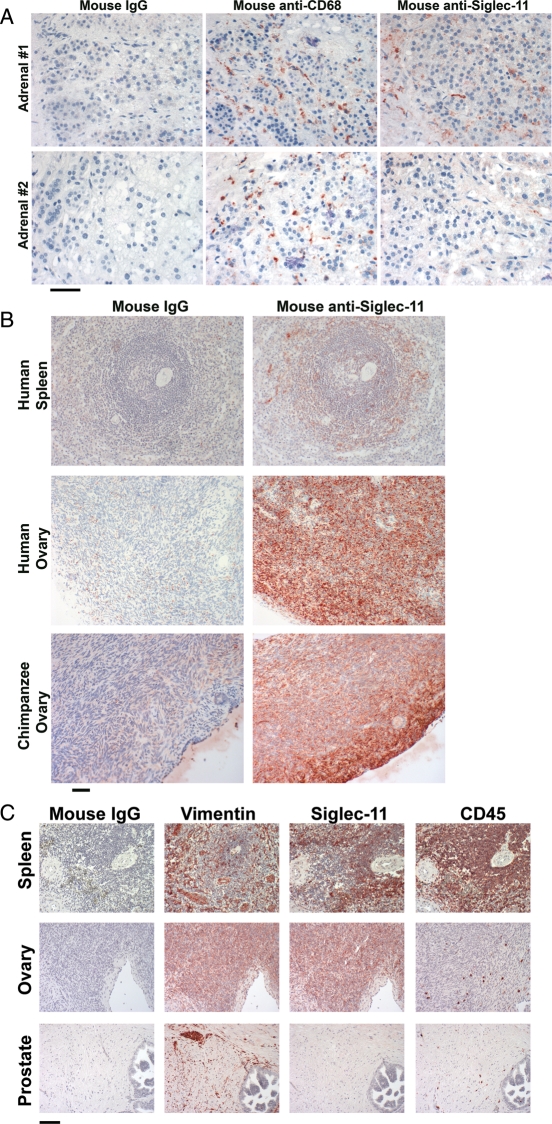
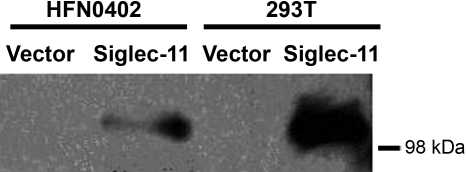
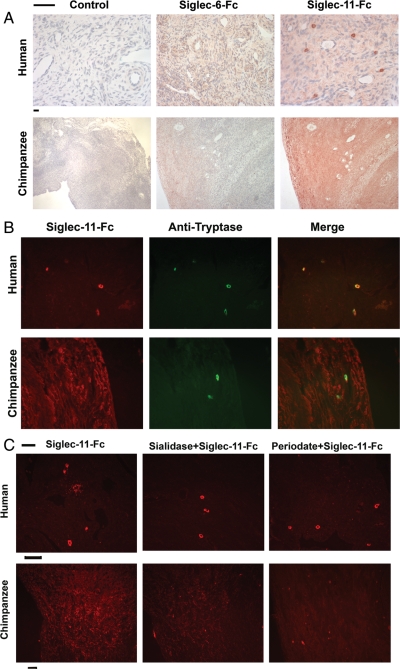
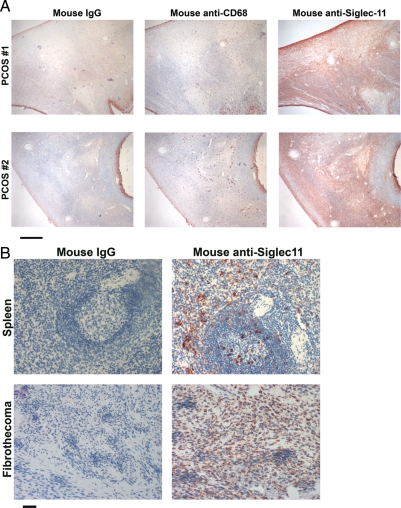
Siglecs (Sialic acid-binding Immunoglobulin Superfamily Lectins) are cell surface signaling receptors of the I-type lectin group that recognize sialic acid-bearing glycans. CD33-related-Siglecs are a subset with expression primarily in cells of hematopoietic origin and functional relevance to immune reactions. Earlier we reported a human-specific gene conversion event that markedly changed the coding region for the extracellular domain of Siglec-11, associated with human-specific expression in microglia (Hayakawa T, Angata T, Lewis AL, Mikkelsen TS, Varki NM, Varki A. 2005. A human-specific gene in microglia. Science. 309:1693). Analyzing human gene microarrays to define new patterns of expression, we observed high levels of SIGLEC11 transcript in the ovary and adrenal cortex. Thus, we examined human and chimpanzee tissues using a well-characterized anti-Siglec-11 mouse monoclonal antibody. Although adrenal expression was variable and confined to infiltrating macrophages in capillaries, ovarian expression of Siglec-11 in both humans and chimpanzees was on fibroblasts, the first example of Siglec expression on mesenchyme-derived stromal cells. Cytokines from such ovarian stromal fibroblasts play important roles in follicle development and ovulation. Stable transfection of SIGLEC11 into a primary human ovarian stromal fibroblast cell line altered the secretion of growth-regulated oncogene α, interleukin (IL)-10, IL-7, transforming growth factor β1 and tumor necrosis factor-α, cytokines involved in ovarian physiology. Probing for Siglec-11 ligands revealed distinct and strong mast cell expression in human ovaries, contrasting to diffuse stromal ligands in chimpanzee ovaries. Interestingly, there was a trend of increased Siglec-11 expression in post-menopausal ovaries compared with pre-menopausal ones. Siglec-11 expression was also found on human ovarian stromal tumors and in polycystic ovarian syndrome, a human-specific disease. These results indicate potential roles for Siglec-11 in ovarian physiology and human evolution.
Figures
References
-
- Abbott DH, Bird IM. Nonhuman primates as models for human adrenal androgen production: Function and dysfunction. Rev Endocr Metab Disord. 2009;10:33–42. doi:10.1007/s11154-008-9099-8. - DOI - PMC - PubMed
-
- Abbott DH, Zhou R, Bird IM, Dumesic DA, Conley AJ. Fetal programming of adrenal androgen excess: Lessons from a nonhuman primate model of polycystic ovary syndrome. Endocr Dev. 2008;13:145–158. doi:10.1159/000134831. - DOI - PMC - PubMed
-
- Angata T, Kerr SC, Greaves DR, Varki NM, Crocker PR, Varki A. Cloning and characterization of human Siglec-11. A recently evolved signaling molecule that can interact with SHP-1 and SHP-2 and is expressed by tissue macrophages, including brain microglia. J Biol Chem. 2002;277:24466–24474. doi:10.1074/jbc.M202833200. - DOI - PubMed
-
- Angata T, Margulies EH, Green ED, Varki A. Large-scale sequencing of the CD33-related Siglec gene cluster in five mammalian species reveals rapid evolution by multiple mechanisms. Proc Natl Acad Sci USA. 2004;101:13251–13256. doi:10.1073/pnas.0404833101. - DOI - PMC - PubMed
-
- Atsalis S, Videan E. Reproductive aging in captive and wild common chimpanzees: Factors influencing the rate of follicular depletion. Am J Primatol. 2009;71:271–282. doi:10.1002/ajp.20650. - DOI - PubMed
Publication types
MeSH terms
Substances
Grants and funding
LinkOut - more resources
Full Text Sources
Molecular Biology Databases
