


Complex regulation of GH autofeedback under dual-peptide drive: studies under a pharmacological GH and sex steroid clamp
- PMID: 21467302
- PMCID: PMC3118586
- DOI: 10.1152/ajpendo.00054.2011
Complex regulation of GH autofeedback under dual-peptide drive: studies under a pharmacological GH and sex steroid clamp
Abstract
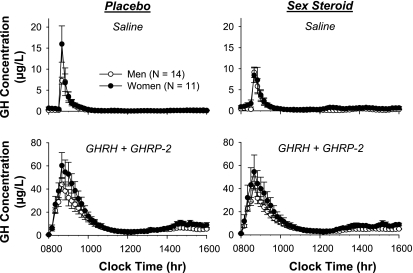
To test the postulate that sex difference, sex steroids, and peptidyl secretagogues control GH autofeedback, 11 healthy postmenopausal women and 14 older men were each given 1) a single iv pulse of GH to enforce negative feedback and 2) continuous iv infusion of saline vs. combined GHRH/GHRP-2 to drive feedback escape during pharmacological estradiol (E(2); women) or testosterone (T; men) supplementation vs. placebo in a double-blind, prospectively randomized crossover design. By three-way ANCOVA, sex difference, sex hormone treatment, peptide stimulation, and placebo/saline responses (covariate) controlled total (integrated) GH recovery during feedback (each P < 0.001). Both sex steroid milieu (P = 0.019) and dual-peptide stimulation (P < 0.001) determined nadir (maximally feedback-suppressed) GH concentrations. E(2)/T exposure elevated nadir GH concentrations during saline infusion (P = 0.003), whereas dual-peptide infusion did so independently of T/E(2) and sex difference (P = 0.001). All three of sex difference (P = 0.001), sex steroid treatment (P = 0.005), and double-peptide stimulation (P < 0.001) augmented recovery of peak (maximally feedback-escaped) GH concentrations. Peak GH responses to dual-peptidyl agonists were greater in women than in men (P = 0.016). E(2)/T augmented peak GH recovery during saline infusion (P < 0.001). Approximate entropy analysis corroborated independent effects of sex steroid treatment (P = 0.012) and peptide infusion (P < 0.001) on GH regularity. In summary, sex difference, sex steroid supplementation, and combined peptide drive influence nadir, peak, and entropic measurements of GH release under controlled negative feedback. To the degree that the pharmacological sex steroid, GH, and dual-peptide clamps provide prephysiological regulatory insights, these outcomes suggest major determinants of pulsatile GH secretion in the feedback domain.
Figures


References
-
- Aguila MC, Boggaram V, McCann SM. Insulin-like growth factor-I modulates hypothalamic somatostatin through growth hormone releasing-factor increased somatostatin release and messenger ribonucleic acid levels. Brain Res 625: 213–218, 1993 - PubMed
-
- Anderson SM, Shah N, Evans WS, Patrie JT, Bowers CY, Veldhuis JD. Short-term estradiol supplementation augments growth hormone (GH) secretory responsiveness to dose-varying GH-releasing peptide infusions in healthy postmenopausal women. J Clin Endocrinol Metab 86: 551–560, 2001 - PubMed
-
- Arvat E, Ceda GP, Di Vito L, Ramunni J, Gianotti L, Broglio F, Deghenghi R, Ghigo E. Age-related variations in the neuroendocrine control, more than impaired receptor sensitivity, cause the reduction in the GH-releasing activity of GHRPs in human aging. Pituitary 1: 51–58, 1998 - PubMed
-
- Barinaga M, Bilezikjian LM, Vale WW, Rosenfeld MG, Evans RM. Independent effects of growth hormone releasing factor on growth hormone release and gene transcription. Nature 314: 279–281, 1985 - PubMed
-
- Bowers CY. Synergistic release of growth hormone by GHRP and GHRH: scope and implication. In: Growth Hormone Secretagogues in Clinical Practice, edited by Bercu BB, Walker RF. New York: Marcel Dekker, 1998, p. 1–25
Publication types
MeSH terms
Substances
Grants and funding
LinkOut - more resources
Full Text Sources
