. 2011 May 18;30(10):1977-89.
doi: 10.1038/emboj.2011.94. Epub 2011 Apr 5.

Analysis of the host microRNA response to Salmonella uncovers the control of major cytokines by the let-7 family

Affiliations

Analysis of the host microRNA response to Salmonella uncovers the control of major cytokines by the let-7 family

Leon N Schulte et al. EMBO J. .

Abstract

MicroRNAs have well-established roles in eukaryotic host responses to viruses and extracellular bacterial pathogens. In contrast, microRNA responses to invasive bacteria have remained unknown. Here, we report cell type-dependent microRNA regulations upon infection of mammalian cells with the enteroinvasive pathogen, Salmonella Typhimurium. Murine macrophages strongly upregulate NF-κB associated microRNAs; strikingly, these regulations which are induced by bacterial lipopolysaccharide (LPS) occur and persist regardless of successful host invasion and/or replication, or whether an inflammatory response is mounted, suggesting that microRNAs belong to the first line of anti-bacterial defence. However, a suppression of the global immune regulator miR-155 in endotoxin-tolerant macrophages revealed that microRNA responses also depend on the status of infected cells. This study identifies the let-7 family as the common denominator of Salmonella-regulated microRNAs in macrophages and epithelial cells, and suggests that repression of let-7 relieves cytokine IL-6 and IL-10 mRNAs from negative post-transcriptional control. Our results establish a paradigm of microRNA-mediated feed-forward activation of inflammatory factors when mammalian cells are targeted by bacterial pathogens.


Conflict of interest statement

The authors declare that they have no conflict of interest.

Figures
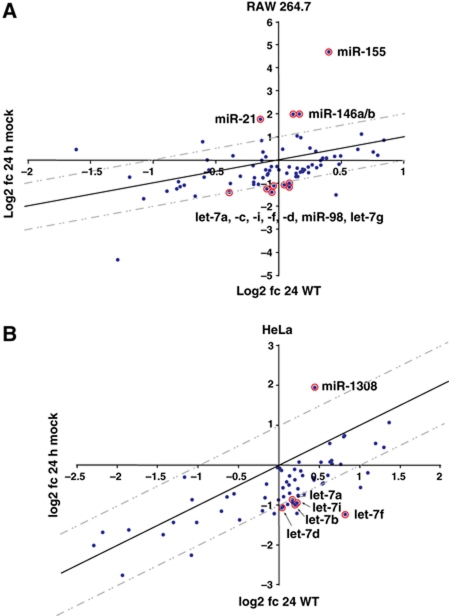
Figure 1
Figure 1
Salmonella infection regulates host microRNA expression in (A) RAW 264.7 and (B) HeLa cells. Small RNA libraries of uninfected cells at 0 h, cells infected with wild-type Salmonella at 24 h p.i. and mock-treated cells at 24 h p.i., were analysed by 454 sequencing, and microRNA expression changes were calculated by comparison of cDNA hits in the libraries (24 h infection versus 0 h and 24 h mock versus 0 h). The graphs show log2 fold changes in infected cells (y axis) versus log2 fold changes in mock-treated cells (x axis).
Figure 2
Figure 2
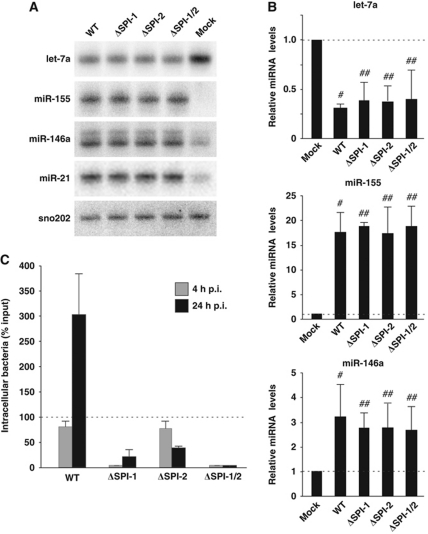
Expression of let-7 microRNAs is downregulated upon Salmonella infection. (A) Northern blot analysis of let-7a, miR-155, miR-146a and miR-21 expression in RAW 264.7 cells after 24 h of mock treatment or infection with Salmonella wild type, or with mutants defective in invasion (ΔSPI-1), intracellular replication (ΔSPI-2) or both (ΔSPI-1/2). (B) qRT–PCR analysis of expression changes of let-7a, miR-155 and miR-146a in RAW 264.7 cells as above. Mean values±s.d. from three independent experiments are shown. (C) Invasion/infection assays performed in RAW 264.7 cells with Salmonella wild type and the three virulence mutants. Bacteria were enumerated at 4 and 24 h p.i. Mean values±s.d. from three independent experiments are shown. #Significant difference between wild-type infection and mock control (P-value <0.05). ##No significant difference compared with wild-type infection (P-value >0.05).
Figure 3
Figure 3
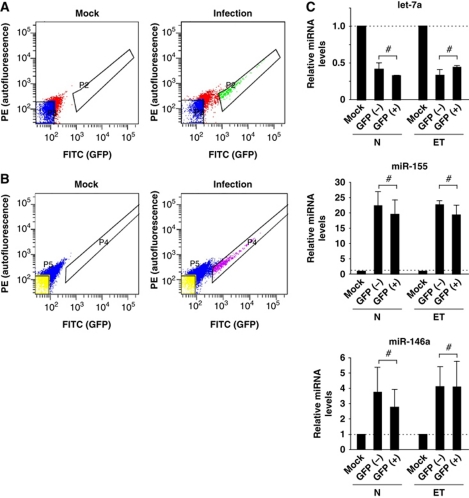
An extracellular Salmonella stimulus is sufficient to induce a microRNA response in the host cells. (A) Naive (N) and (B) endotoxin-tolerant (ET) RAW 264.7 cells were infected with Salmonella expressing GFP. At 24 h p.i., the fraction of cells with internalized bacteria (GFP+) were sorted from the uninfected cells (GFP−) by FACS. (C) qRT–PCR analysis of expression changes of let-7a, miR-155 and miR-146a in the infected (GFP+) and uninfected (GFP−) RAW 264.7 cells. Mean values±s.d. from three independent experiments are shown. #No significant difference between GFP+ and GFP− fraction (P-value>0.05).
Figure 4
Figure 4
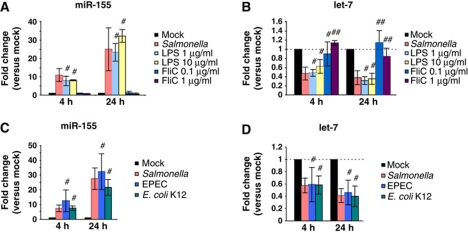
Regulation of miR-155 and let-7 can be recapitulated with purified Salmonella LPS and pathogenic/non-pathogenic Escherichia coli. Expression changes of (A) miR-155 and (B) let-7a upon stimulation of RAW 264.7 cells with the indicated concentrations of LPS and FliC or wild-type Salmonella as determined by qRT–PCR. Expression changes of (C) miR-155 and (D) let-7a upon challenge of RAW 264.7 cells with wild-type Salmonella, enteropathogenic E. coli (EPEC) or non-pathogenic E. coli K12 as determined by qRT–PCR. Mean values±s.d. from three independent experiments are shown. #No significant difference compared with Salmonella infection (P-value>0.05). ##Significant difference compared with Salmonella infection (P-value <0.05).
Figure 5
Figure 5
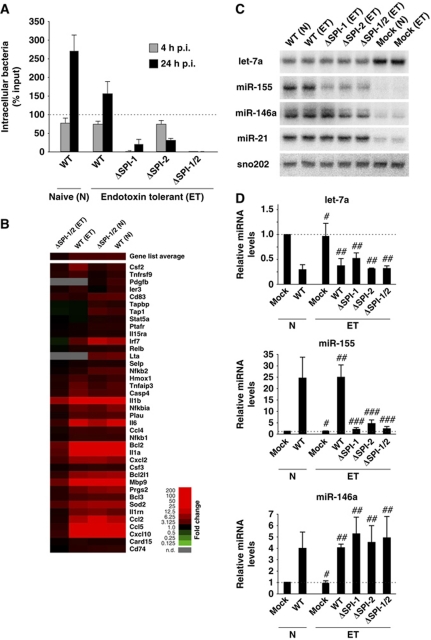
Salmonella infection induces host microRNA responses in naive (N) and endotoxin-tolerant (ET) macrophages. (A) Invasion/infection assays performed in ET RAW 264.7 cells with Salmonella wild type and the ΔSPI-1, ΔSPI-2, ΔSPI-1/2 mutants. Infection rates were determined at 4 and 24 h post infection. The result of the corresponding assays for naive macrophages infected with wild-type bacteria is shown for comparison. (B) Microarray expression analysis of selected NF-κB-dependent genes in naive and ET RAW 264.7 cells infected with Salmonella wild type and the ΔSPI-1/2 mutant compared with the respective mock-infected cells. The relative expression level of each mRNA is colour-coded, as indicated to the right. (C) Northern blot analysis of let-7a, miR-155, miR-146a and miR-21 expression in ET RAW 264.7 cells infected for 24 h with the bacteria indicated. (D) Corresponding qRT–PCR analysis of expression changes of let-7a, miR-155 and miR-146a. Mean values±s.d. from three independent experiments are shown. #No significant difference between naive and ET mock controls (P-value>0.05); ##no significant difference compared with naive wild-type infection (P-value>0.05); ###significant difference compared with naive wild-type infection (P-value <0.05).
Figure 6
Figure 6
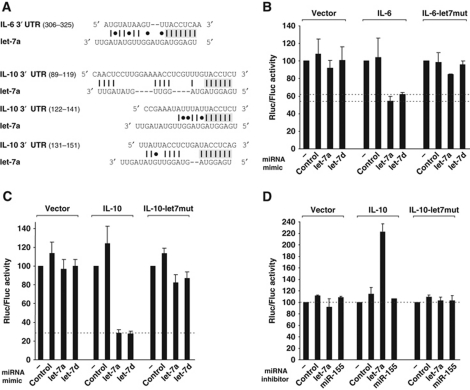
let-7 microRNA family targets the cytokines IL-6 and IL-10. (A) Schematic representation of let-7a complementarity to the 3′ UTRs of IL-6 or IL-10. Shaded regions denote the IL-6 or IL-10 sequences that were deleted or mutated in the reporter vector below. (B, C) MEF cells were transfected with a mixture containing the psicheck2 plasmid (vector) or the Renilla luciferase reporter plasmids carrying the 3′ UTRs of IL-6 or IL-10, or mutants thereof (indicated above the graphs), in combination with microRNA mimics. (D) Same experiment as in (C) but using microRNA inhibitors instead of mimics. Renilla luciferase activity is normalized to that of the Firefly luciferase and set to 100 in cells with no microRNA mimic or inhibitor. Mean values±s.d. from three independent experiments are shown.
Figure 7
Figure 7
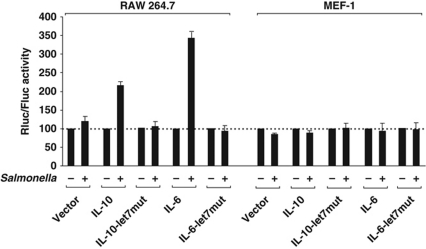
Salmonella infection post-transcriptionally activates expression of IL-6 and IL-10. RAW 264.7 and MEF cells were transfected with the empty psicheck2 plasmid (vector) or luciferase reporters carrying the IL-6 or IL-10 3′ UTRs, or mutants. After 24 h, the cells were mock infected or infected for 24 h with Salmonella wild type before reporter activity was assayed. Renilla and Firefly luciferase activity were analysed as described in Figure 6.

Comment in

References

    1. Androulidaki A, Iliopoulos D, Arranz A, Doxaki C, Schworer S, Zacharioudaki V, Margioris AN, Tsichlis PN, Tsatsanis C (2009) The kinase Akt1 controls macrophage response to lipopolysaccharide by regulating microRNAs. Immunity 31: 220–231 - PMC - PubMed
    1. Arai T, Hiromatsu K, Nishimura H, Kimura Y, Kobayashi N, Ishida H, Nimura Y, Yoshikai Y (1995a) Effects of in vivo administration of anti-IL-10 monoclonal antibody on the host defence mechanism against murine Salmonella infection. Immunology 85: 381–388 - PMC - PubMed
    1. Arai T, Hiromatsu K, Nishimura H, Kimura Y, Kobayashi N, Ishida H, Nimura Y, Yoshikai Y (1995b) Endogenous interleukin 10 prevents apoptosis in macrophages during Salmonella infection. Biochem Biophys Res Commun 213: 600–607 - PubMed
    1. Asirvatham AJ, Gregorie CJ, Hu Z, Magner WJ, Tomasi TB (2008) MicroRNA targets in immune genes and the Dicer/Argonaute and ARE machinery components. Mol Immunol 45: 1995–2006 - PMC - PubMed
    1. Baltimore D, Boldin MP, O’Connell RM, Rao DS, Taganov KD (2008) MicroRNAs: new regulators of immune cell development and function. Nat Immunol 9: 839–845 - PubMed

Publication types

MeSH terms