. 2011 Jul 15;184(2):224-32.
doi: 10.1164/rccm.201012-2061OC. Epub 2011 Mar 11.

Circulating endothelial microparticles as a measure of early lung destruction in cigarette smokers

Affiliations

Circulating endothelial microparticles as a measure of early lung destruction in cigarette smokers

Cynthia Gordon et al. Am J Respir Crit Care Med. .

Abstract

Rationale: There is increasing evidence that emphysema is associated with primary loss of pulmonary capillary endothelium. Plasma levels of endothelial microparticles (EMPs), small vesicles released from activated or apoptotic endothelial cells, are elevated in vascular-related disorders.

Objectives: To evaluate whether plasma EMP levels are elevated in smokers with early lung destruction as assessed by normal spirometry but reduced diffusing capacity of the lung for carbon monoxide (Dl(co)).

Methods: Lung health was assessed by pulmonary function tests (PFTs: spirometry, total lung capacity, Dl(co)) and chest X-ray; smoking status was assessed by urine nicotine and cotinine. EMP levels (CD42b(-)CD31(+) microparticles) were quantified as activated or apoptotic. The initial cohort (n = 92) included healthy nonsmokers (normal PFTs), healthy smokers (normal PFTs), and smokers with early evidence of lung destruction (normal spirometry, low Dl(co)). Two prospective cohorts were then tested: a group similar to the initial cohort and an HIV1(+) cohort.

Measurements and main results: Healthy smokers had mildly increased levels of EMPs. Strikingly, 95% of smokers with normal spirometry, low Dl(co) had increased EMPs, with reduced CD62(+)/CD31(+) ratios (P < 10(-4)) and elevated CD42b(-)CD31(+) annexin V(+) EMPs (P < 10(-4)), suggesting derivation from endothelial apoptosis. Most elevated EMPs were angiotensin-converting enzyme positive, suggesting derivation from pulmonary capillaries. Both prospective cohorts confirmed the initial cohort data.

Conclusions: Plasma EMPs with apoptotic characteristics are elevated in smokers with normal spirometry but reduced Dl(co), consistent with the concept that emphysema is associated, in part, with capillary endothelium apoptosis, suggesting that the early development of emphysema might be monitored with plasma EMP levels.


Figures
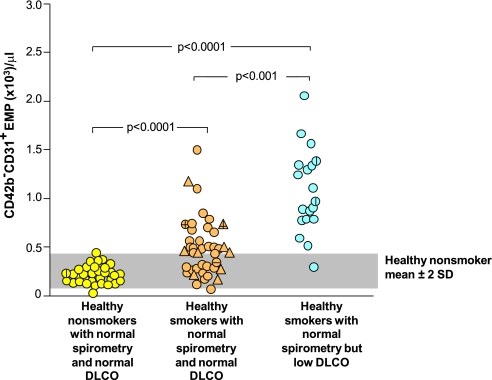
Figure 1.
Figure 1.
Levels of CD42bCD31+ endothelial microparticles (EMPs) per μl in platelet-poor plasma of the study groups. Shown are data for healthy nonsmokers with normal spirometry and normal diffusing capacity of the lung for carbon monoxide (DlCO) (n = 32, yellow circles), healthy smokers with normal spirometry and normal DlCO (combining asymptomatic smokers, n = 32, tan circles, and symptomatic smokers, n = 9, tan triangles), and healthy smokers with normal spirometry and low DlCO (n = 19, blue circles). P values are indicated. For all groups, a vertical line indicates a subject with systemic hypertension, a horizontal line indicates a subject with type 2 diabetes mellitus. The gray shaded area indicates the mean ± 2 SD of CD42bCD31+ EMP/ml platelet of healthy nonsmokers.
Figure 2.
Figure 2.
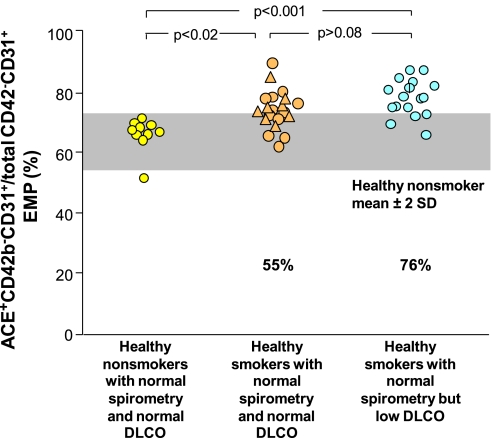
Proportion of CD42bCD31+ endothelial microparticles (EMPs) that express angiotensin-converting enzyme (ACE+). Shown are data for healthy nonsmokers with normal spirometry and normal diffusing capacity of the lung for carbon monoxide (DlCO) (n = 10, yellow circles), healthy smokers with normal spirometry and normal DlCO (combining asymptomatic smokers, n = 12, tan circles, and symptomatic smokers, n = 8, tan triangles), and healthy smokers with normal spirometry and low DlCO (n = 17, blue circles). P values are indicated. For all groups, a vertical line indicates the subject has systemic hypertension. Gray shaded area represents range ± 2 SD of healthy nonsmokers. The % values represent the proportion of individuals in that group who had higher levels of CD42bCD31+ACE+ EMPs beyond the level observed for healthy nonsmokers.
Figure 3.
Figure 3.
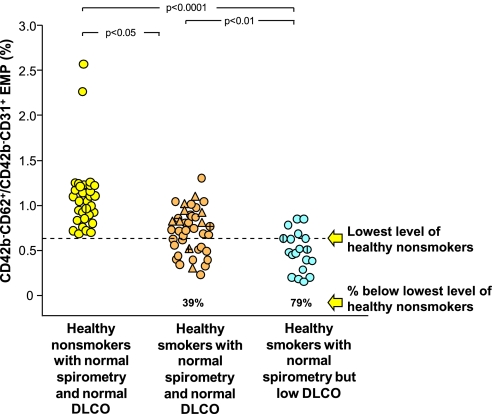
Ratio of circulating CD42bCD62+ to CD42bCD31+ endothelial microparticles (EMPs) in plasma of healthy nonsmokers with normal spirometry and normal diffusing capacity of the lung for carbon monoxide (DlCO) (n = 32, yellow circles), healthy smokers with normal spirometry and normal DlCO (combining healthy smokers, n = 32, tan circles, and symptomatic smokers, n = 9, tan triangles), and healthy smokers with normal spirometry and low DlCO (n = 19, blue circles). P values are indicated. For all groups, a vertical line indicates the subject has systemic hypertension, a horizontal line indicates the subject has type 2 diabetes mellitus. The dashed line represents the value below any subject in the healthy nonsmoker group. The % values below represent the proportion of individuals in that group below the lowest level of healthy nonsmokers.
Figure 4.
Figure 4.
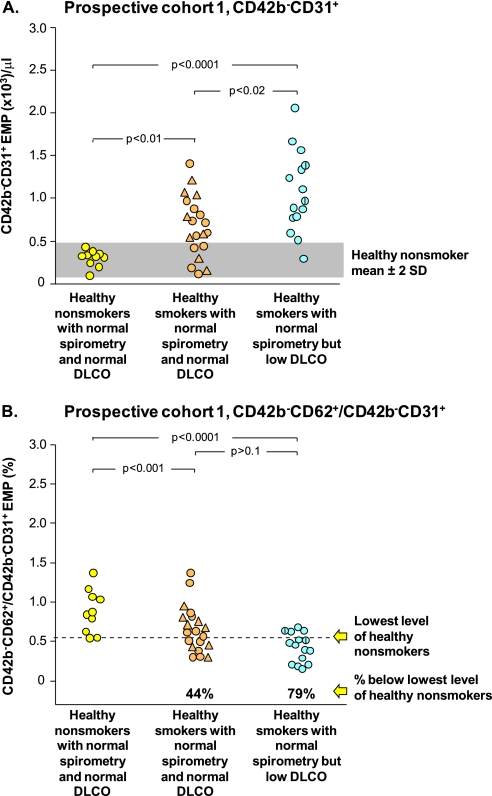
Prospective study cohort 1: plasma endothelial microparticles (EMPs) in a prospective group of healthy nonsmokers with normal spirometry and normal diffusing capacity of the lung for carbon monoxide (DlCO) (n = 10, yellow circles), healthy smokers with normal spirometry and normal DlCO (combining healthy smokers, n = 12, tan circles, and symptomatic smokers, n = 8, tan triangles), and healthy smokers with normal spirometry and low DlCO (n = 15, blue circles). P values are indicated. For all groups, a vertical line indicates the subject has systemic hypertension. (A) Levels of CD42bCD31+ EMPs in platelet-poor plasma of the study groups. (B) Ratio of circulating CD42bCD62+ to CD42bCD31+ EMPs in plasma of study groups. The dashed line represents the value below any subject in the healthy nonsmoker group; the % values below represent the proportion of that group below the lowest level of healthy nonsmokers.
Figure 5.
Figure 5.
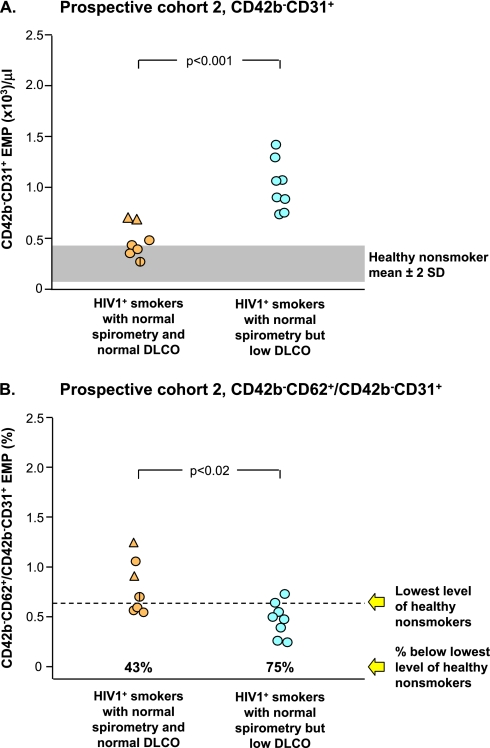
Prospective study cohort 2: endothelial microparticles (EMPs) in a prospective group of HIV1+ healthy smokers with normal spirometry and normal diffusing capacity of the lung for carbon monoxide (DlCO) (combining healthy smokers, n = 5, tan circles, and symptomatic smokers, n = 2, tan triangles) and HIV1+ healthy smokers with normal spirometry and low DlCO (n = 8, blue circles). P values are indicated. For all groups, a vertical line indicates the subject has systemic hypertension. (A) Levels of CD42bCD31+ EMPs in platelet-poor plasma of the study groups. (B) Ratio of circulating CD42bCD62+ to CD42bCD31+ EMPs in plasma of study groups. The dashed line represents the value below any subject in the healthy nonsmoker group; the % values below represent the proportion of that group below the lowest level of healthy nonsmokers.

Comment in

References

    1. Weibel ER. Morphological basis of alveolar-capillary gas exchange. Physiol Rev 1973;53:419–495 - PubMed
    1. Hogg JC, Senior RM. Chronic obstructive pulmonary disease - part 2: pathology and biochemistry of emphysema. Thorax 2002;57:830–834 - PMC - PubMed
    1. Barnes PJ. Mediators of chronic obstructive pulmonary disease. Pharmacol Rev 2004;56:515–548 - PubMed
    1. Spurzem JR, Rennard SI. Pathogenesis of COPD. Semin Respir Crit Care Med 2005;26:142–153 - PubMed
    1. Abboud RT, Vimalanathan S. Pathogenesis of COPD. Part I. The role of protease-antiprotease imbalance in emphysema. Int J Tuberc Lung Dis 2008;12:361–367 - PubMed

Publication types

MeSH terms