


Active and passive cigarette smoking and acute lung injury after severe blunt trauma
- PMID: 21471091
- PMCID: PMC3136993
- DOI: 10.1164/rccm.201011-1802OC
Active and passive cigarette smoking and acute lung injury after severe blunt trauma
Abstract
Rationale: Cigarette smoking has been demonstrated in laboratory studies to have effects on lung epithelial and endothelial function similar to those observed in acute lung injury (ALI). However, the association between active and passive cigarette smoke exposure and susceptibility to ALI has not been prospectively studied.
Objectives: We hypothesized that both active and passive cigarette smoke exposure would be associated with increased susceptibility to ALI after severe blunt trauma.
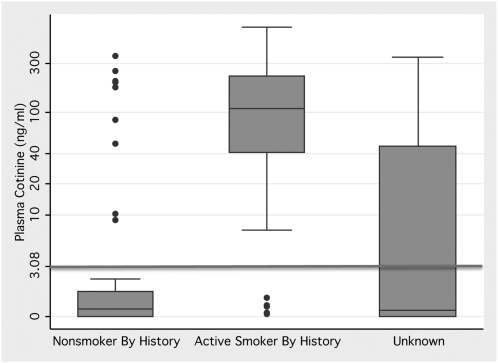
Methods: We measured levels of cotinine, a metabolite of nicotine and validated biomarker of tobacco use, in plasma samples obtained immediately on arrival at the emergency department from 144 adult subjects after severe blunt trauma. Patients were then followed for the development of ALI.
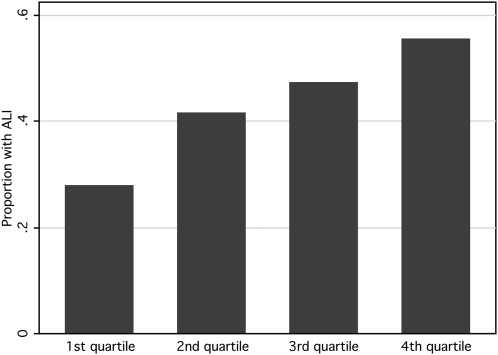
Measurements and main results: Increasing quartiles of plasma cotinine were associated with the development of ALI (odds ratio [OR] for developing ALI in highest cotinine quartile, 3.25; 95% confidence interval [CI], 1.22-8.68; P = 0.017 for trend across quartiles). Moderate to heavy passive smoke exposure was associated with nearly the same odds of developing ALI as active smoking (OR for moderate to heavy passive smoking compared with no exposure or low level exposure, 3.03; 95% CI, 1.15-8.04; OR for active smoking, 2.77; 95% CI, 1.28-5.99). This association persisted after adjusting for other predictors of ALI, including Injury Severity Score and alcohol abuse.
Conclusions: Both moderate to heavy passive smoking and active smoking are independently associated with the development of ALI after severe blunt trauma. This finding has important implications both for public health and for understanding the pathogenesis of ALI.
Figures
Comment in
-
Susceptibility to acute lung injury after severe blunt trauma and its dependence on previous tobacco smoke exposure: does dose really matter?Am J Respir Crit Care Med. 2011 Jun 15;183(12):1580-1. doi: 10.1164/rccm.201103-0508ED. Am J Respir Crit Care Med. 2011. PMID: 21693711 No abstract available.
References
-
- Rubenfeld GD, Caldwell E, Peabody E, Weaver J, Martin DP, Neff M, Stern EJ, Hudson LD. Incidence and outcomes of acute lung injury. N Engl J Med 2005;353:1685–1693. - PubMed
-
- Shah CV, Localio AR, Lanken PN, Kahn JM, Bellamy S, Gallop R, Finkel B, Gracias VH, Fuchs BD, Christie JD. The impact of development of acute lung injury on hospital mortality in critically ill trauma patients. Crit Care Med 2008;36:2309–2315. - PubMed
-
- Moss M, Parsons PE, Steinberg KP, Hudson LD, Guidot DM, Burnham EL, Eaton S, Cotsonis GA. Chronic alcohol abuse is associated with an increased incidence of acute respiratory distress syndrome and severity of multiple organ dysfunction in patients with septic shock. Crit Care Med 2003;31:869–877. - PubMed
-
- Christenson JT, Aeberhard JM, Badel P, Pepcak F, Maurice J, Simonet F, Velebit V, Schmuziger M. Adult respiratory distress syndrome after cardiac surgery. Cardiovasc Surg 1996;4:15–21. - PubMed
Publication types
MeSH terms
Substances
Grants and funding
LinkOut - more resources
Full Text Sources
Other Literature Sources
Medical
