


Laboratory and clinical evaluation of screening agar plates for detection of carbapenem-resistant Enterobacteriaceae from surveillance rectal swabs
- PMID: 21471338
- PMCID: PMC3122751
- DOI: 10.1128/JCM.02566-10
Laboratory and clinical evaluation of screening agar plates for detection of carbapenem-resistant Enterobacteriaceae from surveillance rectal swabs
Abstract
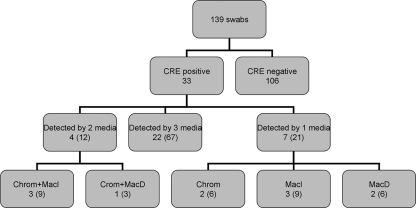
The increased worldwide spread of carbapenem-resistant Enterobacteriaceae (CRE) emphasizes the need for a sensitive screening procedure to identify these microorganisms. Gastrointestinal carriers may serve as the reservoir for cross-transmission in the health care setting, and thus active surveillance is a key part in preventing the spread of such strains. Three agar-based methods for direct CRE detection from rectal swabs were compared: CHROMagar-KPC (Chrom); MacConkey agar with imipenem at 1 μg/ml (MacI); and MacConkey plates with imipenem, meropenem, and ertapenem disks (MacD). First, we compared the levels of detection (LODs) of 10 molecularly characterized carbapenemase-producing Enterobacteriaceae strains by the three methods. Second, we compared their performance in a surveillance study using rectal swabs (n = 139). The LODs of carbapenemase-producing Enterobacteriaceae strains were influenced by their MICs to carbapenems and were best for MacI, followed by Chrom. The MacD method was able to detect only the strains exhibiting MICs of ≥ 32 μg/ml to at least ertapenem. In the surveillance study, both Chrom and MacI had greater sensitivity (85%) than MacD (76%). However, MacI was the most specific method. In conclusion, MacI appears to be most appropriate medium for the detection of CRE in settings in which multiclonal CRE strains with various MICs to carbapenems are circulating.
Figures
References
-
- Bilavsky E., Schwaber M. J., Carmeli Y. 2010. How to stem the tide of carbapenemase-producing enterobacteriaceae?: proactive versus reactive strategies. Curr. Opin. Infect. Dis. 23:327–331 - PubMed
-
- Calfee D., Jenkins S. G. 2008. Use of active surveillance cultures to detect asymptomatic colonization with carbapenem-resistant Klebsiella pneumoniae in intensive care unit patients. Infect. Control Hosp. Epidemiol. 29:966–968 - PubMed
-
- Clinical and Laboratory Standards Institute 2010. Performance standards for antimicrobial susceptibility testing; 20th informational supplement. Approved standard MS100-S20. Clinical and Laboratory Standards Institute, Wayne, PA
Publication types
MeSH terms
Substances
LinkOut - more resources
Full Text Sources
Other Literature Sources
Medical
